

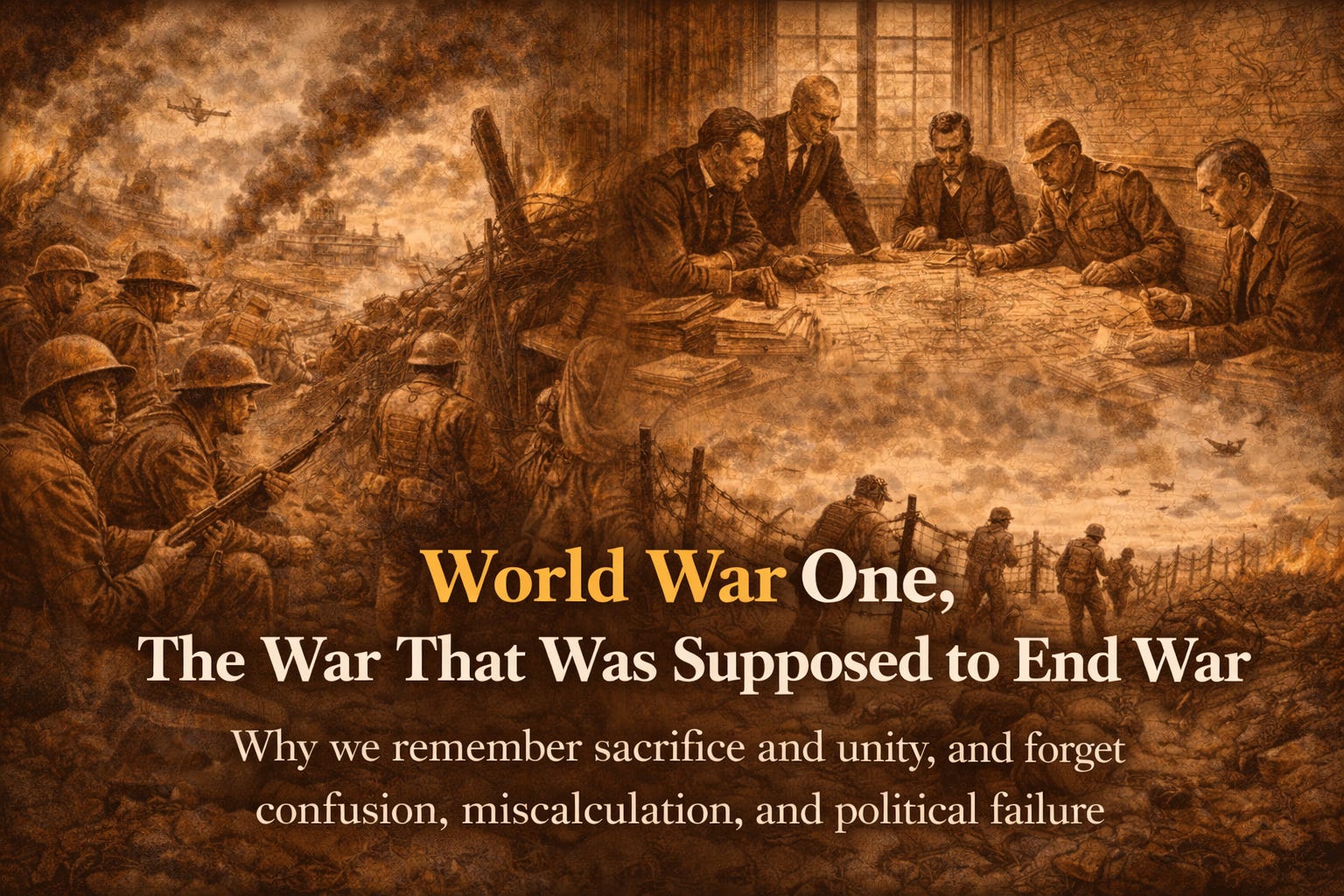
If a modern government launched a vast project with no clear end point, spiralling costs, and wildly optimistic promises, we would call it a fiasco. Committees would be formed. Inquiries demanded. Ministers questioned. Yet when we look back at 1914, we often smooth the edges. We speak of inevitability, duty, and destiny. We tell ourselves that the First World War had to happen.
It did not feel inevitable at the time.
The idea that the war was a tragic but necessary reckoning has grown stronger with distance. In reality, it began amid confusion, miscalculation, and bravado. Leaders gambled. Alliances tangled. Timetables hardened into destiny. Once mobilisation began, momentum overwhelmed caution.
This is not to diminish the courage of those who fought. It is to ask harder questions about those who decided.
Decisions made in fog
In the summer of 1914, European powers were not marching toward war with clear eyes and moral certainty. They were navigating crisis with incomplete information and inflated confidence. Political leaders believed conflict would be short. Many assumed it would be decisive. Few anticipated four years of industrial slaughter.
Plans had been drawn up long before diplomacy collapsed. Military strategy relied on speed, not patience. Once orders were given, stopping the machine proved nearly impossible. Mobilisation itself became a commitment to war.
This was not a clash of civilisations. It was a collision of assumptions. Each power believed it could manage escalation. Each underestimated the scale of destruction modern weaponry would unleash.
Hindsight gives the illusion of clarity. At the time, chaos reigned.
Heroism and its shadow
Britain remembers the war through remembrance ceremonies, poppies, and poetry. We honour sacrifice. We stand in silence. These rituals matter. They recognise loss on a scale that still shocks.
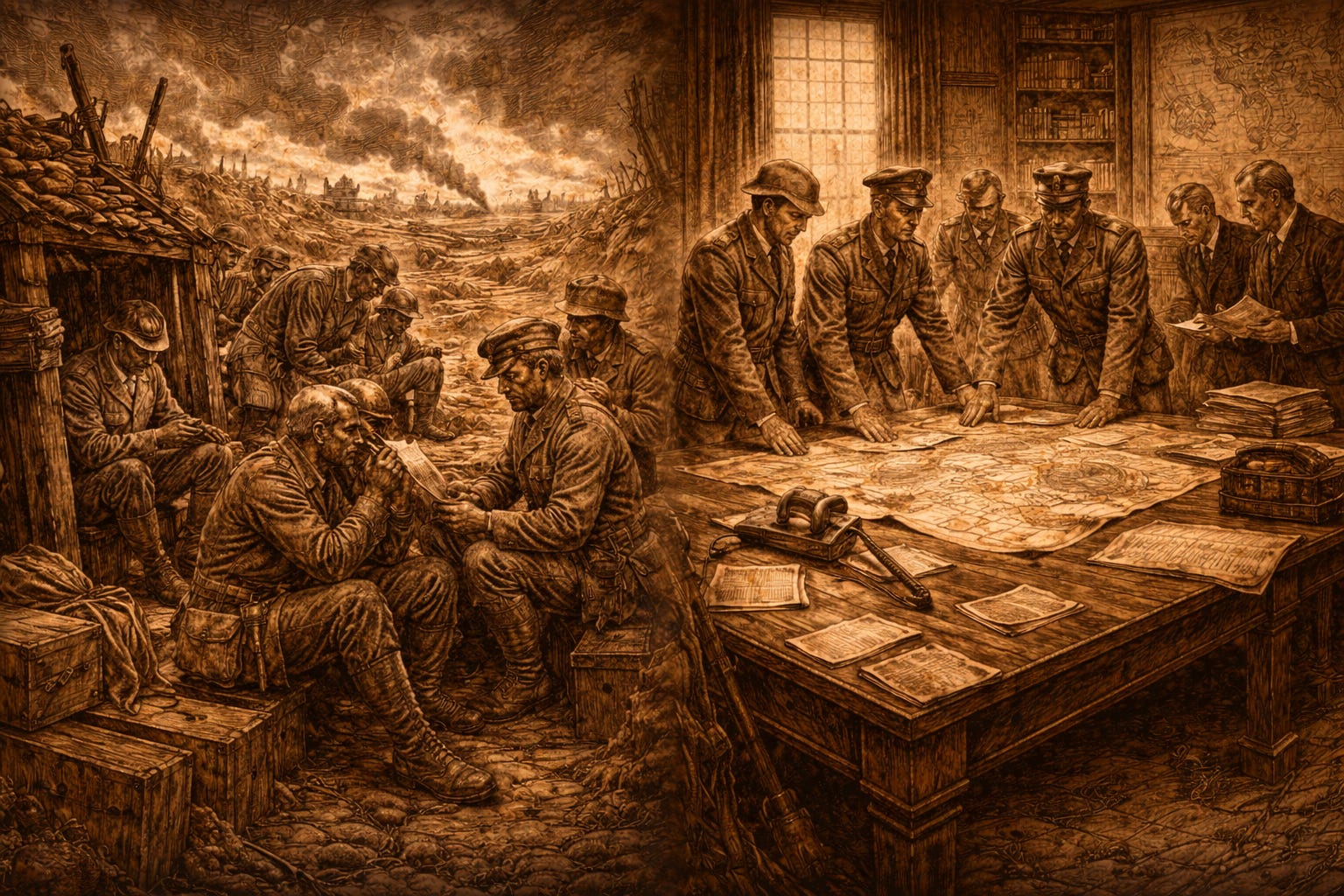
But remembrance can narrow the lens. It focuses on bravery at the front, not uncertainty in the cabinet. It elevates unity while muting dissent. It turns soldiers into symbols, leaving less room to question the political logic that placed them there.
The trenches were sites of extraordinary endurance. They were also the outcome of strategic failure. Repeated offensives promised breakthroughs that rarely came. Commanders clung to outdated tactics against machine guns and barbed wire. Men advanced into fire because the alternative was unthinkable.
Sacrifice became normalised. Casualty lists lengthened. The language of honour filled the space where doubt might have grown.
Industry meets destruction
The First World War marked a shift from limited warfare to industrial annihilation. Factories that once produced goods turned to shells and rifles. Railways moved men into killing zones with mechanical precision. Science accelerated death.
This was modernity turned inward. Efficiency did not civilise conflict. It magnified it. Chemical weapons drifted across fields. Tanks ground forward. Airplanes introduced a new dimension of threat.
The war revealed how technological progress could intensify suffering rather than alleviate it. Yet after the armistice, many nations framed their endurance as proof of resilience rather than warning.
The phrase the war to end war captured hope, not reality. The structures that enabled it remained largely intact.
Political failure and its aftermath
The war’s conclusion did not resolve the tensions that sparked it. Instead, it rearranged them. Empires collapsed. Borders shifted. Economic strain deepened. Political extremism found fertile ground.
The settlement that followed carried its own blind spots. Punitive measures mixed with lofty rhetoric. The desire for stability competed with demands for retribution. Seeds of future conflict were planted in soil still soaked with grief.
It is tempting to treat the Second World War as a separate catastrophe. In truth, it was entangled with the unresolved consequences of the first.
The failure was not merely military. It was diplomatic and moral.
Why the myth endures
So why do we persist in telling a cleaner story? Because the alternative is uncomfortable. To admit that the war was not inevitable is to accept that it might have been avoided. To question leadership is to complicate remembrance.
National identity has woven the war into its fabric. The image of stoic endurance, of a country united in purpose, offers reassurance in uncertain times. Complexity feels like disrespect.
Yet honouring the dead does not require simplifying the causes. It demands honesty about them.
Ending where we began
Return to that hypothetical modern project, launched with confidence and ending in tragedy. We would demand accountability. We would dissect every memo and decision.
History deserves the same scrutiny.
World War One was not a morality play with clear lines and necessary outcomes. It was a catastrophe shaped by human choice, pride, fear, and miscalculation. Remembering that does not diminish sacrifice. It restores context.
If we want remembrance to mean more than ritual, we must resist turning confusion into destiny. The war was not written in stone. It was written in decisions.