

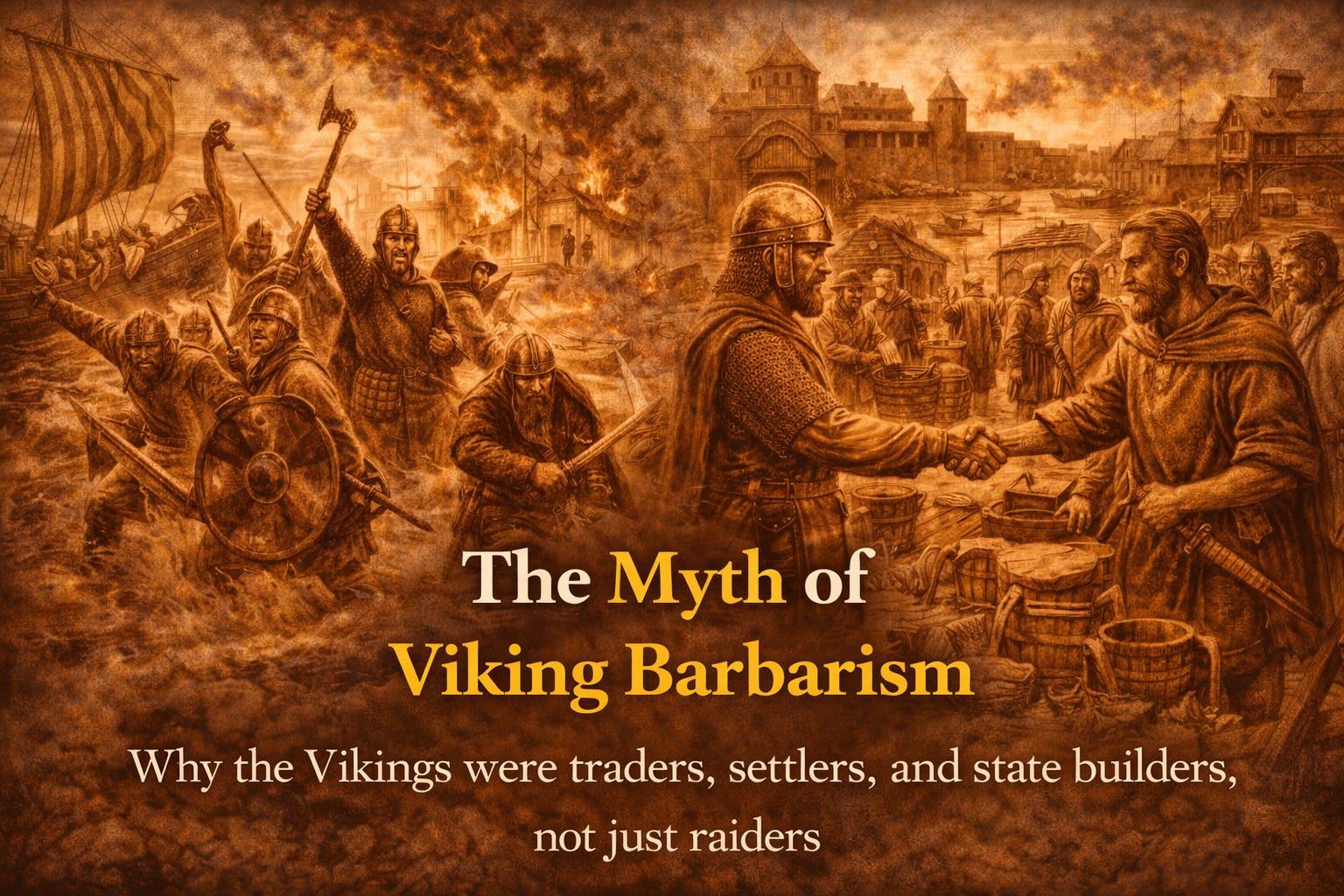
If a group arrived on Britain’s shores today, burned settlements, took hostages, and vanished back across the sea, there would be no debate about what to call them. They would be labelled terrorists, criminals, enemies of order.
That is how the Vikings are often remembered.
Longships cutting through grey water. Monasteries in flames. Axe wielding warriors descending without warning. It is a powerful image, one repeated in classrooms, television dramas, and popular imagination. The Vikings, we are told, were little more than violent raiders, driven by plunder and chaos.
It is not entirely wrong.
It is also far from the whole story.
Raiders who also built
The Viking Age, stretching roughly from the late eighth century to the early eleventh, did begin with violence. The raid on Lindisfarne in 793 remains one of the most famous moments in British history, precisely because of its shock. A holy site attacked by outsiders from the sea felt like the collapse of order itself.
But raids were only one part of Viking activity.
The same people who struck coastal monasteries were also traders, settlers, and explorers. They travelled vast distances, from North America to the Middle East. They established trade routes that connected Scandinavia to Byzantium and beyond. They founded towns that still exist today, Dublin, York, Kiev.
This was not random destruction. It was expansion.
The Vikings did not simply pass through history like a storm. They reshaped it in quieter, more enduring ways.
Violence seen, complexity ignored
So why does the image of the barbarian persist?
Part of the answer lies in who recorded the story.
Much of what we know about early Viking raids comes from Christian chroniclers, monks whose communities were often the targets of attack. Their accounts are vivid, emotional, and understandably hostile. They describe terror, desecration, and loss.
These accounts matter. They are not inventions.
But they are also partial.
They capture the moments of violence, not the years of trade, settlement, and integration that followed. They reflect the perspective of those who suffered, not those who arrived, adapted, and became part of local societies.
History, as so often, preserves the loudest moments most clearly.
Settlers who became neighbours
Over time, Vikings did not remain outsiders. They settled.
In parts of England, particularly the Danelaw, Scandinavian influence shaped law, language, and culture. Words we use today, such as sky, law, and husband, carry Norse roots. Place names across northern England still bear Viking origins.
These were not the marks of passing raiders. They were the signs of people who stayed.
They farmed land, married into local communities, and governed territories. They adapted as much as they imposed. The line between Viking and Anglo Saxon blurred over generations.
The image of the savage outsider becomes harder to sustain when that outsider becomes your neighbour.
Trade, not just plunder
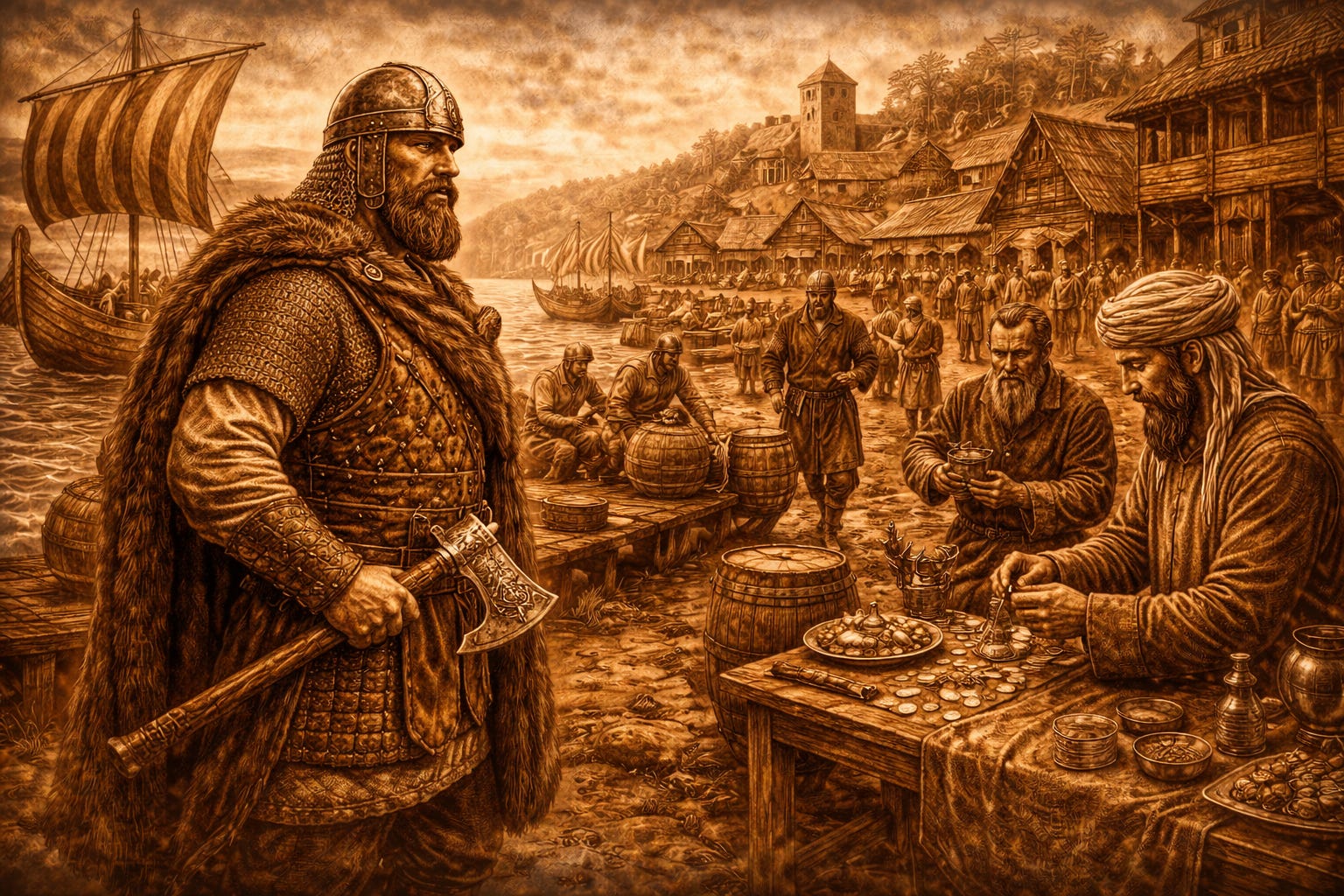
The Viking world was also deeply connected through trade.
Silver from the Islamic world, silk from Byzantium, and goods from across Europe moved along routes maintained by Scandinavian merchants. Markets flourished. Wealth circulated. Networks expanded.
This commercial activity required organisation, negotiation, and trust. It depended on relationships, not just force. The same ships that carried warriors could also carry goods, ideas, and people.
To reduce the Vikings to raiders is to ignore the economic system they helped build.
Barbarism as a label
The word barbarian itself deserves scrutiny.
It has long been used to describe those outside a perceived civilisation, those who do not share its language, customs, or values. It is a label that simplifies difference into inferiority.
To the monks of Lindisfarne, the Vikings were barbarians. To the Vikings, those same monks may have appeared wealthy, defenceless, and part of a world worth exploiting.
Neither perspective captures the full reality.
Barbarism often says more about the observer than the observed.
Myth and memory
The enduring image of Viking brutality persists because it is dramatic. Fire and steel are easier to remember than trade agreements and settlement patterns. Stories of violence travel further than stories of adaptation.
Modern culture has reinforced this image. Films, television, and popular history lean into the spectacle of raids and battles. The quieter realities of daily life, governance, and commerce receive less attention.
The result is a familiar pattern.
A complex society is reduced to its most extreme moments.
Ending where we began
If a group arrived on Britain’s shores today, history would not remember them only through their first act. It would follow what happened next, whether they stayed, traded, integrated, or changed the world around them.
The Vikings deserve the same treatment.
They were capable of violence, sometimes extreme violence. That cannot be ignored. But they were also builders of towns, creators of trade networks, and participants in cultural exchange on a remarkable scale.
To see them only as barbarians is to miss the larger story.
And as with so many of history’s blind spots, the myth tells us something important, not about the Vikings themselves, but about how we choose to remember the past.