

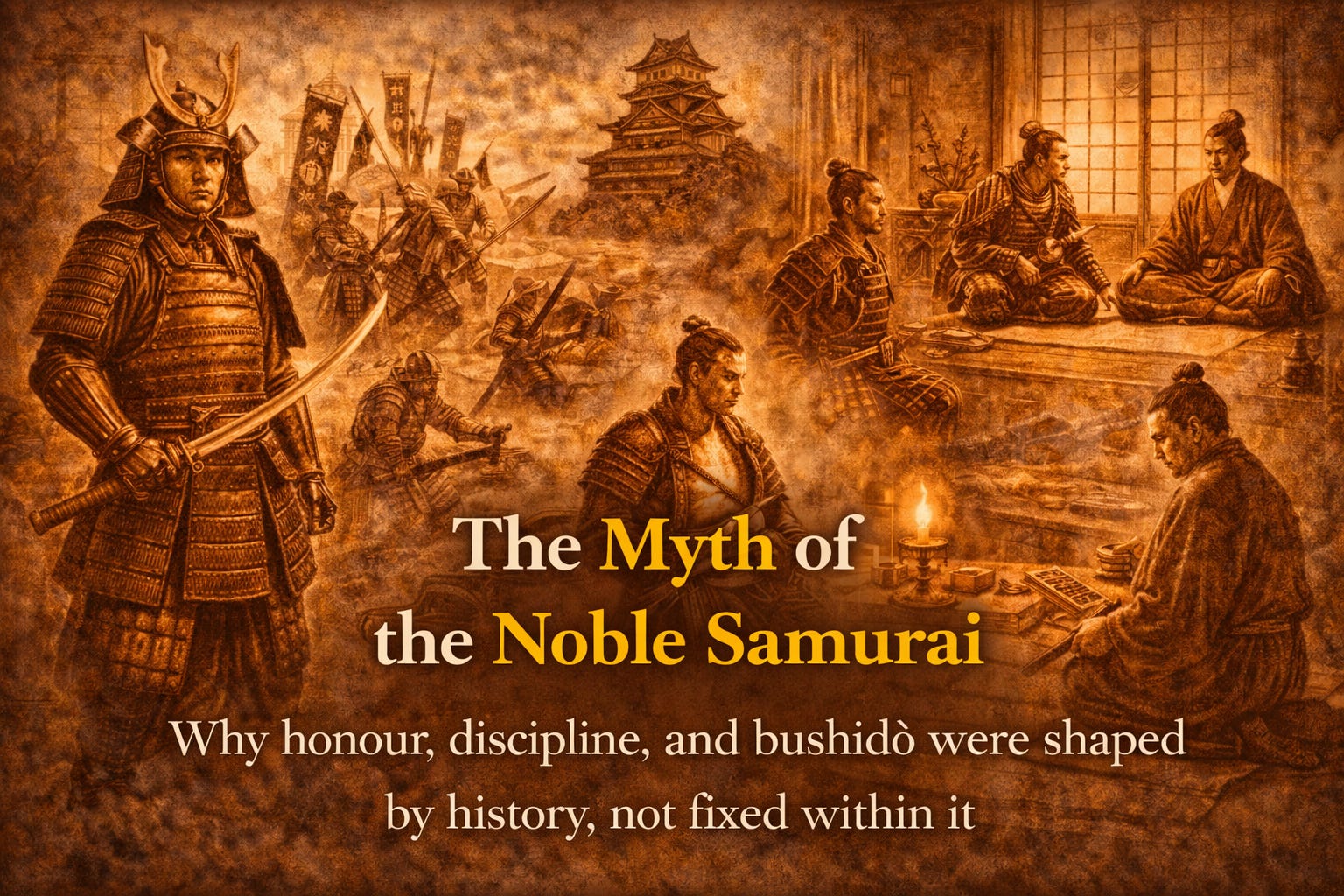
If you watched a modern film about leadership, you would likely see a familiar figure. Calm under pressure, loyal to the end, guided by an unbreakable moral code. A warrior who chooses death over dishonour and duty over self.
More often than not, that figure looks like a samurai.
The image is powerful. It has travelled far beyond Japan, shaping how we think about discipline, honour, and even modern leadership. The samurai has become a symbol, a kind of historical shorthand for integrity and control.
It is also, in many ways, a myth.
Warriors of reality, not legend
The samurai did exist, of course. For centuries they formed the military elite of Japan, serving powerful lords, fighting in wars, and helping to shape the political landscape.
But they were not the timeless paragons of virtue that popular culture suggests.
Samurai were products of their time. They lived in a world of shifting alliances, regional conflicts, and constant political manoeuvring. Loyalty was often conditional. Survival mattered. Power mattered.
A samurai might serve one lord, then another. Alliances could change quickly, especially during periods of civil war such as the Sengoku era. Strategy, pragmatism, and ambition were as important as any notion of honour.
This was not a world governed by a single, rigid moral code.
Bushidō, a code rewritten
Central to the myth of the noble samurai is the idea of bushidō, the way of the warrior. It is often presented as an ancient, unchanging code that dictated how samurai lived and died.
In reality, bushidō as we understand it today was shaped much later.
During Japan’s long period of peace under the Tokugawa shogunate, from the early seventeenth century onwards, the role of the samurai began to change. With fewer wars to fight, many became administrators, officials, and bureaucrats.
It was during this time that writers and thinkers began to formalise ideas about samurai behaviour. They looked back on earlier centuries and constructed a moral framework that emphasised loyalty, discipline, and honour.
This was not a reflection of a timeless tradition. It was an interpretation, shaped by a society that was no longer defined by constant warfare.
Bushidō, in many ways, was a product of peace, not war.
Politics behind the poetry
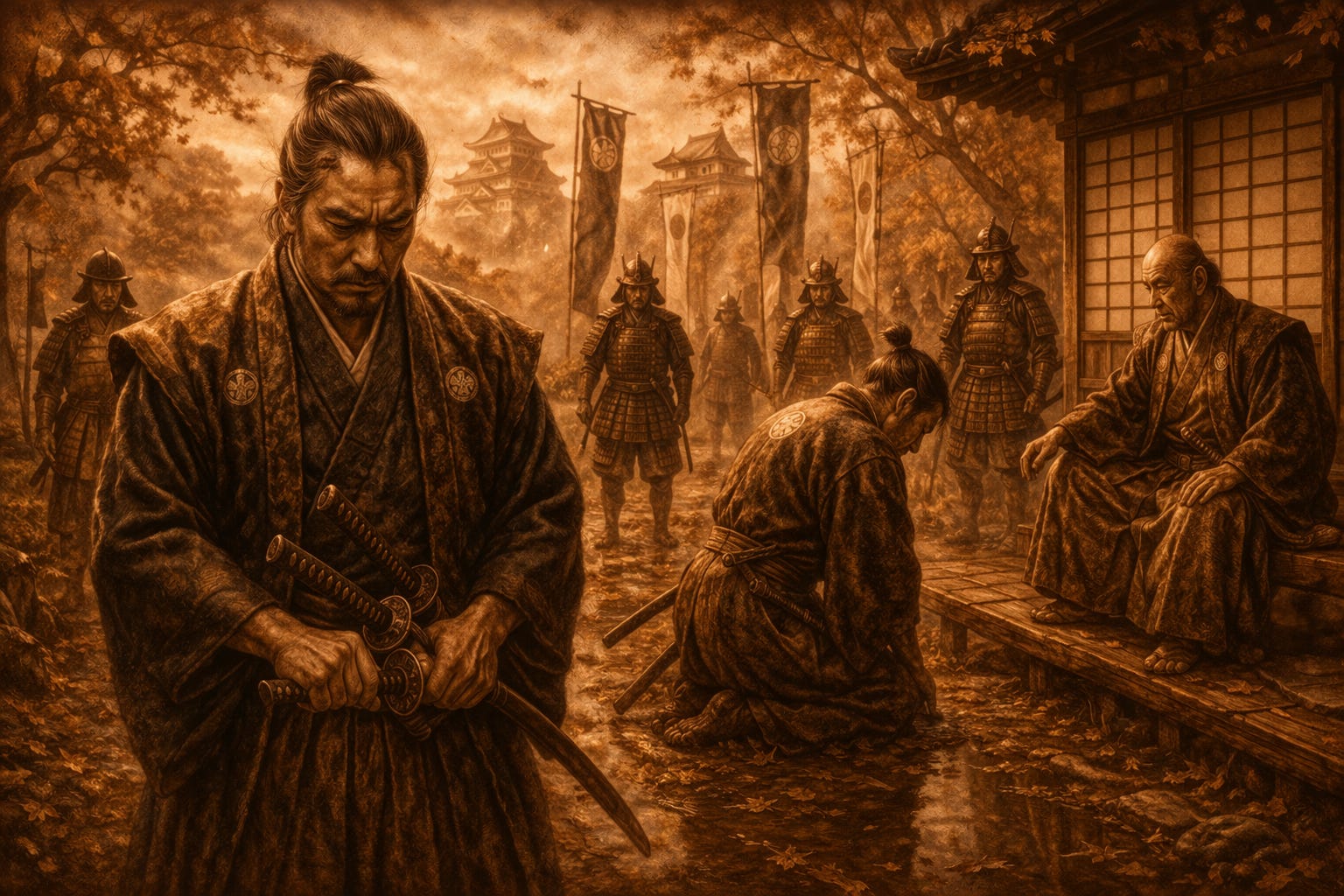
The romantic image of the samurai owes much to later storytelling.
In the nineteenth and early twentieth centuries, as Japan modernised and sought to define its national identity, the samurai became a symbol of cultural strength and continuity. Their supposed code of honour was promoted as a model for society, reinforcing ideas of loyalty and sacrifice.
Stories were polished. Complex realities were simplified.
The samurai of history, pragmatic, political, often ruthless, became the samurai of legend, noble, disciplined, and unwavering.
This transformation was not unique. Many societies reshape their past to serve the needs of the present.
Honour and survival
This is not to say that honour meant nothing to the samurai.
Concepts of reputation, loyalty, and duty were important, as they have been in many warrior cultures. Acts of bravery and sacrifice were recognised and valued.
But these ideas were not applied consistently or universally. They existed alongside practical concerns, ambition, fear, and calculation.
Seppuku, the ritual suicide often associated with samurai honour, is a good example. It did occur, but not as frequently or as uniformly as the myth suggests. It was shaped by context, expectation, and circumstance, not simply by an abstract code.
The reality was more human, more complicated.
Myth and modern fascination
Why does the myth endure?
Because it offers clarity.
The idea of the noble samurai provides a clean, compelling narrative. It presents a world where values are fixed, choices are clear, and integrity is absolute. In a modern world that often feels uncertain and contradictory, that kind of story is appealing.
It is no coincidence that the samurai has become a global symbol, appearing in films, books, and even business philosophy. The myth has travelled because it speaks to something we want to believe.
That history can provide simple answers.
Ending where we began
If a modern leader claimed to follow an unbreakable code, to act always with perfect honour and unwavering loyalty, we might admire the sentiment. We might also question how such certainty could survive in a complex, unpredictable world.
The samurai lived in such a world.
They fought, negotiated, adapted, and survived. They were shaped by politics, by conflict, by changing circumstances. Their lives were not governed by a single, timeless code, but by the realities of the moment.
The myth of the noble samurai persists because it offers a story of perfection. History offers something more valuable.
A reminder that even the most iconic figures of the past were human, navigating a world as uncertain as our own.