
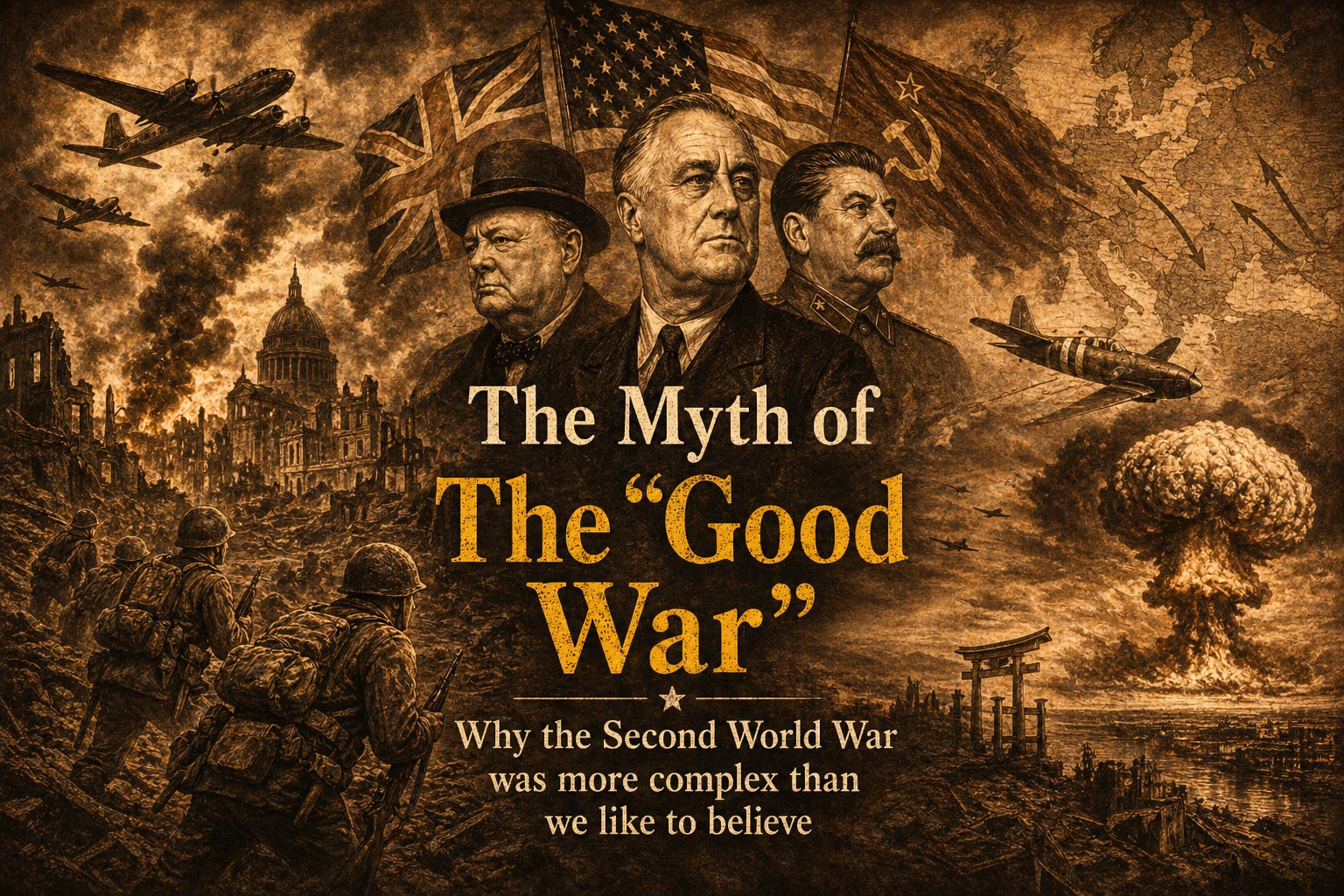
If you listen to how modern conflicts are discussed, the language is often familiar. Good versus evil. Freedom against tyranny. The right side of history.
We reach for clarity because war is easier to understand when its purpose feels certain.
No conflict fits that mould more comfortably than the Second World War.
It is often described as the “good war”. A necessary fight against Nazism. A moment when the moral lines were clear and the outcome, victory, felt justified.
In many ways, that judgement is understandable.
But it is not complete.
A war that had to be fought
There is no ambiguity about the threat posed by Nazi Germany. Its ideology, its expansionism, and its crimes demanded resistance. The defeat of that regime was necessary.
This is the foundation of the “good war” narrative.
It matters, and it should not be diminished.
But recognising the necessity of the war does not mean every action within it was morally simple or beyond question.
War does not grant moral immunity.
Methods that complicate the story
The conduct of the war introduced difficult realities.
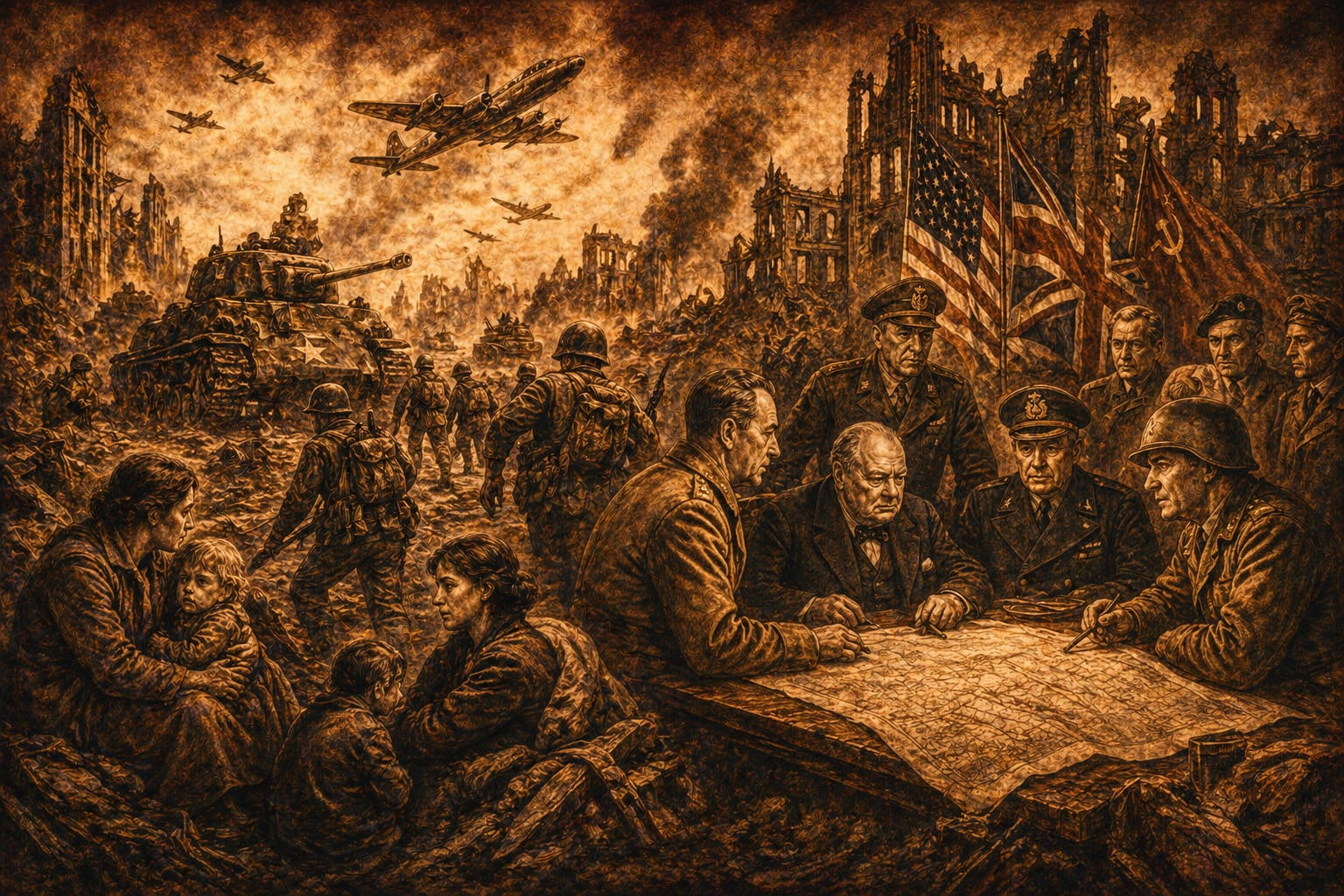
Strategic bombing campaigns targeted cities as well as military infrastructure. Dresden, Hamburg, Tokyo, these names are associated not only with military objectives, but with large scale civilian casualties. The aim was to weaken enemy morale and capacity. The cost was measured in lives far from the battlefield.
The use of atomic weapons against Hiroshima and Nagasaki brought the war in the Pacific to an abrupt end. It also raised profound ethical questions that continue to be debated.
These actions were taken within the context of total war. They were justified at the time as necessary to achieve victory and to avoid even greater loss of life in prolonged conflict.
But necessity and morality are not always the same.
Allies with contradictions
The alliance that defeated Nazi Germany was not built on shared values alone.
It included powers with their own complexities and contradictions.
The Soviet Union played a decisive role in the defeat of Germany, bearing immense losses on the Eastern Front. It was also a regime responsible for repression, purges, and its own forms of state violence.
Britain and France, while fighting for freedom in Europe, maintained empires that denied that same freedom to millions elsewhere. Colonial troops fought and died in a war framed as a defence of liberty that they themselves did not fully enjoy.
The United States entered the war as a champion of democracy, while still grappling with segregation and inequality at home.
These realities do not erase the importance of the Allied cause. They do, however, complicate the idea of a purely moral coalition.
Why the myth endures
The “good war” narrative persists because it offers something rare.
Clarity.
It provides a story in which the lines are drawn sharply. One side represents oppression, the other liberation. The outcome confirms the righteousness of the effort.
After the devastation of the war, that clarity served a purpose. It helped societies process loss, honour sacrifice, and rebuild a sense of direction.
It also shaped how future generations would understand conflict.
Complexity was softened. Contradictions were smoothed away.
The war became not only a historical event, but a moral reference point.
Memory and meaning
To question the simplicity of the “good war” is not to question the necessity of defeating Nazism. It is to recognise that even just causes are pursued through imperfect means.
This distinction matters.
When history is reduced to clear moral binaries, it becomes easier to apply those same binaries to the present. Conflicts are framed in familiar terms. Nuance is lost. Difficult questions are avoided.
Understanding the complexity of the past does not weaken its lessons. It strengthens them.
It forces us to confront the reality that war, even when justified, carries consequences that resist easy judgement.
Ending where we began
When modern conflicts are described as battles between good and evil, the language echoes the way we remember the Second World War.
It is comforting. It is compelling.
But it is also incomplete.
The war was necessary. It was fought against a regime whose defeat was essential. It was also a conflict in which decisions were made that continue to challenge our understanding of morality.
The myth of the “good war” persists because it offers certainty.
History offers something more demanding.
A reminder that even in the most justified of struggles, the path to victory is rarely as clear, or as clean, as we would like to believe.