

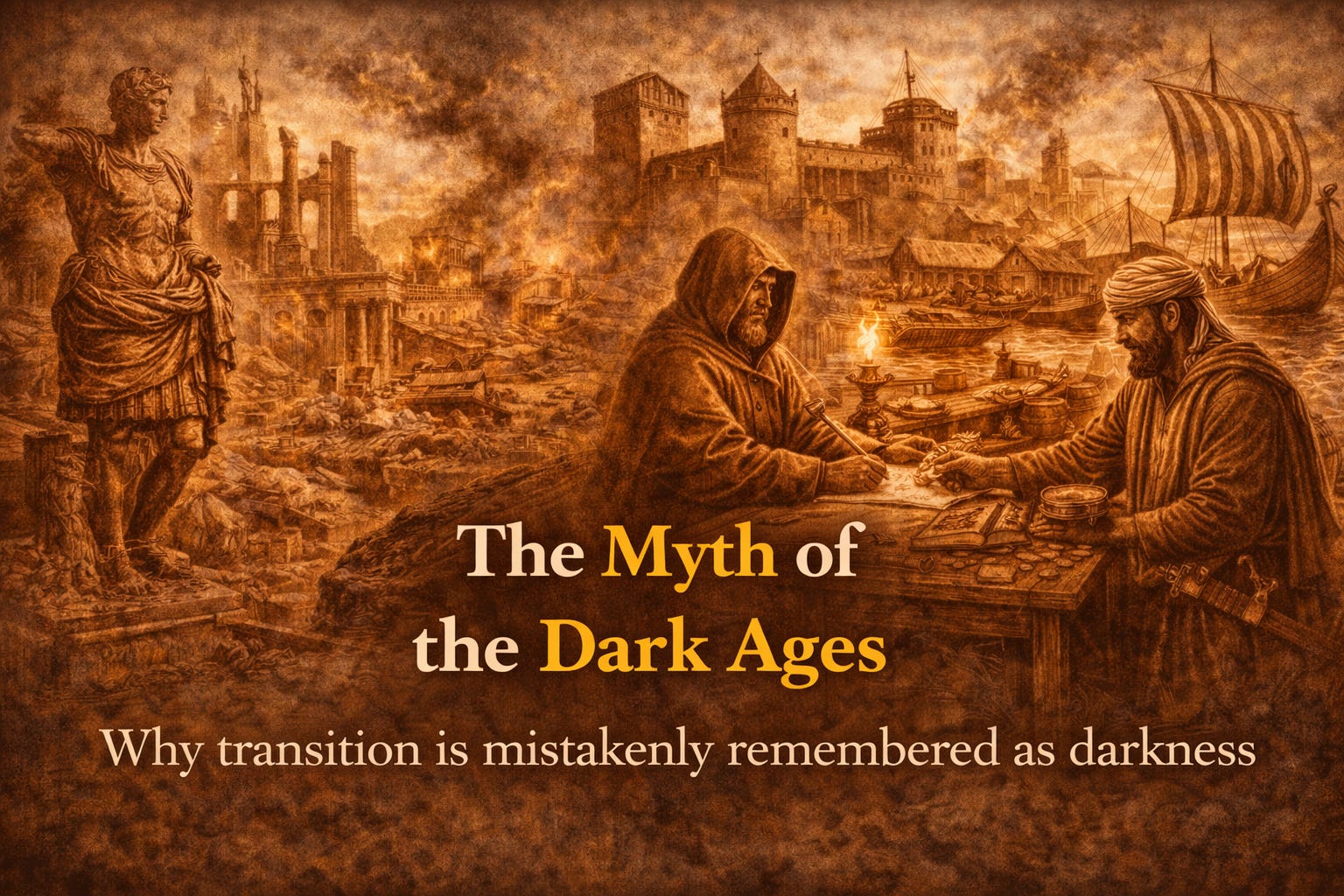
If a modern society lost a dominant power overnight, its systems fractured, its economy splintered, and its institutions weakened, we would not call it darkness. We would call it transition, disruption, perhaps even reinvention.
Yet when Rome declined in the West, history gave the centuries that followed a far more dramatic label.
The Dark Ages.
It is a phrase that suggests collapse, ignorance, and stagnation. A world where learning vanished, progress halted, and civilisation slipped backwards until the Renaissance came to rescue it.
It is one of the most enduring myths in Western history.
It is also deeply misleading.
After Rome, not after civilisation
The fall of the Western Roman Empire in the fifth century did not erase civilisation. It altered it.
Central authority weakened. Cities shrank. Trade patterns shifted. But life did not stop. Communities adapted to new political realities. Local power structures replaced imperial ones. Kingdoms emerged where provinces once stood.
This was not a descent into darkness. It was a transformation.
The idea of total collapse comes partly from comparison. Rome had been vast, organised, and bureaucratic. What followed looked smaller, less uniform, less controlled. To later observers, especially those writing centuries afterwards, that difference appeared as decline.
But difference is not the same as absence.
Knowledge did not disappear
One of the most persistent claims about the so called Dark Ages is that learning vanished.
It did not.
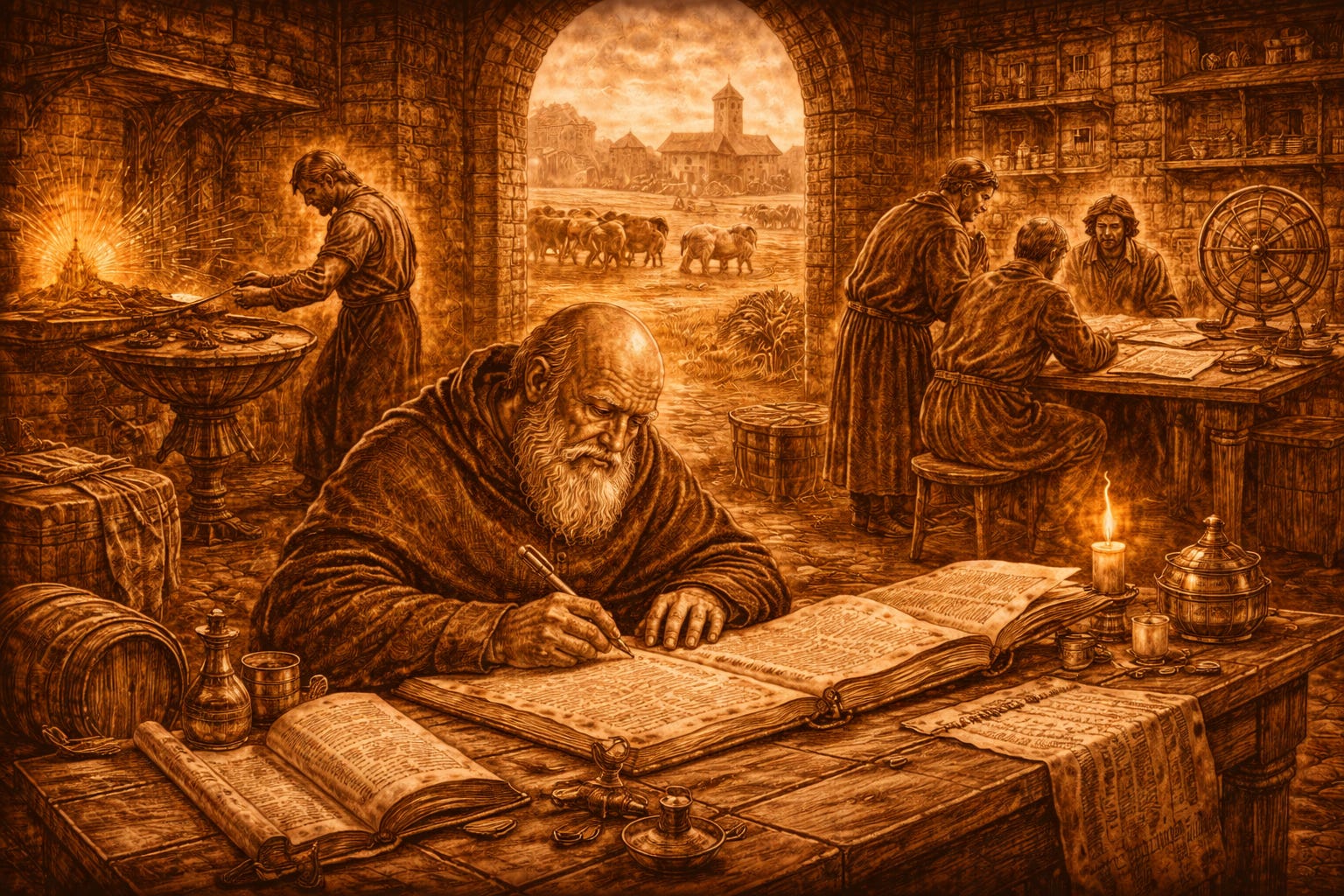
Monasteries across Europe became centres of scholarship. Monks copied manuscripts, preserved classical texts, and produced new works of theology, philosophy, and history. Without their efforts, much of what we know about the ancient world would have been lost.
Beyond Europe, intellectual life flourished.
In the Islamic world, scholars translated and expanded upon Greek and Roman knowledge. Mathematics, medicine, astronomy, and philosophy advanced significantly. These ideas would later flow back into Europe, shaping medieval and early modern thought.
Learning did not vanish. It moved, adapted, and survived in different forms.
Innovation in unexpected places
Far from stagnating, early medieval societies developed new technologies and practices.
Agriculture improved through tools such as the heavy plough, allowing farmers to work tougher soils and increase yields. The horse collar made animal labour more efficient. Watermills spread widely, transforming how energy was used in daily life.
Architecture evolved. Stone buildings, churches, and fortifications appeared across the landscape. Craftsmanship in metalwork, textiles, and art continued to develop.
These were not signs of a world standing still. They were signs of gradual, practical innovation.
Progress did not stop. It simply looked different from the grand engineering projects of Rome.
Trade and connection endured
Another common assumption is that Europe became isolated.
While long distance trade networks contracted in some regions, they did not disappear. Goods continued to move across land and sea. The Viking world, often remembered for raids, was also deeply connected through trade routes stretching from Scandinavia to the Middle East.
Markets existed. Exchange continued. Cultural contact persisted.
Europe was not cut off from the wider world. It remained part of a broader network of interaction, even if that network had changed shape.
The problem with the label
So why call it the Dark Ages at all?
The term was not used by the people who lived through the period. It was popularised much later, particularly during the Renaissance, when scholars sought to present their own era as a rebirth of classical knowledge. By contrasting themselves with a supposed age of darkness, they elevated their own achievements.
It was a useful narrative.
It simplified the past into a neat story, a golden age of Rome, followed by darkness, followed by rebirth. It made history easier to understand and more flattering to those telling it.
But simplicity came at the cost of accuracy.
Complexity over caricature
The centuries after Rome were not uniformly prosperous. There was conflict, instability, and hardship. Political fragmentation created uncertainty. Life could be difficult and unpredictable.
But that is true of many periods in history.
To reduce these centuries to darkness is to ignore their complexity. It overlooks the resilience of communities, the continuity of knowledge, and the quiet innovations that shaped the future.
It replaces a living, evolving world with a caricature.
Ending where we began
If a modern society experienced disruption on the scale of Rome’s decline, we would not describe it as darkness. We would study how it adapted, how it survived, how it changed.
The early medieval world deserves the same perspective.
It was not waiting to be rescued. It was already building the foundations of what came next.
The myth of the Dark Ages persists because it offers a simple story. History, as always, offers something richer.
Not darkness, but transition. Not ignorance, but adaptation. Not an empty gap, but a bridge between worlds.
Everything you state is absolutely true but, as you recognize, the full story is too much to neatly package for consumption for the non-historians (pro and amateur) out there.