

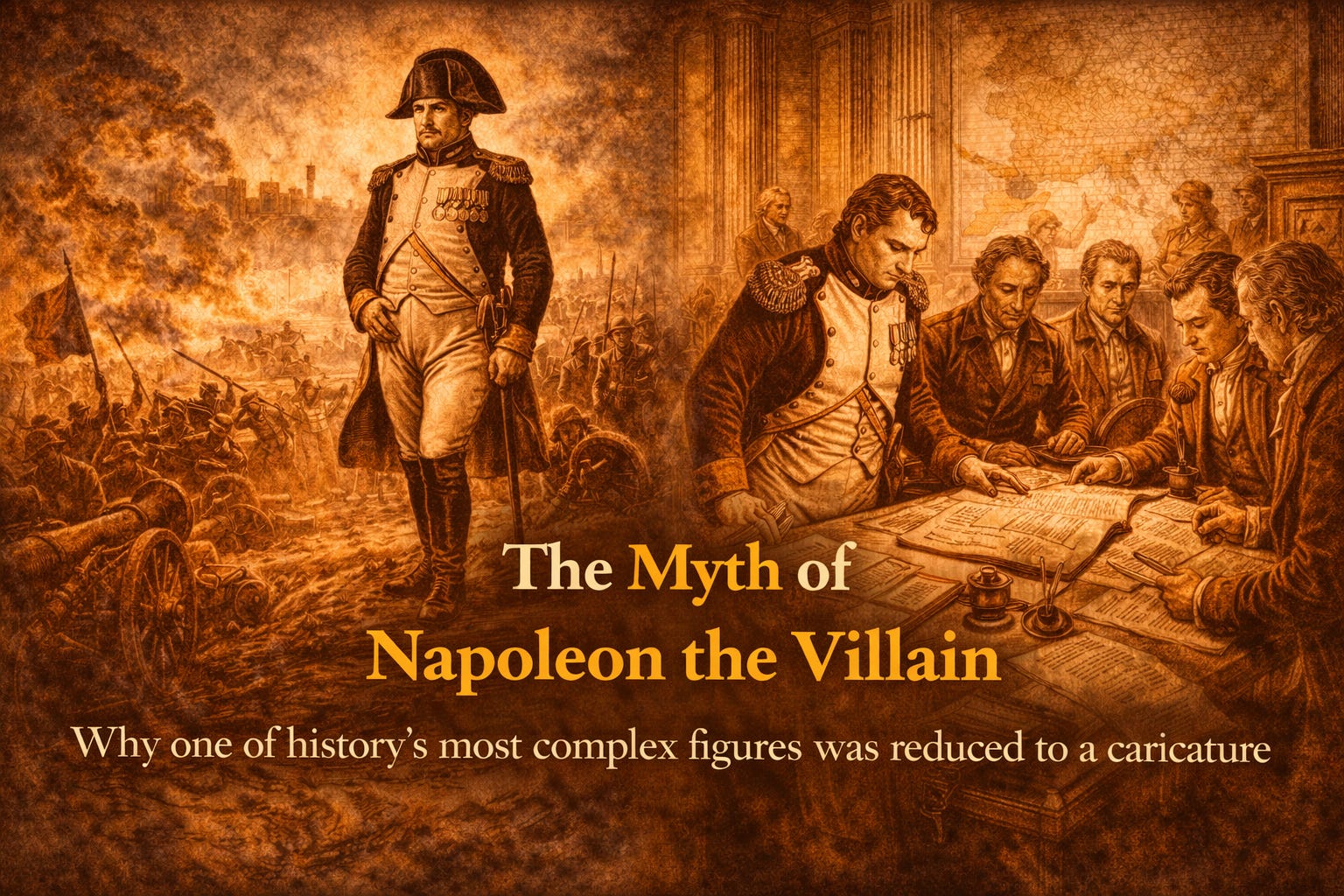
If a modern leader rose from relative obscurity, seized power during political chaos, reformed the legal system, stabilised the economy, and then led a series of wars across an entire continent, the judgement would be swift.
Hero to some. Villain to others. Dangerous to many.
History tends to make that judgement simpler than it really is.
Napoleon Bonaparte is often remembered as the villain. A power-hungry dictator who betrayed the ideals of the French Revolution and dragged Europe into years of bloodshed. A man driven by ego, ambition, and conquest.
There is truth in that.
But it is only part of the story.
From chaos to control
Napoleon did not rise in a stable world. He emerged from the aftermath of the French Revolution, a period marked by political instability, economic uncertainty, and social upheaval.
France had dismantled its monarchy, experimented with republican government, and endured the violence of the Terror. Authority was fragile. Institutions were weak. Confidence was low.
Napoleon offered something many in France were desperate for.
Order.
Through a combination of military success and political manoeuvring, he positioned himself as the figure capable of restoring stability. His coup in 1799 was not simply a grab for power, it was also a response to a system that many believed was failing.
He did not create the chaos. He inherited it.
Reforms that endured
Once in power, Napoleon introduced a series of reforms that would outlast his rule.
The Napoleonic Code reshaped the legal system, promoting equality before the law, protecting property rights, and standardising legal practices. It removed many of the privileges that had defined the old regime and created a framework that influenced legal systems far beyond France.
Administration became more centralised and efficient. Education was reorganised. Infrastructure improved. Financial systems were stabilised.
These were not the actions of a leader interested only in conquest. They were the foundations of a modern state.
It is difficult to dismiss a figure as purely destructive when so much of what they built continued to function long after they were gone.
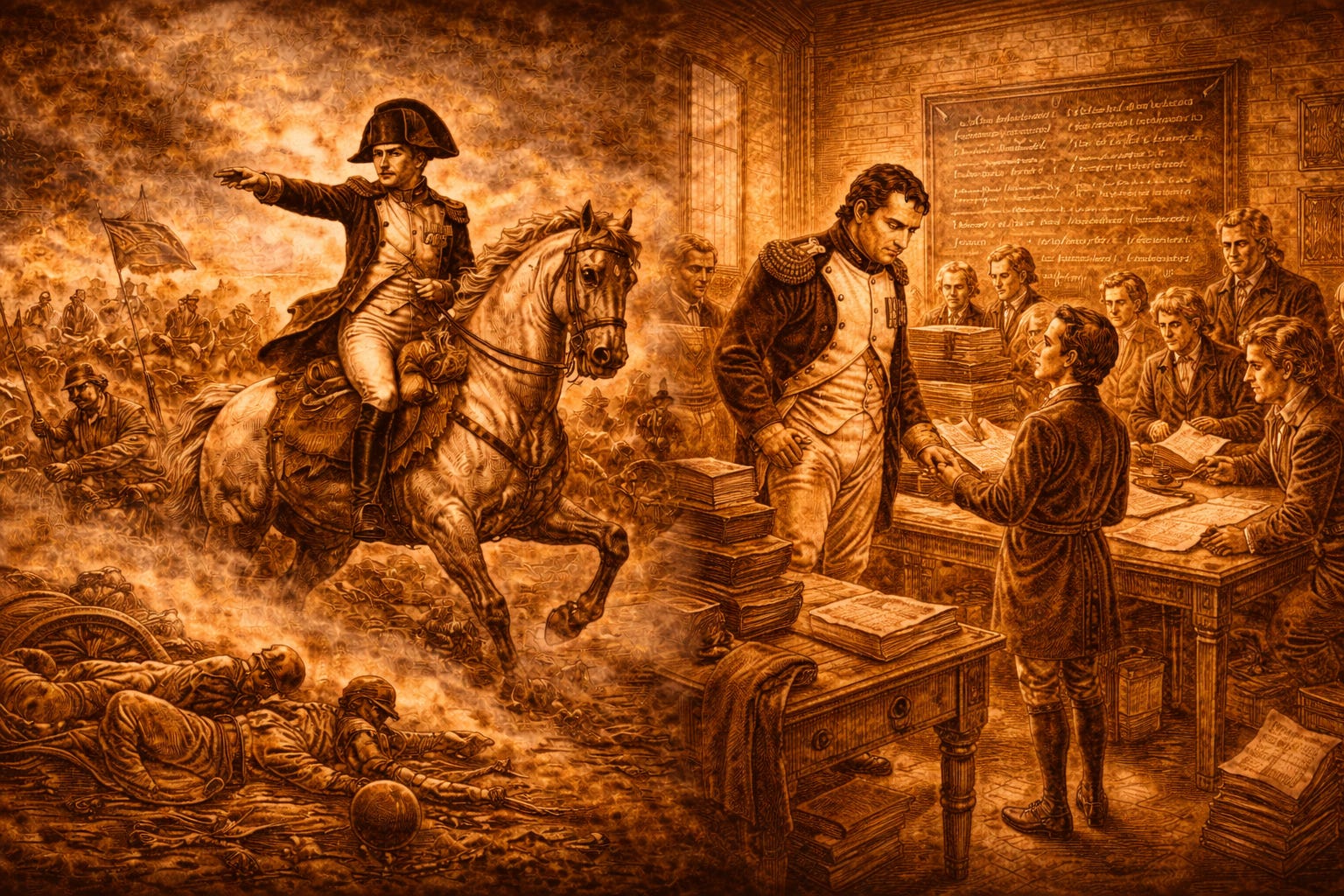
War and ambition
None of this removes the reality of war.
Napoleon’s rule was defined by conflict. His armies marched across Europe, reshaping borders and challenging established powers. The scale of these wars was immense, and the cost in human lives was staggering.
Ambition played its part. Napoleon sought dominance. He extended French influence far beyond its borders. His decisions prolonged conflict and drew multiple nations into repeated confrontation.
Here, the image of the villain finds firmer ground.
But even this requires context.
Europe’s monarchies were not passive victims. They formed coalitions, declared war, and sought to contain or overthrow revolutionary France long before Napoleon crowned himself emperor. The conflicts of the period were not one-sided. They were part of a broader struggle over power, ideology, and control.
Napoleon was both a driver of war and a participant in an already volatile system.
A legacy shaped by enemies
The image of Napoleon as a villain was not created in isolation.
Britain, one of his most persistent opponents, invested heavily in portraying him as a threat to civilisation. Propaganda depicted him as a tyrant, a monster, a figure of ridicule and fear. These images were powerful and widely circulated.
After his defeat, the victors had little incentive to present a balanced view. Framing Napoleon as the embodiment of chaos and aggression justified the restoration of older political systems and reinforced their own legitimacy.
History, written by those who prevailed, sharpened the caricature.
The complexity of his rule was reduced to a simpler, more convenient narrative.
Between hero and tyrant
Napoleon’s legacy resists easy classification.
He preserved elements of the Revolution while also concentrating power in his own hands. He promoted legal equality while restricting political freedom. He stabilised France while destabilising Europe.
He was neither purely hero nor purely villain.
This is precisely why his story has been simplified.
History often prefers clear categories. It is easier to teach, easier to remember, and easier to use. Complex figures are flattened into symbols. Their contradictions are smoothed away.
Napoleon becomes a warning, or a triumph, depending on who is telling the story.
Ending where we began
If a modern leader emerged today with a record like Napoleon’s, the debate would be fierce and ongoing. Supporters would point to reform and stability. Critics would highlight conflict and authoritarianism. No single narrative would dominate.
Yet with distance, history tends to settle on a simpler version.
Napoleon the villain.
It is a label that captures part of the truth, but not enough of it.
The reality is more uncomfortable. He was a product of his time, shaped by revolution, conflict, and opportunity. He made choices that brought both progress and destruction. His legacy cannot be contained within a single word.
The myth persists because it offers clarity.
History offers something harder.
A reminder that even the most famous figures of the past are rarely as simple as we would like them to be.