

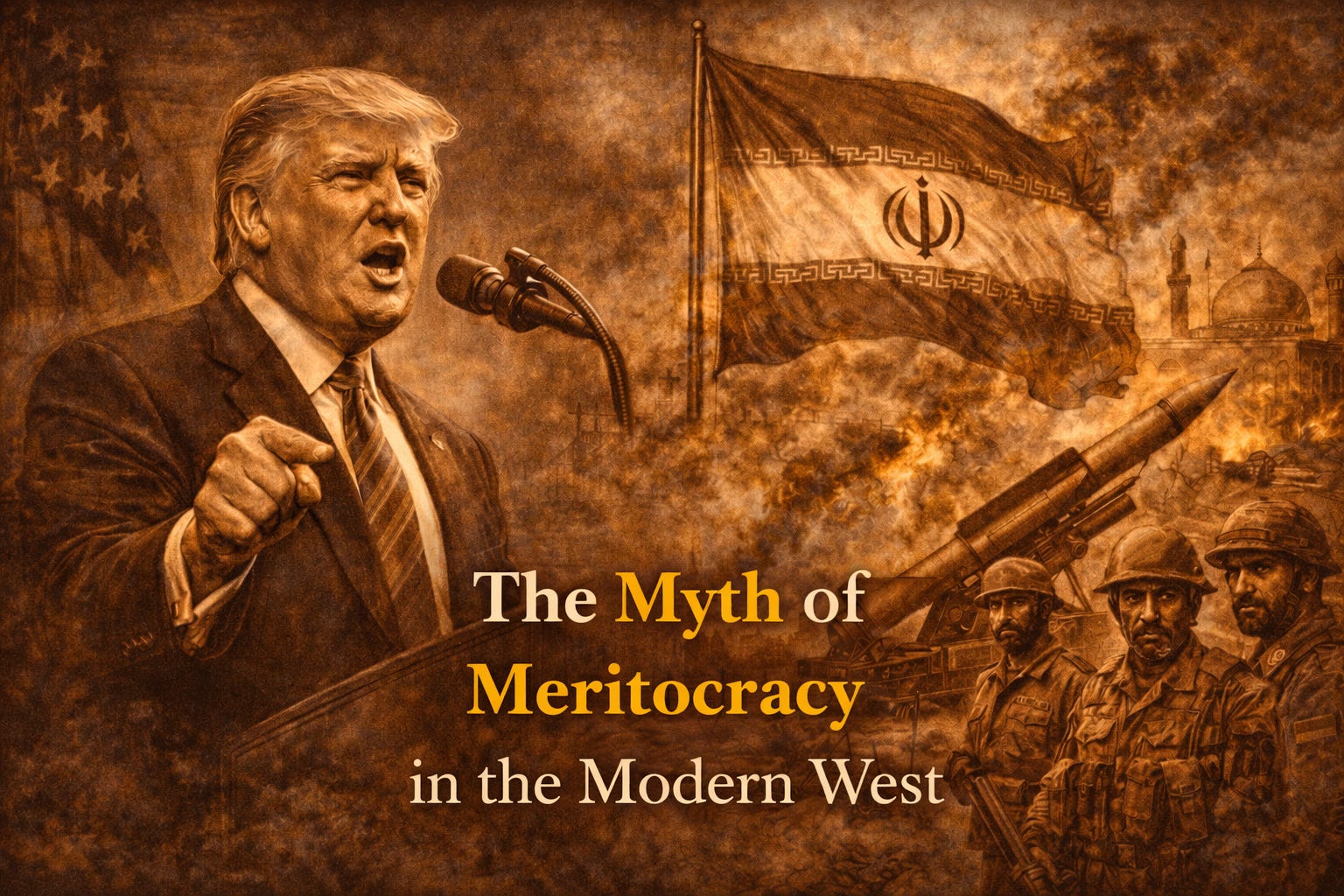
When the United States and Israel launched strikes against Iran last week, the decision did not emerge from a broad public consensus or the calm application of expert reasoning. It came from a narrow circle of political power, surrounded by shifting explanations and disputed intelligence. Critics questioned the urgency of the threat and the absence of a clear strategy. Public support was lukewarm. Yet the machinery of war moved forward.
This is not unusual. Major decisions in modern democracies often appear to rise from open debate and careful judgement. In reality, they frequently originate within small groups whose authority is rarely challenged until after the consequences arrive.
That tension sits awkwardly beside one of the modern West’s most comforting beliefs, the idea of meritocracy.
Meritocracy promises that ability and effort determine success. It tells us that the most capable people rise naturally to positions of influence. Leadership, wealth, and status are supposed to reflect talent rather than privilege.
It is a powerful idea. It is also one of the most persistent myths of modern history.
The promise of merit
The concept of meritocracy emerged from Enlightenment thinking. Philosophers argued that societies should abandon inherited privilege and reward talent instead. If individuals were judged by ability rather than birth, the best minds would guide government, science, and commerce. Progress would accelerate.
Compared with hereditary aristocracy, this vision seemed revolutionary. A society that selected its leaders through education and achievement appeared fairer and more rational than one ruled by bloodlines.
But meritocracy did not remove hierarchy. It rearranged it.
Access to education quickly became the new gatekeeper. Those with wealth secured better schools, tutors, and opportunities. Their children entered prestigious universities and professional networks already equipped to succeed. The ladder of opportunity remained in place, but some people began their climb several rungs higher than others.
The language of merit concealed how advantage reproduced itself.
Wealth and the quiet reproduction of power
Modern economies celebrate competition and innovation. The narrative suggests that entrepreneurs rise through creativity and determination. Yet the distribution of wealth often tells another story.
Financial security allows risk. Connections provide access. Failure is survivable when resources remain intact. Those born into comfort can afford to experiment. Those without safety nets rarely have that luxury.
The Industrial Revolution offers a useful historical example. It created immense new fortunes and transformed economic life across Europe and North America. At the same time it entrenched inequality on a scale previously unknown. Industrial wealth clustered among a relatively small group of owners and investors while millions of workers struggled in poverty.
Opportunity existed, but it was uneven. Hard work did not guarantee advancement. The myth of meritocracy allowed societies to interpret inequality as natural rather than structural.
Success appeared deserved because the system claimed to reward merit.
Politics and the illusion of open leadership
Democratic politics reinforces the same belief. Elections are meant to ensure that leadership reflects public choice and competence. In theory, anyone with ability and determination can rise to influence.
In practice, political power rarely moves so freely.
Campaigns depend on funding, organisation, and visibility. Parties promote candidates who already belong to established networks. Advisors, donors, and institutional interests shape decisions long before voters enter the conversation.
The recent escalation of conflict with Iran illustrates this pattern. Military action was justified through shifting arguments about security and deterrence. Yet the decision emerged from a limited group of political leaders and advisers. Public scepticism, diplomatic alternatives, and intelligence uncertainty struggled to compete with the momentum of executive authority.
War, perhaps the most consequential choice a government can make, revealed how little modern politics resembles the tidy meritocratic ideal.

Competence and the persistence of error
One of meritocracy’s central promises is that leadership improves when positions are filled by the most capable individuals. If ability determines authority, mistakes should become rarer.
History offers little comfort on that front.
Modern governments staffed by highly educated officials have repeatedly made catastrophic decisions. Strategic miscalculations in Iraq and Afghanistan demonstrated how expertise does not eliminate error. Economic crises have unfolded under the supervision of respected institutions. Intelligence failures recur despite sophisticated technology and analysis.
The problem is not that competence is irrelevant. Expertise matters enormously. The difficulty lies in assuming that systems reliably select the most competent people or that those individuals operate free from political pressure, ideology, and personal ambition.
Human judgement remains fallible, even within elite institutions.
Meritocracy as moral reassurance
Why, then, does the myth endure? Because it provides moral clarity.
Meritocracy tells us that outcomes reflect effort and ability. Those who succeed deserve their success. Those who struggle simply have not worked hard enough or chosen wisely enough. The story is reassuring because it aligns prosperity with virtue.
Questioning meritocracy unsettles that comfort. It suggests that inequality may arise from inherited advantage rather than personal failure. It implies that institutions claiming neutrality may reproduce existing hierarchies.
For societies built on ideals of fairness and opportunity, such doubts can feel destabilising.
Old hierarchies in new language
History rarely replaces one system with another overnight. Structures evolve gradually, carrying elements of the past into the present. Aristocratic privilege faded, but its logic adapted.
Elite schools replaced noble titles as markers of status. Professional networks performed the social work once handled by royal courts. Wealth continued to circulate within familiar circles.
Meritocracy provided a language that justified these continuities. Success could be explained as the natural reward for talent while structural advantages remained largely invisible.
The result is a system that celebrates individual achievement while quietly preserving patterns of influence.
Returning to the present
The decision to strike Iran will eventually become another chapter in the long history of foreign policy debates. Analysts will examine intelligence, motives, and consequences. Some will defend the choice. Others will condemn it.
What the episode already reveals is something older and more persistent. Even in societies that champion meritocracy, immense power can still concentrate within a narrow leadership circle. Decisions with global consequences may unfold without broad consensus or clear demonstration of superior judgement.
The belief that the best naturally rise to guide us is attractive. It offers confidence in the fairness of the system and the wisdom of those who lead it.
History encourages caution.
Merit does matter. Talent and effort shape lives and institutions in countless ways. Yet power rarely travels by merit alone. It follows wealth, influence, education, and proximity to decision making.
The myth of meritocracy comforts us because it promises a fair world. The lesson of history is quieter and less satisfying.
Systems that claim to reward merit must always be questioned, because the people deciding what counts as merit often sit at the very top.