

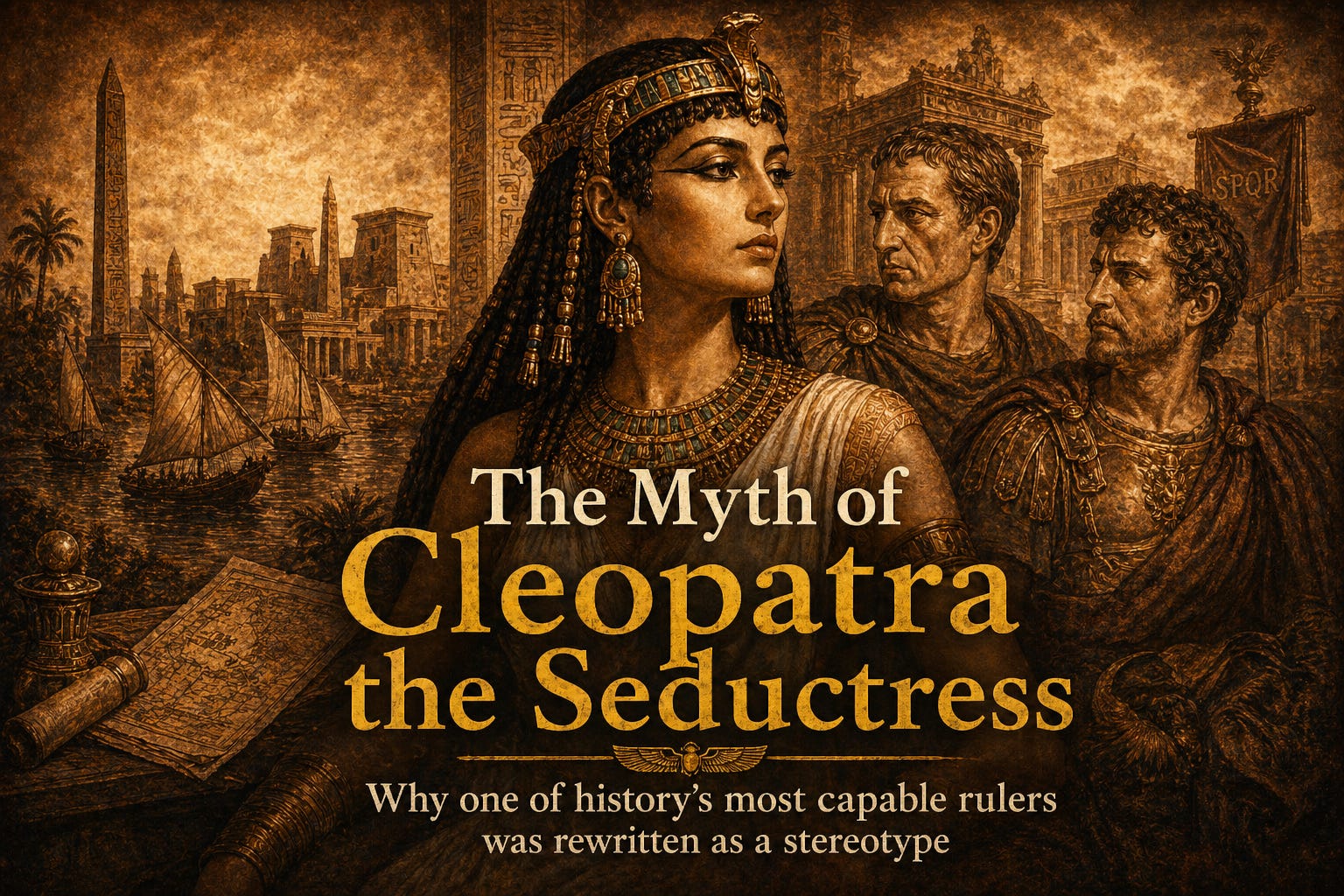
If a modern female leader rose to power in a fragile state, negotiated with global superpowers, secured alliances, stabilised her economy, and held her throne against overwhelming pressure, how would she be remembered?
You would hope for words like strategist, diplomat, operator.
More often than not, history reaches for something else.
Cleopatra VII of Egypt is one of the most famous women who ever lived. Her name carries weight, drama, intrigue. Yet for many, her story begins and ends with seduction. A queen defined not by policy or power, but by her relationships with Julius Caesar and Mark Antony.
It’s a compelling image.
It’s also a distortion.
A ruler in a dangerous world
Cleopatra inherited a kingdom that was anything but secure.
Egypt in the first century BC was wealthy, strategically vital, and politically unstable. Rome loomed large, expanding its influence and intervening in the affairs of neighbouring states. Internal rivalries within the Ptolemaic dynasty made matters worse.
Cleopatra did not step into a position of comfort. She stepped into a fight for survival.
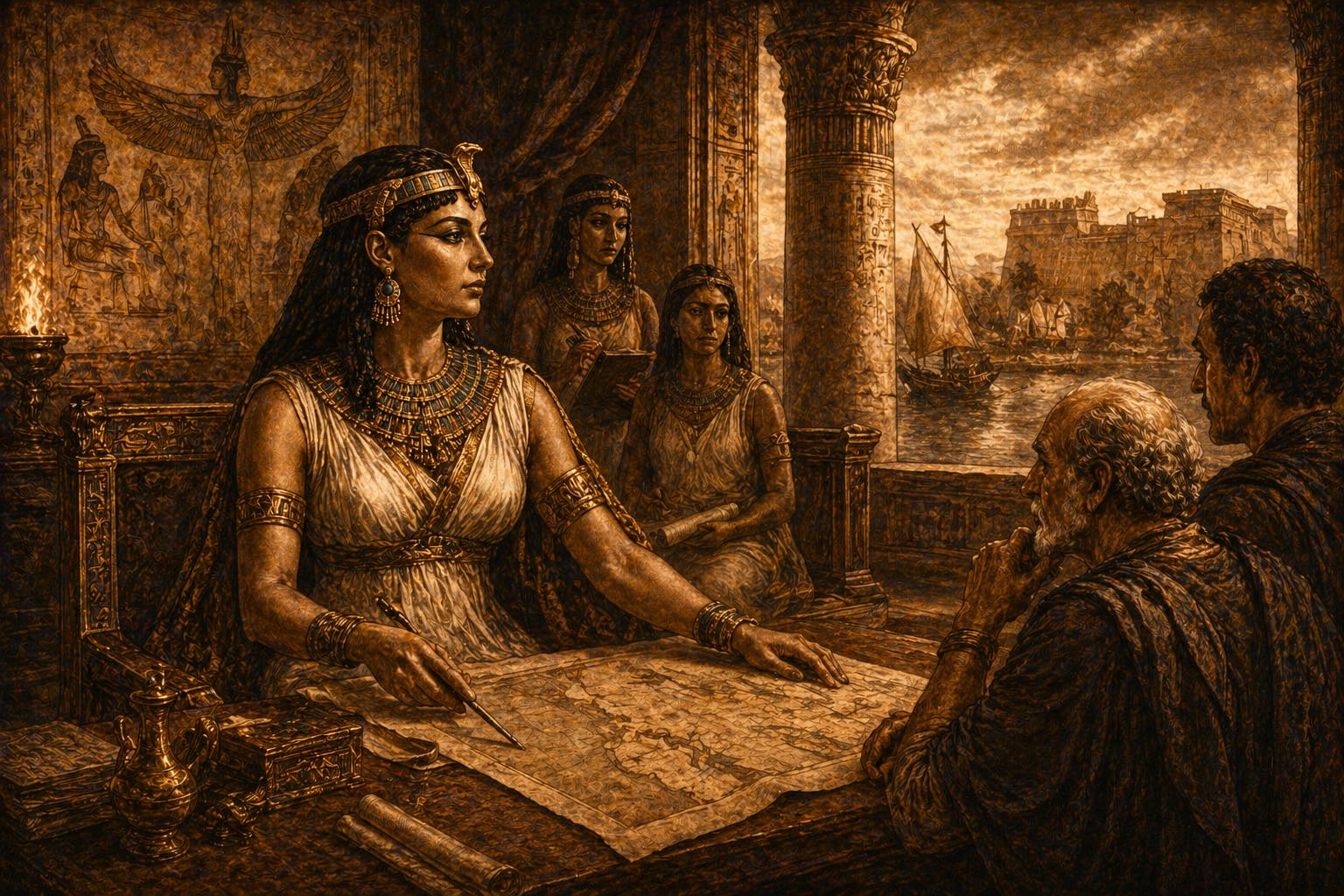
From the outset, her rule demanded more than charm. It required calculation, intelligence, and the ability to navigate a world dominated by Roman power.
She was not simply a participant in history. She was an active player.
Intelligence over image
Cleopatra was highly educated. She spoke multiple languages, a rarity among rulers of her time, and was known for her engagement with philosophy, science, and governance.
This was not incidental. It was central to how she ruled.
Communication mattered in a diverse kingdom. Understanding different cultures, traditions, and political systems gave her an advantage. It allowed her to operate across boundaries that others could not easily cross.
Yet this intellectual capacity rarely forms the core of her popular image.
It is easier, and more dramatic, to focus on the idea of seduction than on the reality of strategy.
Alliances, not affairs
Her relationships with Caesar and Antony are often presented as romantic entanglements that defined her reign.
They were, in fact, political alliances.
Rome was the dominant force in the Mediterranean world. Securing its support, or at least its tolerance, was essential for any ruler in the region. Cleopatra’s interactions with its leading figures were part of that necessity.
Her connection with Caesar helped her secure her position in Egypt. Her alliance with Antony strengthened her standing and expanded her influence.
These were calculated decisions made in a context where failure could mean exile or death.
To reduce them to personal relationships is to ignore the stakes involved.
The power of propaganda
The image of Cleopatra as a seductress owes much to those who defeated her.
After her death, Octavian, later Augustus, had every reason to shape the narrative. Presenting Cleopatra as a dangerous, manipulative foreign queen served to justify his victory and reinforce his authority in Rome.
She became a symbol of excess, temptation, and moral decay. Antony’s alliance with her was framed as weakness, a loss of Roman virtue under her influence.
This version of Cleopatra was effective. It simplified a complex political rivalry into a moral tale.
And it endured.
Later writers, artists, and filmmakers built upon this foundation, amplifying the drama and reinforcing the stereotype. Over time, the political leader was overshadowed by the legend.
Power and perception
Cleopatra’s story reflects a broader pattern.
Powerful women in history are often remembered differently from their male counterparts. Their achievements are reframed. Their authority is questioned. Their motivations are reduced to personality or relationships.
A male ruler forming alliances through marriage or negotiation is seen as strategic. A female ruler doing the same may be portrayed as manipulative or seductive.
These narratives say as much about those telling the story as they do about the figures themselves.
Ending where we began
If a modern leader were judged primarily by who they formed alliances with, rather than how they governed, we would recognise the imbalance.
Cleopatra deserves the same consideration.
She ruled in one of the most volatile periods of the ancient world. She maintained her position against significant internal and external threats. She engaged with the most powerful figures of her time on her own terms.
Her story is not one of simple seduction.
It is one of intelligence, strategy, and survival.
The myth persists because it is dramatic and easy to tell.
History offers something more demanding.
A reminder that behind even the most familiar names lies a reality far more complex than the version we inherit.