

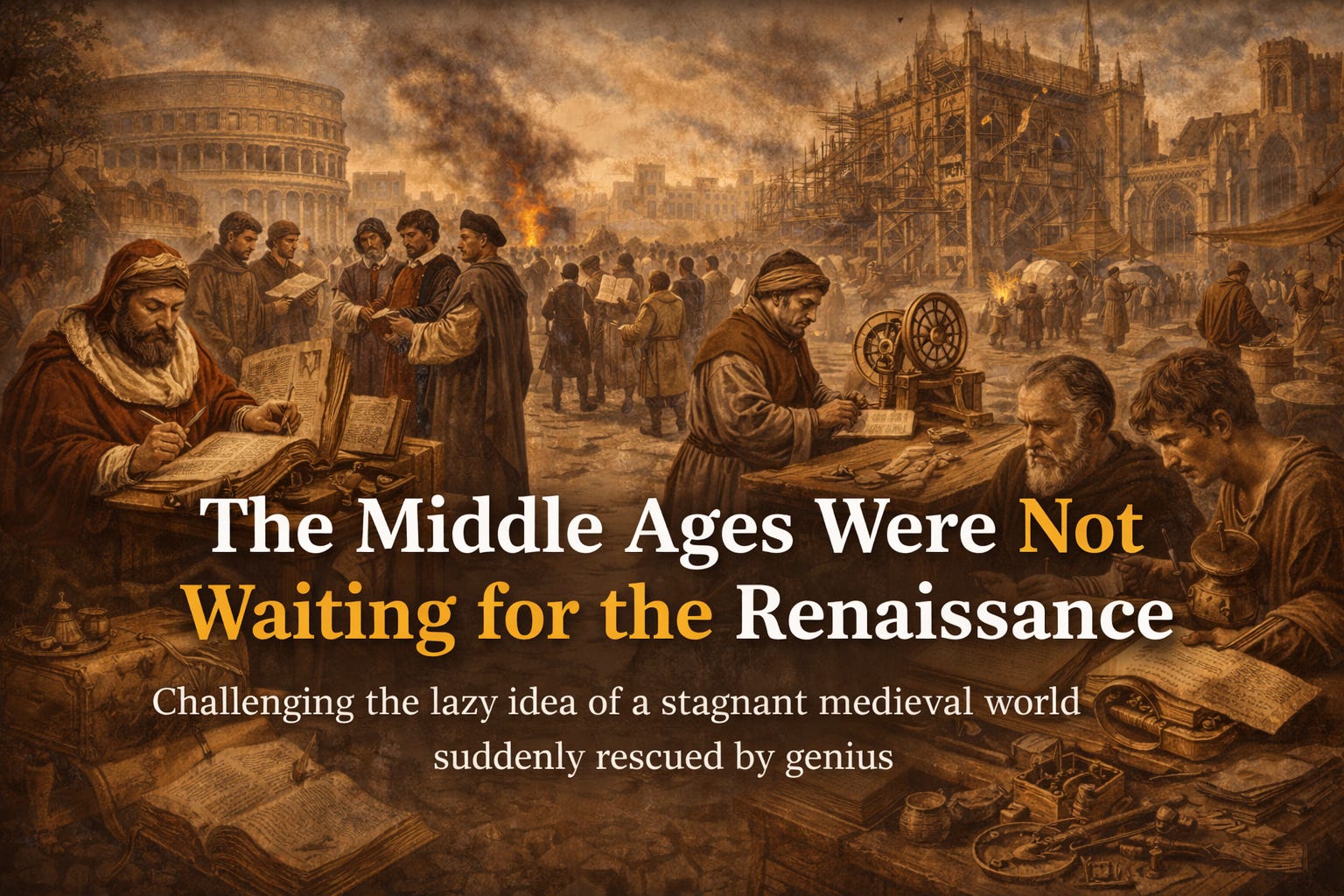
Imagine opening a group chat and finding it frozen in time. No messages. No arguments. No bad jokes. No misunderstandings. Then, suddenly, one person posts something brilliant, and the conversation springs to life. That, in essence, is how the Middle Ages are often treated. A thousand years of silence, followed by a miraculous burst of intelligence labelled the Renaissance.
It is a comforting story. It is also wrong.
The medieval world was not waiting patiently to be saved. It was noisy, inventive, argumentative, deeply curious, and frequently chaotic. Ideas moved. Knowledge travelled. People experimented, failed, revised, and tried again. The notion that Europe spent centuries in intellectual hibernation only to be jolted awake by a handful of Italian geniuses says far more about modern storytelling than medieval reality.
This blind spot has proved remarkably durable, and it continues to distort how we understand progress, creativity, and the past itself.
Medieval curiosity did not sleep
Medieval Europe was obsessed with understanding the world. It asked big questions about nature, faith, motion, medicine, time, and meaning. Scholars argued over Aristotle, not as passive recipients but as active critics. They debated how the body worked, how light behaved, how memory functioned, and whether reason and belief could coexist.
Universities emerged across the continent, not as finishing schools for obedience but as arenas of dispute. Lectures were public. Arguments were formalised. Disagreement was expected. Knowledge advanced through conflict as much as consensus.
Monasteries copied texts, yes, but they also commented on them, corrected them, and sometimes contradicted them. Manuscripts were not static artefacts. They were working documents, full of marginal notes, corrections, and questions.
The medieval mind was not incurious. It was relentless.
Innovation without fanfare
The Middle Ages quietly reshaped daily life. Mechanical clocks altered how time was experienced. Heavy ploughs transformed agriculture. Watermills and windmills multiplied energy far beyond human muscle. Eyeglasses extended working lives. Paper replaced parchment. Banking systems expanded. Accounting evolved.
These developments lacked the drama of a single moment of revelation, which is precisely why they are overlooked. Gradual change rarely makes for heroic narrative.
Architecture tells the same story. Gothic cathedrals were not accidents of faith but triumphs of engineering. Builders experimented with load distribution, materials, and geometry. They learned from failure. Collapses were studied, not hidden.
Innovation was continuous, practical, and cumulative.
Knowledge travelled farther than we admit
Medieval Europe was never sealed off from the wider world. Trade routes connected it to Africa, the Middle East, and Asia. Ideas travelled alongside goods. Mathematics, astronomy, medicine, and philosophy crossed linguistic and religious boundaries.
Translation movements flourished. Texts were rendered into Latin from Arabic and Greek. Scholars grappled with unfamiliar concepts and adapted them to local frameworks. Meaning shifted. New syntheses emerged.
This circulation of knowledge did not pause until the fifteenth century. It was already in motion long before the Renaissance received its name.
The myth of sudden rediscovery depends on forgetting the generations who preserved, debated, and developed what later figures inherited.
Why the Renaissance gets the credit
The Renaissance benefits from branding. It has a neat name, famous faces, and surviving artefacts that flatter modern tastes. Oil paintings endure better than manuscripts. Marble statues photograph well. Personalities make good stories.
The Middle Ages suffer from the opposite. Their achievements are collective, incremental, and often anonymous. Their thinkers wrote in styles that demand patience. Their breakthroughs unfolded slowly.
Later writers reinforced this imbalance. Casting the medieval period as dark made the modern age appear brighter. Progress was defined by distance from the past rather than continuity with it.
This framing persists because it reassures us. It implies that ignorance naturally gives way to enlightenment, that history moves forward in clean leaps, and that genius appears when it is needed.
Reality is messier. Progress depends on groundwork. Genius depends on context.
What we lose by flattening the medieval world
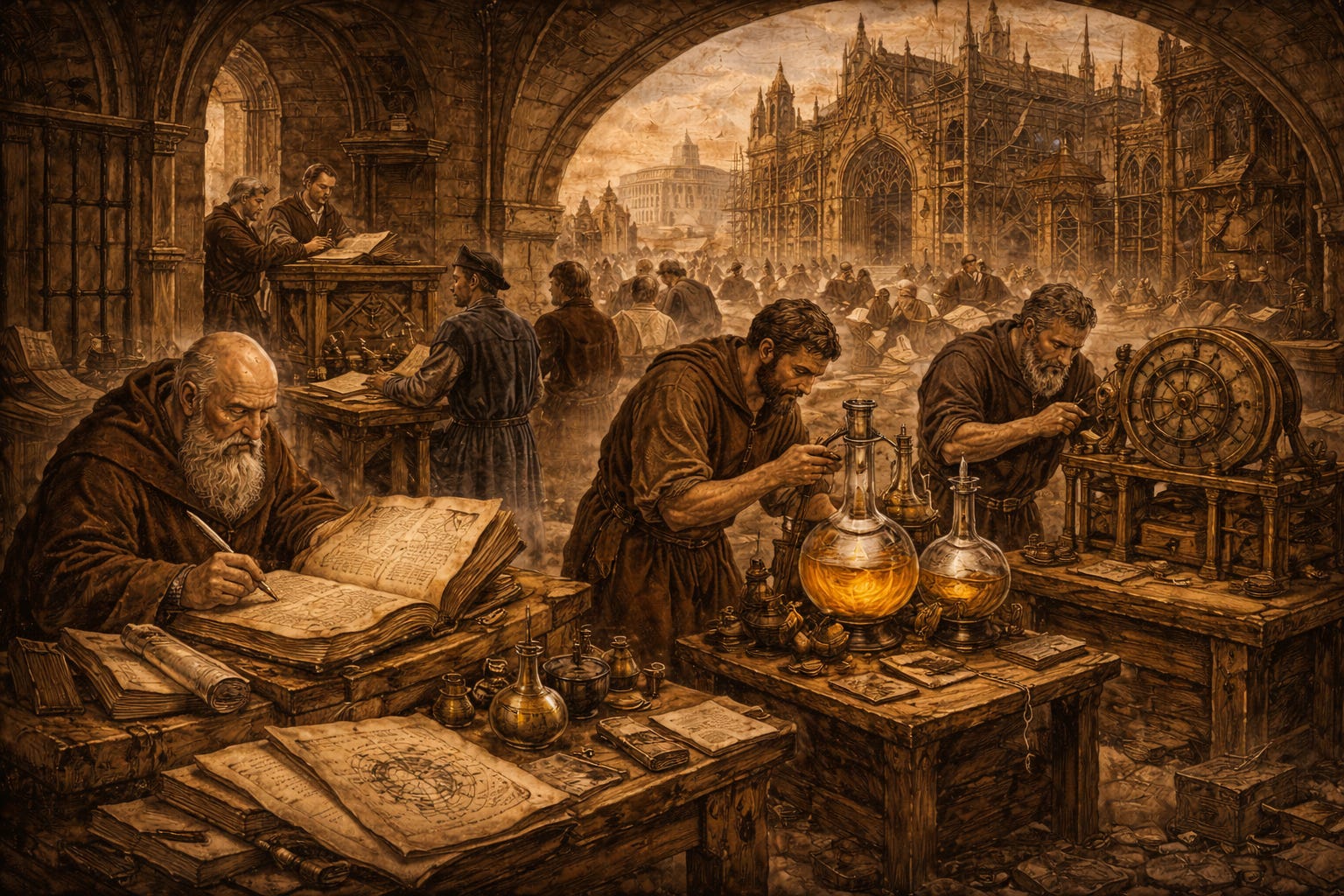
Reducing the Middle Ages to a waiting room impoverishes our understanding of how knowledge actually develops. It encourages the belief that ideas emerge fully formed rather than built through labour, error, and debate.
It also distorts how we value collective effort. Medieval innovation rarely carries a single name. It belongs to communities of builders, scholars, translators, and craftspeople. When history is told through lone heroes, these contributions vanish.
Most dangerously, the myth invites complacency. If progress feels inevitable, it appears unstoppable. The medieval world reminds us that advancement requires maintenance, argument, and care.
Intellectual life does not switch on overnight. It is sustained, or it fades.
A better way to see it
The Middle Ages were not a pause between acts. They were an act in themselves, full of motion and momentum. The Renaissance did not rescue Europe from stagnation. It inherited a world already rich with ideas, tools, and questions.
Seeing this continuity does not diminish later achievements. It places them where they belong, within a long, uneven human effort to understand and improve the world.
History becomes more honest when we stop looking for miracles and start recognising momentum.
To return to that group chat, the Middle Ages were never silent. The messages were flowing all along. Some were thoughtful. Some were wrong. Some were brilliant. The Renaissance simply arrived late, scrolled back, and replied.