

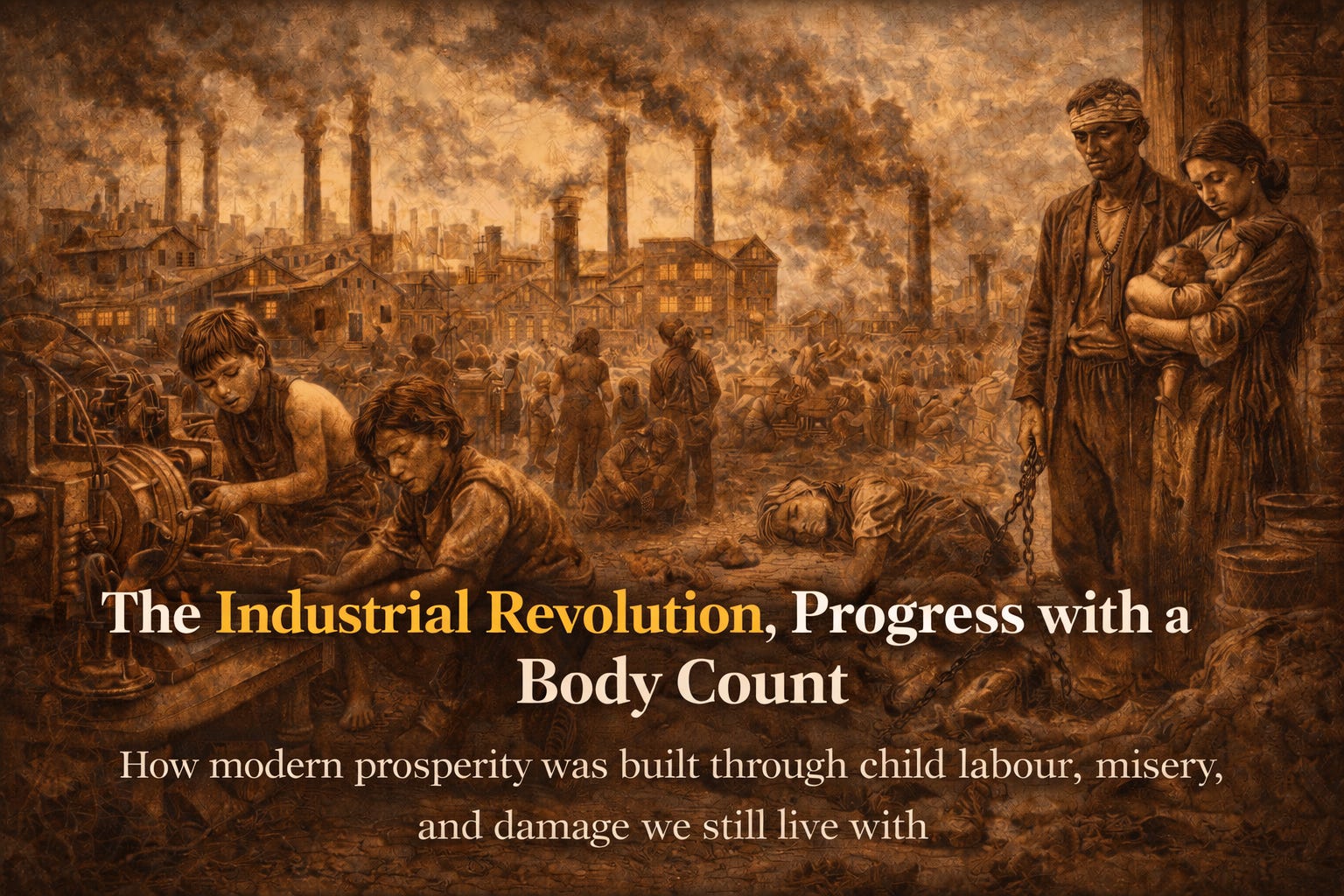
Scroll through a tech company’s annual report and you will find the same familiar words. Innovation. Growth. Disruption. Efficiency. Somewhere near the back, in smaller print, there will be a paragraph about sustainability, wellbeing, and responsibility. The Industrial Revolution wrote the first draft of that script. What it offered the world was progress, loudly proclaimed, while quietly passing the costs to those least able to refuse.
We are still living inside that bargain.
Factories before people
The Industrial Revolution is often introduced as a marvel of ingenuity. Steam engines, mechanised looms, iron bridges, railways stretching across landscapes like veins. It transformed production and reshaped society. What tends to slip from view is the human arithmetic that made it work.
Factories did not rise because machines were clever. They rose because labour was cheap, disciplined, and disposable. Men, women, and children worked brutal hours in dangerous conditions because there were few alternatives. Wages were driven down by desperation. Safety was an afterthought. Injury and death were treated as unfortunate but acceptable.
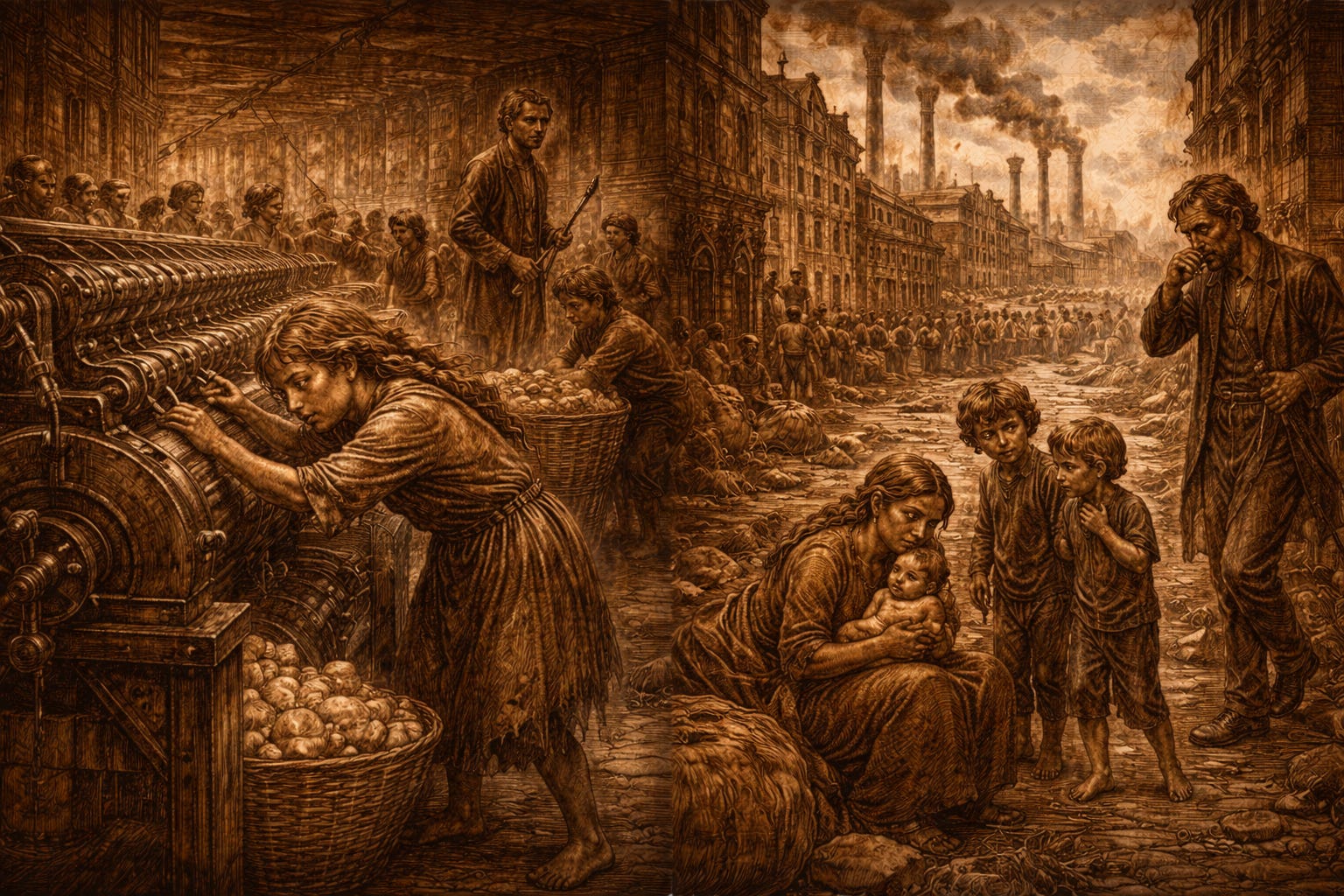
Child labour was not an aberration. It was a cornerstone. Small bodies fit neatly between machines. Nimble fingers untangled threads. Long hours were normalised before childhood had the chance to exist as a protected stage of life. This was not ignorance. It was calculation.
Cities that swallowed people
Industrialisation pulled populations into towns at astonishing speed. Cities ballooned without the infrastructure to support them. Housing was cramped, damp, and filthy. Disease thrived. Clean water was scarce. Waste piled up where people lived and worked.
Mortality rates in industrial cities often exceeded those of rural areas and even some pre modern societies. Life expectancy fell in places that were supposedly advancing. Progress arrived unevenly and violently.
Yet these conditions were rarely framed as a crisis of the system. They were treated as growing pains. Necessary sacrifices on the road to prosperity. The logic was clear. Industry would eventually lift all boats. In the meantime, some boats were allowed to sink.
Wealth built on silence
The profits of industrialisation were real. So were the fortunes they created. What mattered was who benefited and who bore the cost.
Factory owners accumulated wealth at a pace previously unknown. Investors celebrated efficiency and output. Governments were reluctant to intervene, fearing disruption to growth. When reformers raised concerns, they were accused of sentimentality or economic ignorance.
Those who suffered had little voice. Trade unions were suppressed. Protest was criminalised. Poverty was moralised. If workers struggled, it was framed as personal failure rather than structural design.
This silence was not accidental. It was enforced. Power depended on keeping the costs of progress invisible or acceptable.
Environmental damage as collateral
The Industrial Revolution also rewired humanity’s relationship with the natural world. Coal powered machines and blackened skies. Rivers became dumping grounds. Landscapes were scarred by extraction.
Pollution was understood, even then. Complaints were recorded. Health impacts were observed. What was lacking was urgency. Environmental damage was treated as an unfortunate side effect rather than a central consequence.
The idea that nature existed to be exploited took firm root. Resources were there to be consumed. Waste could be displaced elsewhere. Future consequences were someone else’s problem.
This mindset did not disappear. It scaled up.
Reform without reckoning
Over time, conditions did improve. Laws were passed. Child labour was restricted. Working hours shortened. Sanitation improved. These reforms are often presented as proof that the system corrected itself.
That is only half the story. Change came through pressure, resistance, and struggle. It was fought for, not gifted. Even then, reforms addressed the worst excesses without dismantling the underlying logic.
The core assumption remained intact. Growth mattered more than wellbeing. Efficiency trumped dignity. Those who suffered were expected to endure for the greater good.
This legacy still shapes how societies respond to inequality today.
Why the myth persists
We continue to tell the Industrial Revolution as a heroic turning point because it flatters the present. Modern comforts trace their lineage back to those factories and furnaces. Questioning the cost feels like questioning our right to enjoy the benefits.
There is also comfort in distance. The suffering belongs to another century. Another set of people. Another world. Except the patterns remain familiar.
When supply chains rely on exploited labour abroad. When environmental damage is outsourced. When economic success is celebrated without examining who paid for it. We are repeating an old story with new tools.
Ending where we began
Think again of that glossy annual report. The promises of innovation sit alongside carefully worded acknowledgements of harm. The language has softened. The structure remains.
The Industrial Revolution was transformative. It reshaped the world. But progress built on suffering leaves a long shadow. Understanding that history is not about guilt. It is about honesty.
If we want a future that does not keep repeating the same bargain, we need to stop treating human cost as an acceptable footnote to advancement. Progress without memory has always come with a body count.