

It was December 2003, and Washington, D.C., was as congested as ever. The streets were gridlocked with commuters racing to escape an incoming snowstorm. Sam cut his meeting short to beat the chaos, but progress was agonisingly slow. Horns blared, and tempers flared as drivers navigated the icy streets. Yet, as Sam turned onto Independence Avenue, his frustration gave way to shock. There, looming against the cityscape, was a spectacle he couldn’t fathom, a towering silver rocket, secured to a flatbed truck, inching forward under a police escort. Its polished surface reflected the red and blue lights of patrol cars, casting an otherworldly glow on the crowd.
“What is that thing?” a passerby whispered to another, their breath visible in the frigid air.
“It says ‘SpaceX’ on the side,” the other replied, squinting at the unfamiliar logo painted on the rocket. “Falcon 1? Never heard of it.”
The rocket was more than just a prop. It was Elon Musk’s way of announcing his arrival to the world of space exploration. Positioned outside the National Air and Space Museum, where a gala was underway to celebrate a century of flight, the 70-foot behemoth stood as a bold challenge to the aerospace elite inside. Musk, the man behind this audacious display, was determined to shatter the status quo.
When he finally stepped up to the impromptu podium, dressed sharply but looking unassuming, he introduced himself to the puzzled onlookers. “My name is Elon Musk,” he began, his voice steady but charged with conviction. “I made my fortune with internet ventures, but I’ve realised my true calling is to make humanity a multi-planetary species. Space should not belong to a select few; it must be accessible to everyone.”
For many in attendance, Musk’s words sounded like the fanciful ambitions of yet another eccentric millionaire. Those familiar with the industry dismissed him outright. “Every so often, someone shows up thinking they can beat NASA and the giants like Boeing or Lockheed,” muttered one aerospace executive. “They always leave bruised, broken, or both.”
But Musk was different. While scepticism hung thick in the air, his quiet determination revealed a deeper resolve. He planned to force the doors open if the insiders wouldn’t let him in. To him, the gala’s indifference wasn’t a setback; it was fuel.
In business, innovation often begins with an outsider challenging the establishment. Whether it’s a single disruptive idea or the sheer will to question norms, history favours those bold enough to push boundaries. This unrelenting drive would become Musk’s defining trait, a force that would shape SpaceX and transform the entire space industry.
The backdrop of this new space race was strikingly different from its Cold War predecessor. In the 1960s, governments vied for dominance among the stars. By the early 2000s, however, the mantle of exploration had shifted. Private companies, backed by tech visionaries and fueled by unimaginable wealth, were now the vanguard of innovation.
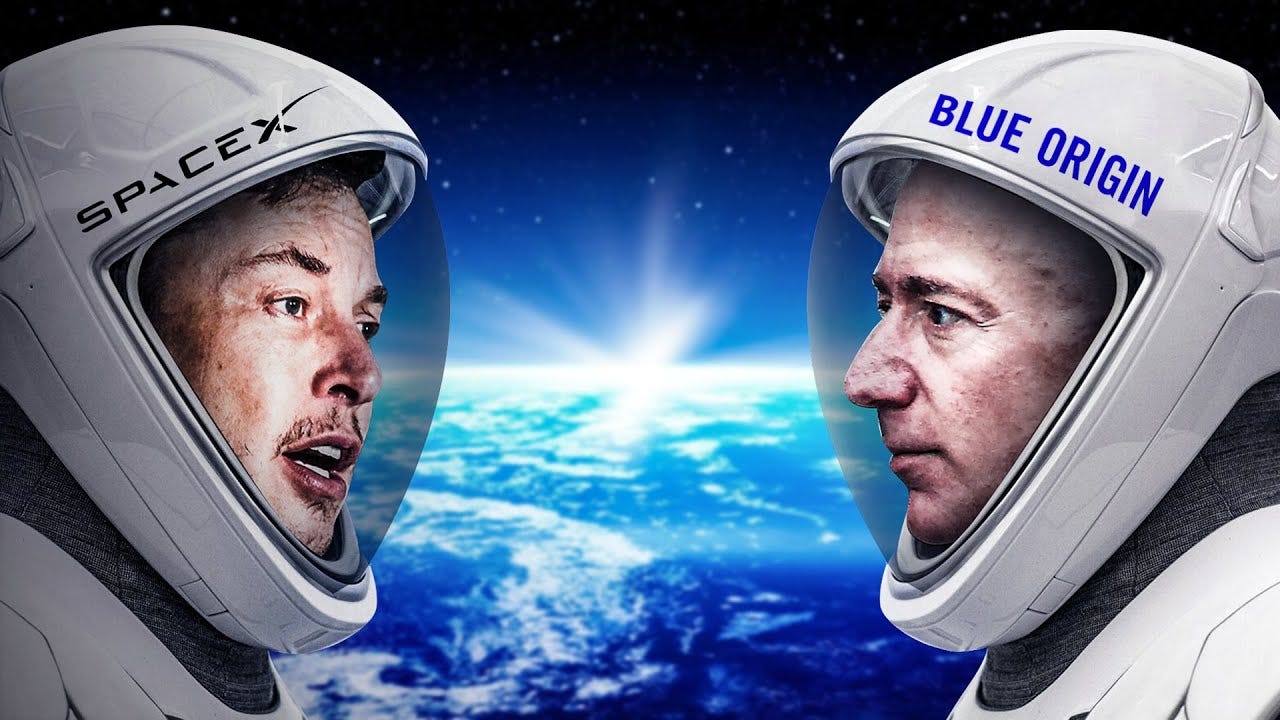
Musk wasn’t alone in his quest. Across the globe, a quiet revolution was brewing. Fellow billionaires, each with their grandiose visions of humanity’s future in space, were laying their stakes. Among them was Jeff Bezos, the Amazon founder, who quietly launched his aerospace company, Blue Origin, in 2000. While Musk relied on bombast and public displays, Bezos operated in the shadows, methodically acquiring land and designing prototypes in secrecy.
Bezos’s cautious approach contrasted sharply with Musk’s high-profile announcements, but both men were driven by the same belief: humanity’s survival depended on breaking free from Earth’s fragile confines. Bezos envisioned a future where millions lived and worked in space, while Musk saw Mars as the ultimate insurance policy, a backup plan for civilisation in the event of catastrophe.
The rivalry between these titans would soon take centre stage, fueled by their shared ambitions and strikingly different approaches to achieving them. Musk thrived on chaos, relishing challenges that others deemed impossible. On the other hand, Bezos excelled at creating order, leveraging his analytical mindset to dismantle obstacles systematically.
Yet, despite their differences, their missions shared one undeniable truth: neither was content with the status quo. Both sought to redefine what was possible, not just for themselves but for humanity as a whole. Together, they were rewriting the narrative of space exploration, transforming it from a government monopoly into a competitive frontier brimming with opportunity.
As the gala ended and the snow began to fall, Musk’s Falcon 1 was quietly disassembled and returned to its warehouse. The crowd dispersed, and the event was largely forgotten by those who attended. However, for Musk, it began a journey to redefine the aerospace industry. What his critics saw as hubris, he viewed as a necessity. In his mind, the stakes couldn’t be higher. Earth was just the beginning.
Pioneering the Beyond
It was the year 2000, and in a waterfront office in Seattle, Burt Rutan set his split pea soup aside, eager to present his latest, boldest concept. Known for his boundary-pushing designs, the mutton-chopped engineer from the Mojave Desert had flown north to pitch an idea to one of the world’s wealthiest individuals, Paul Allen, Microsoft’s enigmatic co-founder turned tech investor.
“Paul,” Rutan began, leaning forward, “remember when you mentioned how incredible it would be to see a spacecraft that could land like a plane? I’ve figured out how to make it work.”
Allen dabbed at his mouth with a napkin, his curiosity piqued. “You have my attention,” he replied, setting his spoon down.
“The problem with spacecraft,” Rutan explained, “is re-entry. Too steep, and they burn up; too shallow, and they skip off the atmosphere. But what if we designed a rocket plane with wings that fold upward during descent? The drag would stabilise the angle, like feathers on a badminton shuttlecock.”
The analogy clicked instantly for Allen, who had spent summers playing badminton as a child. “And after re-entry?” he asked.
“The wings return to normal, and it lands on a runway,” Rutan said. “Simple, efficient, and safe.”
Allen’s smile broadened. The idea was as wild as it was ambitious, in line with his passion for exploration. Rutan requested $20 million to make it a reality, citing the dream of spaceflight and a chance to claim the $10 million X Prize, awarded to the first private team to launch a reusable crewed spacecraft. For Allen, the numbers mattered less than the opportunity to make history.
“Let’s do it,” he said, extending his hand.
Though the deal was struck, neither man could have anticipated the rocky path ahead. Building a spaceship would prove to be far more than just an engineering challenge; it would test their patience, resolve, and risk appetite.
Three years later, in the sweltering heat of California’s Mojave Desert, the fruits of their labour stood poised for flight. The aircraft-like “White Knight,” a carrier vehicle designed to lift its passenger, SpaceShipOne, into the stratosphere, taxied across the runway. The craft ascended into a cloudless sky with Allen watching from the control room.
Inside SpaceShipOne, the pilot braced as it detached from White Knight. A few moments later, the onboard rocket engine roared, hurling the craft skyward at breakneck speed. The pilot felt the acceleration slam him into his seat as the vehicle passed through the sound barrier and into the realm of the unimaginable.
Breaking through the atmosphere, SpaceShipOne offered it’s pilot an awe-inspiring view: the vast blackness of space juxtaposed against the curvature of Earth, bathed in a soft blue haze. “Unbelievable,” he radioed. “You can’t imagine this until you see it.”
On the ground, Allen and Rutan erupted into cheers. Their audacious gamble had paid off; their vehicle was operational and on the verge of achieving what no private spacecraft had before.
While Allen and Rutan basked in their success, a very different conversation unfolded elsewhere. Elon Musk and Jeff Bezos sat face-to-face at a five-star restaurant in San Francisco, exchanging their philosophies about humanity’s future in space.
“We’re using chemical propulsion,” Bezos began, sharing details about his nascent company, Blue Origin. “We’ve explored other ideas, but rocket fuel remains the most practical.”
Musk’s eyes narrowed. “What do you mean, other ideas?”
Bezos chuckled lightly. “We considered alternatives like slingshot devices or electromagnetic accelerators for a time. The science was interesting, but ultimately, ”
“Interesting?” Musk interrupted. “Jeff, the future of civilisation isn’t a thought experiment. It’s a matter of survival.”
For Musk, the conversation wasn’t academic. He envisioned Mars as the next frontier and humanity’s backup plan in the face of existential threats. Bezos, however, had a different priority.
“I’m focused on Earth,” Bezos said, leaning back. “If we don’t find a way to offload heavy industry into space, we’ll choke this planet dry.”
The two men left the table cordial but unconvinced by the other’s vision. Their competing ambitions marked the start of a rivalry that would shape the next era of space exploration.
Back in Mojave, Rutan and Allen faced their crossroads. Although SpaceShipOne had flown successfully, the risks weighed heavily on Allen’s mind. Watching the pilot’s wife clutch his arm before launch, Allen had been struck by the profound danger of their endeavour. Software crashes, he mused, rarely endangered lives. Space crashes, however, were another matter.
Enter Richard Branson, the charismatic founder of the Virgin Group. Upon discovering SpaceShipOne, Branson quickly saw its potential for commercial space tourism. “Paul,” he said during a visit, “you’ve built the future. Don’t let it gather dust in a museum.”
Allen hesitated his caution at odds with Branson’s boundless enthusiasm. But in the end, a deal was struck: Branson would license the technology, and Virgin Galactic would turn it into a business. It allowed Allen to step back gracefully, knowing the vision would live on.
By 2004, SpaceShipOne had claimed the X Prize, Blue Origin had launched its first test vehicle, and Musk’s SpaceX had burned through millions without a successful launch. Each of these pioneers faced unique challenges, yet their combined efforts transformed the dream of space travel into a burgeoning industry.
For the first time, the stars seemed closer than ever.
Against the Flames
It was May 2005, and Gwynne Shotwell strode purposefully through SpaceX’s open-plan headquarters in El Segundo, California. In her hands was a rolled-up world map. Elon Musk had just tasked her with solving a critical problem: finding a launch site for their Falcon 1 rocket.
SpaceX had hit a wall. Their initial plan to launch from California’s Vandenberg Air Force Base was mired in delays. Boeing and Lockheed Martin, the aerospace titans who ruled the Pentagon’s satellite launches, ensured that. In their eyes, SpaceX was an unwelcome intruder, a scrappy startup led by a tech entrepreneur who they dismissed as more dreamer than engineer.
Shotwell approached a cluster of engineers surrounding a hulking machine to weld rocket fuel tanks. “Hans,” she called out to Hans Koenigsmann, their stoic German launch engineer, “I need you in the conference room. Now.”
“What’s going on?” he asked, stepping beside her.
“Vandenberg’s putting us off again. Months this time. We need a new option, fast.”
Shotwell pinned the map to the wall inside the conference room and gestured at the Pacific Ocean. “We need somewhere remote, ideally near the equator. What about Hawaii?”
Koenigsmann shook his head. “The bases there aren’t equipped for launches.”
Shotwell’s eyes roamed the map until they settled on a minuscule speck of land. “What about here, the Marshall Islands? Specifically, Kwajalein Atoll.”
“Kwajalein? That’s where they tested nukes, isn’t it?”
“Exactly. It’s isolated, has the military-grade infrastructure, and they’ve even used it for missile defence tests. It’s perfect.”
Within weeks, SpaceX was packing up its rockets and equipment for what seemed like a tropical getaway. The reality, however, was anything but idyllic.
By the summer of 2005, SpaceX’s engineers lived on Kwajalein, contending with blistering heat, oversized cockroaches, and logistical nightmares. Supplies took weeks to arrive, so the team resorted to ingenuity when building the launchpad on the nearby island of Omelek. Using planks and logs, they rolled the Falcon 1 into place like ancient Egyptians moving stones for the pyramids.
Finally, on November 26, 2005, everything was ready. The Falcon 1 stood poised on the launchpad, gleaming white against the tropical backdrop. Inside a cramped trailer serving as their control room, the team worked through pre-launch checklists. Fuel? Ready. Helium? Confirmed. Liquid oxygen? Silence.
Koenigsmann frowned as he examined the readings. “We’re losing liquid oxygen. It’s venting out.”
Attempts to remotely fix the problem failed. The engineers’ window for launch was rapidly closing, but Koenigsmann made a snap decision. A technician was dispatched to Omelek, a risky manoeuvre involving a choppy boat ride and precious minutes ticking away. Once on the island, the technician radioed back grimly, “We can fix the vent, but we’ve lost too much oxygen to complete the launch.”
Koenigsmann called it off. “Abort mission. Get the rocket into storage before the sea air corrodes it.”
It was the first of several disappointments. Over the coming months, power issues and other setbacks plagued SpaceX’s efforts. For Elon Musk, the delays were excruciating. The Falcon 1 was supposed to be his statement to the world, his proof that SpaceX could deliver on its promise of low-cost, reliable spaceflight. Instead, the rocket remained grounded, while Richard Branson of Virgin Galactic was seizing headlines with flashy promotional videos for suborbital space tourism.
Finally, in March 2006, SpaceX prepared for another launch attempt. This time, everything aligned. In the control room, Musk leaned forward, eyes glued to the monitors as the countdown began. “Three… two… one…”
The Falcon 1 roared to life, flames billowing from its engines as it lifted off the pad. Cheers erupted as the rocket climbed higher and higher, leaving the palm trees and turquoise waters far below.
Then, the onboard camera feed began to wobble. Musk’s jaw tightened as the image spun wildly, the horizon twisting out of view. Moments later, the feed cut to static. The rocket had spiralled out of control and crashed into the ocean.
The control room fell silent. Musk turned to his team, his voice tight but resolute. “We’ll figure out what went wrong. We’ll do better.”
But the reality was grim. Each failure drained precious funds from SpaceX’s already limited resources. Once flush with his fortune from PayPal, Musk was now borrowing money to keep the company afloat.
The months that followed brought even more significant challenges. Blue Origin, led by Jeff Bezos, began aggressively poaching SpaceX’s top engineers, offering them salaries Musk couldn’t hope to match. The Falcon 1’s subsequent two launches also failed, the rockets falling short of orbit each time. The losses devastated the engineers who had poured their lives into the project.
By August 2008, SpaceX was on the brink. If there is one more failure, the company will be finished. Musk gathered his team and made his case. “This is it. Everything we’ve worked for comes down to this. I believe in this team. I believe in us.”
The Falcon 1’s fourth flight launched on September 28, 2008. This time, the rocket soared flawlessly into orbit, a first for a privately developed liquid-fueled spacecraft. In the control room, the exhausted team erupted into jubilant celebration, tears streaming down their faces.
Musk stood amidst the chaos, visibly emotional but composed. “This is just the beginning,” he said. And for SpaceX, it indeed was.
Forged in Orbit
It was August 2008, and aboard a military cargo plane high over the Pacific, the Falcon 1 rocket, SpaceX’s ambitious, privately developed spacecraft, was under siege. Wrapped tightly in protective plastic to shield it during transit, the missile was experiencing an unexpected crisis. The cabin’s air pressure, rising as the plane descended toward Hawaii, was crushing the Falcon 1 like a juice box under a heavy hand. The airtight wrapper meant to safeguard the rocket was now its undoing.
“Elon’s not going to like this,” muttered avionics engineer Bulent Altan as he sprinted to the cockpit. “Climb! Gain altitude now!” he barked at the pilot, who pulled the plane back into thinner air. The crushing sounds subsided, but Altan knew they were far from safe. “We’ve got thirty minutes of fuel left,” the pilot warned.
Armed with pocket knives, Altan and his team rushed to the hold. They hacked at the plastic wrap, slicing open the casing to equalise the air pressure. When the plane landed, the Falcon 1 was battered but intact. The team stared at its crumpled body in dismay. One engineer muttered, “This thing looks worse than it did when we started.”
Yet failure was not an option. For Elon Musk, this wasn’t just about the Falcon 1. SpaceX and his electric car company, Tesla, were on the brink of collapse. If this rocket didn’t reach orbit, everything he had built would implode.
Weeks later, on September 28, 2008, the repaired Falcon 1 stood tall on its launchpad at the Kwajalein Atoll, a remote speck of land in the Pacific. This was SpaceX’s fourth attempt to reach orbit, and it would be their last chance. Inside the California headquarters, employees gathered nervously around screens, their eyes fixed on the live feed.
The countdown began. “Five, four, three, two, one…”
The rocket’s engines ignited, and a fireball roared beneath it as the Falcon 1 lifted off. The team in California erupted in cheers as the rocket ascended, leaving a blazing trail in its wake.
The first stage booster detached cleanly, tumbling back to Earth as the second stage engine ignited. The Falcon 1 soared higher, the curvature of the Earth visible against the vast blackness of space. At nine minutes and thirty seconds into the flight, it happened: the Falcon 1 reached orbit.
The control room exploded in celebration. Musk, visibly emotional, turned to his team. “We did it,” he said, his voice barely audible over the cheers. SpaceX had made history, becoming the first private company to send a liquid-fueled rocket into orbit. It was a victory that silenced sceptics and forever changed the company’s trajectory.
The success of the Falcon 1 opened floodgates. SpaceX secured a $1.6 billion contract with NASA to ferry cargo to the International Space Station. But Musk wasn’t content to stop there. He knew the future lay in scaling up. Customers were clamouring for heavier payloads, and the Falcon 1 simply wasn’t big enough.
In July 2009, SpaceX retired the Falcon 1, pivoting its focus entirely to the Falcon 9, a more powerful rocket designed to carry larger satellites, and eventually people, into space.
By April 2010, Musk’s vision had intersected with another force of change: the Obama administration. President Obama scrapped NASA’s Constellation program, a costly and over-budget initiative to replace the ageing space shuttles. Instead, he called for private companies to take on the task of low-Earth orbit missions, freeing NASA to focus on more ambitious goals like Mars.
The decision was politically divisive. Critics accused Obama of abandoning America’s dominance in space. To counter this, the White House visited SpaceX’s Florida launchpad, where the Falcon 9 was being prepared for its maiden flight.
Dressed in a sharp pinstripe suit, Musk guided the President around the towering rocket. “How tall is it?” Obama asked, craning his neck.
“Twenty stories,” Musk replied, beaming with pride. “It’s powered by nine engines, hence the name. Even if one fails, the others can still get the payload to orbit.”
“And that’s the Dragon?” Obama pointed to the capsule being developed to carry cargo, and eventually astronauts, to the International Space Station.
“Yes,” Musk said. “The Falcon 9 carries the Dragon to orbit, where it docks with the station. This is the future.”
Obama nodded, impressed. “A lot’s riding on this,” he said.
“It’ll deliver,” Musk replied confidently.
And it did. On June 4, 2010, the Falcon 9 launched successfully, reaching orbit on its first attempt. SpaceX had once again defied the odds, proving that private companies could match, and even surpass, the capabilities of traditional aerospace giants.
The launch was a watershed moment for SpaceX, but the company’s ambitions extended further. In May 2012, the Dragon capsule completed its first mission to the International Space Station, delivering supplies and marking a new era of commercial spaceflight. Convinced of SpaceX’s capabilities, NASA committed an additional $440 million to develop a crewed version of the Dragon.
SpaceX’s achievements transformed the private space race, but Musk’s competition remained. Shrouded in secrecy, Jeff Bezos’s Blue Origin quietly developed its own technologies. Virgin Galactic was making strides in space tourism. And the world’s gaze remained fixed on the stars, where the next great leap awaited.
The battle for the heavens was just beginning for Musk, Bezos, and their rivals.
Orbital Rivalries
In July 2013, Elon Musk sat in his Hawthorne office, gripping the phone tightly as a NASA official outlined the unexpected twist. The agency had just informed him that there was a new competitor for Launchpad 39A, a historic piece of real estate at Florida’s Kennedy Space Center. Musk’s immediate assumption was that the rival bidder would be a minor player, perhaps a smaller aerospace firm trying to make its mark. He was wrong.
“It’s Blue Origin,” the official revealed. “They’ve partnered with the United Launch Alliance.”
Musk’s face darkened. “Blue Origin? They’ve barely launched anything. And now they’re teaming up with the Alliance?”
The United Launch Alliance (ULA), a juggernaut formed by aerospace behemoths Boeing and Lockheed Martin, had monopolised U.S. government rocket launches for years. Their involvement meant the fight for 39A wasn’t just about a launchpad, it was a declaration of war.
Musk hung up and sat back, his mind racing. Blue Origin and ULA were formidable opponents. But Musk had no intention of backing down. His strategy would be clear: cast SpaceX as the bold, efficient pioneer safeguarding America’s space future. And, if necessary, call out Blue Origin for what he viewed as an opportunistic move.
In September, NASA was preparing to award the 39A lease to SpaceX when Blue Origin threw a wrench into the plan, filing a complaint with the Government Accountability Office. Their argument was simple: NASA shouldn’t hand exclusive control of such a historic site to one company. Blue Origin proposed a “shared use” model where multiple players could operate from 39A.
For Musk, this was pure obstruction. SpaceX needed sole access to accommodate its ambitious launch schedule, including developing its Falcon Heavy rocket. Sharing the pad would be a logistical nightmare. To make his case, Musk turned to the media.
“Blue Origin’s proposal is nothing more than a stalling tactic,” Musk declared to Space News. “They haven’t even launched a reliable suborbital vehicle after more than a decade of development. We’ll accommodate if they dock something at the space station within the next five years. But frankly, we’re more likely to find unicorns dancing in the flame duct.”
His sharp words made headlines, and in December 2013, the Government Accountability Office sided with NASA. SpaceX was awarded exclusive rights to 39A. Musk’s victory over Blue Origin and ULA was critical, but the rivalry was far from over.
By 2014, geopolitical tensions between the U.S. and Russia were escalating. Russia’s annexation of Crimea and its increasing interference in global affairs raised alarms in Washington, especially at the Pentagon. America’s dependence on Russian-made RD-180 engines, used by ULA’s Atlas V rockets, suddenly seemed like a strategic vulnerability.
Sensing an opportunity, Musk went on the offensive. In March 2014, he appeared before the Senate Defense Subcommittee to argue that the Pentagon’s reliance on ULA was costly and risky.
“The Department of Defense is paying $380 million per launch,” Musk stated. “SpaceX can do it for a fraction of the cost.”
He didn’t stop there. “ULA’s rockets rely on Russian engines. How can we call that ‘assured access to space’ when it depends on Vladimir Putin’s approval?”
Musk’s testimony made waves but didn’t immediately sway the Pentagon. Weeks later, the Air Force awarded ULA another batch of contracts, bypassing SpaceX entirely. Furious, Musk instructed his legal team to sue the Department of Defense.
It was a bold move that risked alienating the institution Musk hoped to win over. But for Musk, the lawsuit wasn’t just about contracts, it was about levelling the playing field. If SpaceX could survive this battle, it would prove it belonged at the centre of America’s space strategy.
Meanwhile, ULA was scrambling to defend its reputation. Recognising the vulnerability of relying on Russian engines, the Alliance turned to an unlikely partner: Blue Origin. Together, they announced the development of the BE-4 engine, a powerful, American-made replacement for the RD-180.
At a press conference in Washington, D.C., ULA’s new CEO, Tory Bruno, sat alongside Jeff Bezos. “This partnership marks a new chapter in space exploration,” Bruno said, emphasising the BE-4’s advanced technology and the commitment to reducing costs. Bezos, beaming with pride, described the engine as “a marvel of engineering,” highlighting its use of liquid natural gas and its reusability.
For Musk, the announcement was a wake-up call. The combined forces of ULA and Blue Origin posed a significant threat. While the BE-4 wouldn’t be ready for several years, its existence fueled the rivalry.
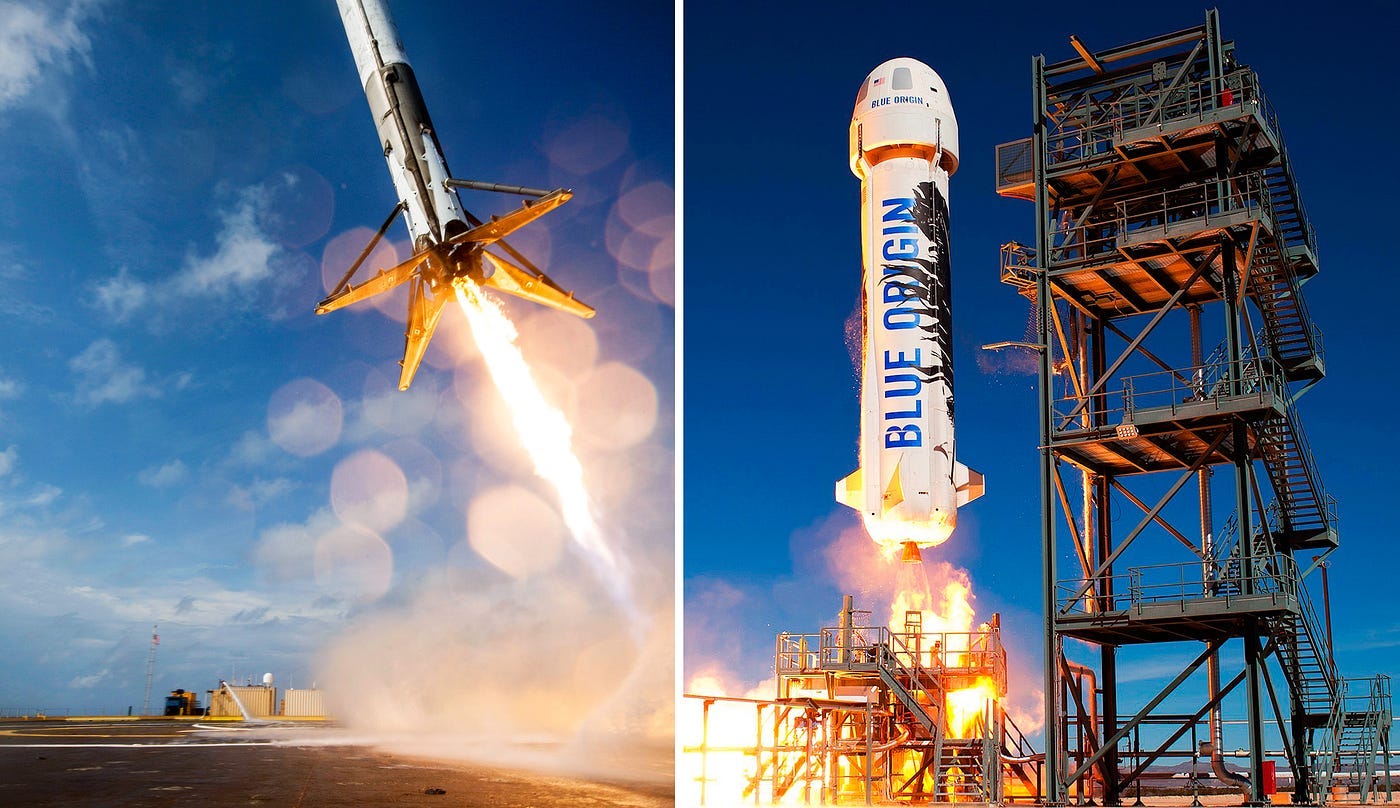
The competition between SpaceX and Blue Origin reached a fever pitch in November 2015 when Blue Origin’s New Shepard rocket achieved a historic milestone. The rocket launched into suborbital space, detached its capsule, and then returned to Earth, landing vertically, a feat no one had accomplished before.
Jeff Bezos celebrated the achievement on Twitter with his first-ever post on the platform: “The rarest of beasts, a used rocket. Controlled landing is not easy, but done right can look easy.”
Musk, ever competitive, fired back: “Congrats on the landing. But it’s worth noting that SpaceX has been landing orbital rockets, much harder to do, since last year.”
Despite Musk’s retort, the truth stung. Blue Origin had beaten SpaceX in demonstrating reusability. The pressure was now on Musk to make a decisive move and reclaim the upper hand.
For Musk and Bezos, this wasn’t just a space race but a battle for the future of humanity’s journey beyond Earth. As the rivalry intensified, the stakes only grew higher. The question was no longer if the private space race would redefine the industry but how far and fast each company could go.
Chasing Horizons
It was December 2015, and Elon Musk stood alone on a drizzling evening at the Kennedy Space Center, the reflective jacket he’d hastily thrown on barely shielding him from the cold. Across the water, the launchpad glowed faintly. The Falcon 9 rocket had just launched into orbit, and Musk’s gaze wasn’t fixed on the stars or the mission’s immediate goal. Instead, he scanned the cloudy sky, waiting for a moment that could transform the future of space travel.
A month earlier, Blue Origin had made headlines with the successful landing of its New Shepard rocket, the first reusable spacecraft to achieve such a feat. For Musk, that success stung. SpaceX had been trying to perfect rocket reusability for years, and every attempt had failed so far. Seven rockets were lost, seven fiery reminders of the problem’s complexity.
But Musk was determined. SpaceX’s vision, colonising Mars, reducing the cost of space travel, and creating a multi-planetary future, depended on reusable rockets. Without them, the dream remained just that: a dream. Tonight, he wouldn’t watch from the comfort of a control room. He wanted to be there, standing in the drizzle, as the Falcon 9’s booster made its daring attempt to land.
At 62 miles above Earth, the first stage of the Falcon 9 detached, flipping itself around to begin its descent. Onboard computers calculated real-time trajectory adjustments, using cold gas thrusters and grid fins to stabilise the booster as it hurtled back toward the ground. The sky was too overcast for Musk to see the rocket, but suddenly, a flicker of flame cut through the gloom. The booster was coming home.
Moments later, the roar of its engines filled the air, followed by a shockwave that nearly knocked Musk off balance. He steadied himself and squinted toward the launchpad. For a moment, there was silence. No fireball. No disaster. Then, over the radio, cheers erupted: “It landed!”
Musk returned to the control room, where the SpaceX team was celebrating. On the screen was the Falcon 9 booster, standing tall against the night, a modern-day obelisk marking the beginning of a new chapter in space exploration. Musk didn’t wait long to check his phone, where congratulatory tweets flooded in. Among them was a message from Jeff Bezos: “Congrats SpaceX on landing Falcon suborbital booster stage. Welcome to the club.”
Musk frowned. Suborbital? He knew what Bezos was doing, downplaying SpaceX’s achievement by highlighting that Falcon 9’s booster didn’t reach orbit. But Musk didn’t need to respond. His fans already did it for him, pointing out the massive differences between Falcon 9 and New Shepard. For Musk, this was more than a petty rivalry. The reusable rocket wasn’t just a competitive edge but a fundamental step toward a future where humanity wasn’t tethered to Earth.
By February 2018, Musk’s vision had taken another giant leap forward. On a sunny day in Cape Canaveral, SpaceX was preparing to launch the Falcon Heavy, a rocket designed to carry larger payloads into space than any vehicle since the Saturn V. The Falcon Heavy was a behemoth, three Falcon 9 boosters strapped together, each reusable, each representing a step toward affordable space exploration.
The spectacle was pure Musk. For the payload, he chose a cherry-red Tesla Roadster, complete with a mannequin in a spacesuit, “Starman”, seated behind the wheel. The car’s dashboard displayed Don’t Panic in homage to Douglas Adams’ The Hitchhiker’s Guide to the Galaxy. This wasn’t just a technical demonstration but a statement about humanity’s future.
The Falcon Heavy roared to life, its 27 engines generating over five million pounds of thrust. As it ascended, the crowd of onlookers marvelled at the coordinated dance of engineering: the two side boosters detached and returned to Earth in perfect synchronisation, landing on adjacent pads. It was a showstopper, but only some things went as planned. The central booster missed its target, crashing into the ocean.
Still, the day was a triumph. With its symbolic driver, the Tesla Roadster began its journey around the sun. The world took notice, and Musk once again solidified SpaceX’s reputation as a leader in innovation.
As SpaceX pushed the boundaries of what was possible, others raced to keep up. Jeff Bezos, ever methodical, announced Blue Origin’s plans for New Glenn, a massive orbital rocket named after astronaut John Glenn. Though shaken by tragedy, Richard Branson’s Virgin Galactic introduced the VSS Unity, promising to make space tourism a reality. Even Boeing, a stalwart of traditional aerospace, was scrambling to maintain its relevance. Their Starliner capsule aimed to carry NASA astronauts, but repeated delays and technical failures tarnished their credibility.
By May 2020, SpaceX achieved what no private company had: launching humans into orbit. With astronauts Doug Hurley and Bob Behnken aboard, the Crew Dragon capsule docked with the International Space Station and returned safely to Earth. The mission marked the first crewed flight from U.S. soil since the Space Shuttle era and cemented SpaceX’s place at the forefront of modern space exploration.
For Musk, the journey wasn’t over. He envisioned lunar bases, Martian cities, and a future where humanity could thrive beyond Earth. For Bezos and Branson, the race was far from settled. Each had their vision and their strategy. And while the rivalry sometimes seemed personal, the stakes were profoundly global. This was about survival, progress, and the next chapter of humanity’s story among the stars.
Beyond Boundaries
It was May 2020, and the Kennedy Space Center was energising. The Falcon 9 rocket’s Crew Dragon capsule perched atop stood as a sleek monument to two decades of ambition, grit, and innovation. This launch wasn’t just another step in Elon Musk’s journey to disrupt spaceflight, it was a redefinition of what private companies could achieve. For the first time in history, a commercially built spacecraft was about to carry NASA astronauts to the International Space Station.
Inside the capsule, astronauts Doug Hurley and Bob Behnken sat in minimalist seats that more closely resembled a futuristic car interior than a space module. The dashboard was a series of touchscreen displays, starkly contrasting the labyrinthine control panels of the previous spacecraft. But the sleek design belied the seriousness of the mission. Every detail of this launch was a high-stakes test of SpaceX’s capabilities.
When the countdown reached zero, the Falcon 9 roared to life, lifting off with a blaze of light and smoke. The launch was flawless, a technical symphony of engineering precision. Six hours later, the Crew Dragon successfully docked with the ISS, marking a turning point for both SpaceX and NASA.
Elon Musk, visibly emotional, addressed reporters after the mission. “This is more than just a launch,” he said. “It’s a signal that humanity is ready for the next chapter. The moon, Mars, and beyond are within our grasp.”
For SpaceX, this wasn’t just about making history. It was about demonstrating the power of private industry to achieve what had once been the exclusive domain of government agencies. And it was a declaration to competitors like Jeff Bezos’s Blue Origin: SpaceX was leading the race, and it wasn’t slowing down.
But the road to this triumph had been anything but smooth. Over the past two decades, Musk has faced every imaginable challenge, technical failures, financial crises, and fierce competition. Yet, SpaceX had outpaced even the most established aerospace giants through sheer determination. In contrast, Blue Origin remained a step behind despite its steady progress. Bezos’s New Shepard rocket had made strides in suborbital tourism, but his orbital ambitions were still years away from fruition.
By 2021, Bezos aimed to close the gap with New Glenn, a massive rocket capable of challenging SpaceX’s Falcon Heavy. Bezos’s vision extended beyond launching rockets; his plans included orbital colonies and a sprawling internet satellite network. However, the gap between vision and execution was glaring. While SpaceX sent astronauts into orbit, Bezos’s New Shepard was still confined to suborbital joyrides.
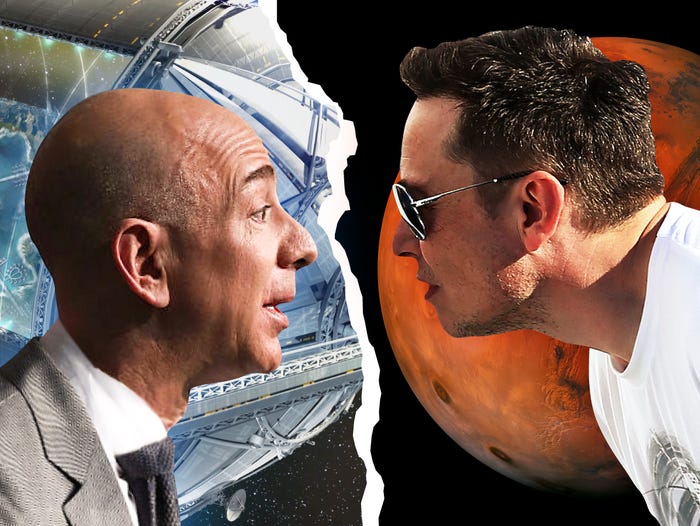
The rivalry between the two billionaires was not just a competition of engineering feats but a clash of philosophies. Musk envisioned Mars as humanity’s second home, a necessity for long-term survival. Bezos, ever pragmatic, saw the potential for vast industries in Earth’s orbit, with the moon as a stepping stone. Both men believed in the transformative power of space exploration, but their paths diverged sharply.
As 2022 approached, the space race entered its most dynamic phase. SpaceX’s Starship program promised a fully reusable spacecraft capable of ferrying people and cargo across the solar system. The sheer scale of Starship dwarfed anything else in development. Musk touted it as the key to colonising Mars, while sceptics pointed to its untested nature and the enormous challenges ahead.
Meanwhile, Bezos doubled down on Blue Origin’s methodical approach. New Glenn’s development was slow but deliberate, reflecting Bezos’s commitment to “gradatim ferociter” (step by step, ferociously). His focus on reliability and reusability echoed Musk’s early rhetoric, but Bezos’s strategy was notably more conservative. Critics argued that Blue Origin risked being left behind by SpaceX’s rapid pace of innovation.
The stakes were rising for Musk and Bezos and humanity’s broader relationship with space. As costs plummeted and access expanded, new players entered the field. Private satellite networks promised to revolutionise global communications, while ventures in space tourism and asteroid mining captured imaginations. Yet, these advancements also brought challenges, space debris, geopolitical tensions, and the ethical implications of private control over extraterrestrial resources.
By the decade’s end, the space economy was poised to explode, with projections reaching the trillions. Musk’s vision of making humanity a multi-planetary species was no longer dismissed as science fiction. And while Bezos’s progress was slower, his commitment to building the infrastructure for a sustainable orbital economy remained steadfast.
The rivalry between SpaceX and Blue Origin had catalysed a renaissance in space exploration, one not seen since the Apollo era. But nations didn’t drive this competition, unlike the Cold War’s space race. It was fueled by visionaries who dared to imagine a future beyond Earth.
For Musk, Bezos, and the others following in their wake, space was no longer the final frontier, it was the next great leap. And for the world watching, it was a reminder that the boundaries of human potential are only as fixed as our willingness to challenge them.
Corporate Clashes Series by Samuel H. Vance
‘The New Space Race: SpaceX and Blue Origin’ is a serialised extract from Samuel H. Vance’s Corporate Clashes series of books.
You can order Corporate Clashes on Amazon
