

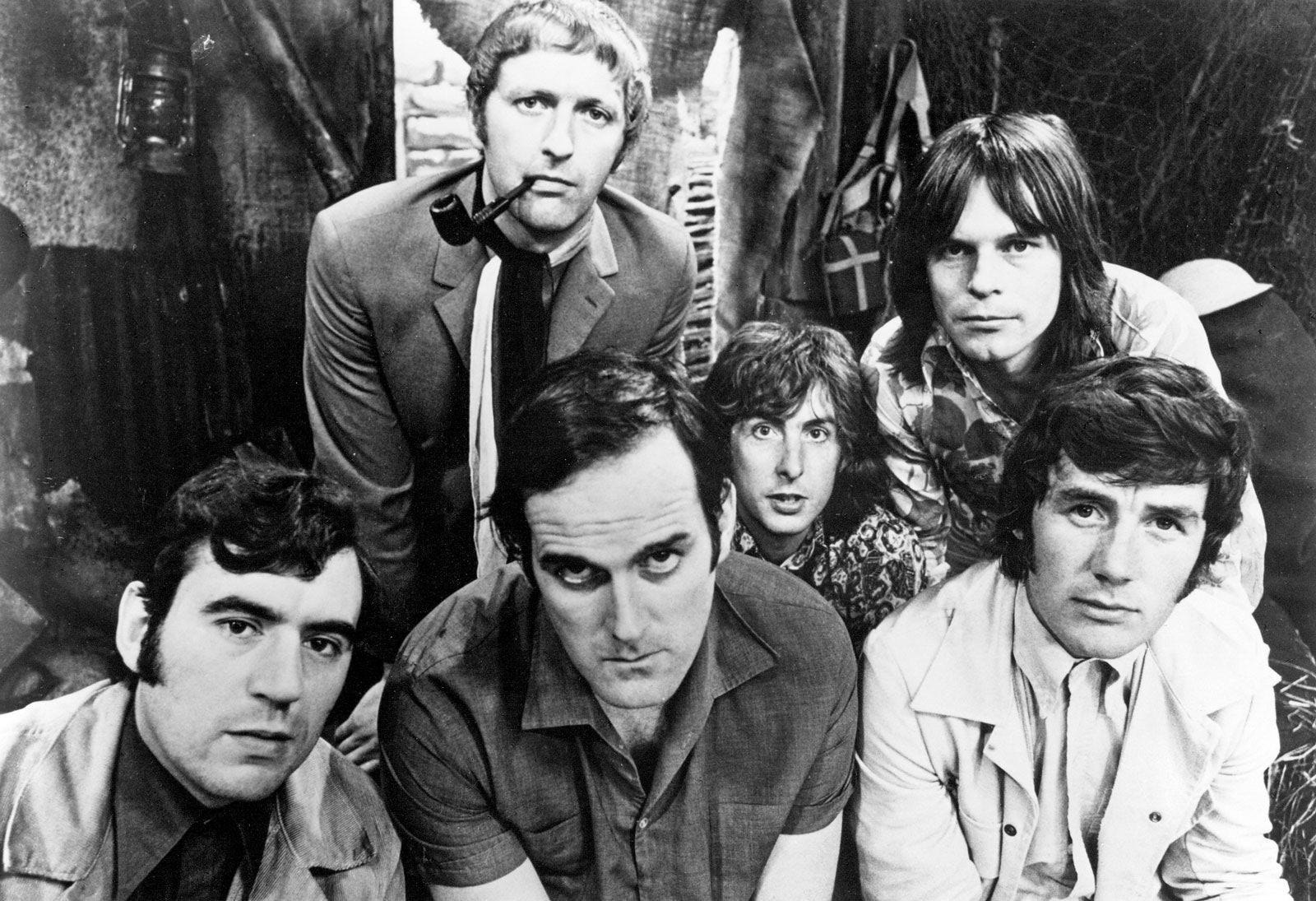
The story of Monty Python began with no grand manifesto, no polished strategy, and no obvious promise of conquest. That feels right. Revolutions rarely arrive carrying a neat agenda. More often, they enter sideways, wearing the wrong coat, laughing too loudly, and leaving respectable people wondering what on earth has just happened.
Monty Python was formed in 1969 by Graham Chapman, John Cleese, Terry Gilliam, Eric Idle, Terry Jones and Michael Palin. Their television work soon became centred on Monty Python’s Flying Circus, first broadcast by the BBC on 5 October 1969, and the group’s run extended across television, film, stage, records and books.
My view is simple. Monty Python mattered because it trusted nonsense more than manners. It understood that Britain, stiff with ceremony and class codes, was ready to be ambushed by silliness with a blade in its boot.
Comedy Born From Disorder
There is something beautifully untidy about the group’s beginning. The six men did not appear as a finished machine. They were writers, performers, university products, outsiders and insiders at once. Some came through Oxford, some through Cambridge, Gilliam came from America with an animator’s eye and a taste for the grotesque.
That mixture mattered. Python was never merely a collection of sketches. It was an argument about what comedy could do when it stopped obeying the old traffic lights.
The old sketch show often liked a tidy path. Set up, punchline, applause, exit. Python took that structure and tossed it into the street. Scenes melted into animations. Characters vanished before they had explained themselves. Authority figures spoke gibberish with magnificent confidence. The joke did not always land where expected, because often there was no runway at all.
That was the thrill of it. Python made confusion feel deliberate. It turned the viewer into an accomplice. You had to lean forward. You had to accept that the world might be mad, and that the only honest response was to laugh at its paperwork, uniforms, sermons and pomp.
Britain Needed This Kind of Laughter
By 1969, Britain was still carrying itself like an empire that had mislaid the map home. Deference remained strong, yet younger people were losing patience with the old voices of command. The country had changed in music, fashion, sex, politics and language. Comedy had to change with it.
Python’s great instinct was to aim at the habits of seriousness. Judges, soldiers, civil servants, presenters, bishops, policemen, headmasters and experts, all those official costumes of certainty, became vulnerable. Their power depended on being taken seriously. Python denied them that privilege.
This is why the work still feels dangerous in spirit, even when the sketches are familiar. The target was never only one politician, one institution, or one social class. The deeper target was the British weakness for dressing absurdity in proper clothes.
The genius was that they did not lecture. They played. They used daft voices, dead parrots, silly walks, medieval stupidity, fake scholarship, collapsing logic and sudden animation. Beneath it all was a serious comic intelligence. They knew that nonsense could expose nonsense.
Genius Had a Human Cost
It is tempting to tidy the story into legend, six men laughing their way into immortality. That would make it less interesting, and less true.
The brilliance came with strain. Graham Chapman’s alcoholism affected the work and those around him, especially John Cleese, his writing partner. The group was not a cosy brotherhood in constant harmony. They were colleagues bound by talent, ambition, irritation, fatigue and timing. That makes the achievement more impressive, in some ways. Great work does not always come from perfect friendship. Sometimes it comes from friction controlled just long enough to catch fire.
Chapman’s later sobriety adds another note to the story, not sentimental, simply human. He was capable of wild comic precision and private chaos. When he died in 1989, aged 48, the loss carried the cruel neatness of tragedy arriving near an anniversary that should have been celebratory.
John Cleese’s famous memorial address for Chapman caught the Python spirit exactly. It was affectionate, rude, wounded and funny. It refused to let grief become respectable too quickly. That, perhaps, was one of the group’s finest acts of loyalty. They honoured him in the language he would have recognised.
Legacy of Intelligent Absurdity
Monty Python’s legacy lies in permission. They gave later comedians permission to break form, to distrust authority, to end a sketch at the wrong moment, to be clever without smoothing the edges, to be childish without being stupid.
Their influence spread far beyond Britain. The group’s work has often been compared in cultural impact to The Beatles in music, and their films, especially Monty Python and the Holy Grail, Life of Brian and The Meaning of Life, helped carry their comic language around the world.
Yet I think their most lasting gift is smaller and sharper than fame. They showed that laughter can be a form of refusal. Refusal to nod along. Refusal to accept the official version. Refusal to confuse seriousness with truth.
On this day in 1969, British comedy did not become louder. It became stranger, braver and more suspicious of anyone holding a clipboard. Monty Python found a way to make anarchy look like play and intelligence look like lunacy.
That is why the work endures. Not because every sketch is flawless. Not because every joke survives unchanged. It endures because the instinct behind it remains alive. Whenever public life becomes pompous, whenever institutions speak in dead language, whenever certainty marches about in polished shoes, Python is waiting nearby with a custard pie, a ridiculous hat, and the devastating suggestion that the whole performance may be nonsense.
And sometimes, history needs exactly that.