

On This Day, 5 May 1945, with Adolf Hitler dead and Nazi Germany collapsing, Castle Itter in the Tyrol became the setting for a battle so improbable that history seems to lose its balance. The hilltop fortress in Austria had been used as a prison for high profile French captives, among them former prime ministers Édouard Daladier and Paul Reynaud, generals Maxime Weygand and Maurice Gamelin, tennis champion Jean Borotra, trade union leader Léon Jouhaux, François de La Rocque, and Marie-Agnès de Gaulle, Charles de Gaulle’s elder sister.
The lasting power of the Battle of Castle Itter lies in who came to defend them. American soldiers fought beside German Wehrmacht defectors. French prisoners picked up weapons. An SS officer, Kurt-Siegfried Schrader, helped the defence. Austrian resistance men played their part. At the centre stood Lieutenant John C. “Jack” Lee Jr. of the US 12th Armored Division and Major Josef “Sepp” Gangl, a German officer who had turned away from the dying regime and chosen to protect civilians and prisoners from the fanatics still stalking the valleys.
My view is simple. Castle Itter matters because it strips war of its neat labels. By May 1945, the machinery of Nazism was broken, but its cruelty was still alive in men who would rather kill in defeat than surrender in shame. Against them stood a makeshift fellowship of the practical and the decent, people who had no time for speeches because ammunition was low and the enemy was close.
History often asks us to remember which side won. Castle Itter asks a harder question, who remained human when the uniforms had stopped explaining everything?
Josef Gangl’s choice
Josef Gangl had been a soldier for most of his adult life. He was no innocent bystander, and history should never polish men into saints simply because their final chapter glows more brightly than the earlier ones. What he did in those last hours carries moral weight because the safer route was clear.
In Wörgl, as SS loyalists threatened townspeople and punished anyone who signalled surrender, Gangl aligned himself with the local Austrian resistance. When Andreas Krobot, the castle’s cook, brought word that the prisoners at Itter were vulnerable, Gangl did not hide behind procedure. He went in search of the Americans under a white flag, knowing he could be shot by either side before anyone had time to understand his intentions.
That courage is too easily missed by histories drunk on scale. It had no parade ground symmetry. It was untidy, compromised, urgent. Gangl was trying to save what could still be saved from the wreckage. That seems to me the truest form of late war bravery, the refusal to let the last murders happen simply because defeat had arrived too late for mercy.
When Gangl died during the battle, he was reportedly trying to move Paul Reynaud out of danger. A German officer was killed saving a former French prime minister from the fire of Nazi loyalists. That sentence contains almost the whole madness of Europe in 1945, and a small portion of its redemption.
Jack Lee and a castle full of contradictions
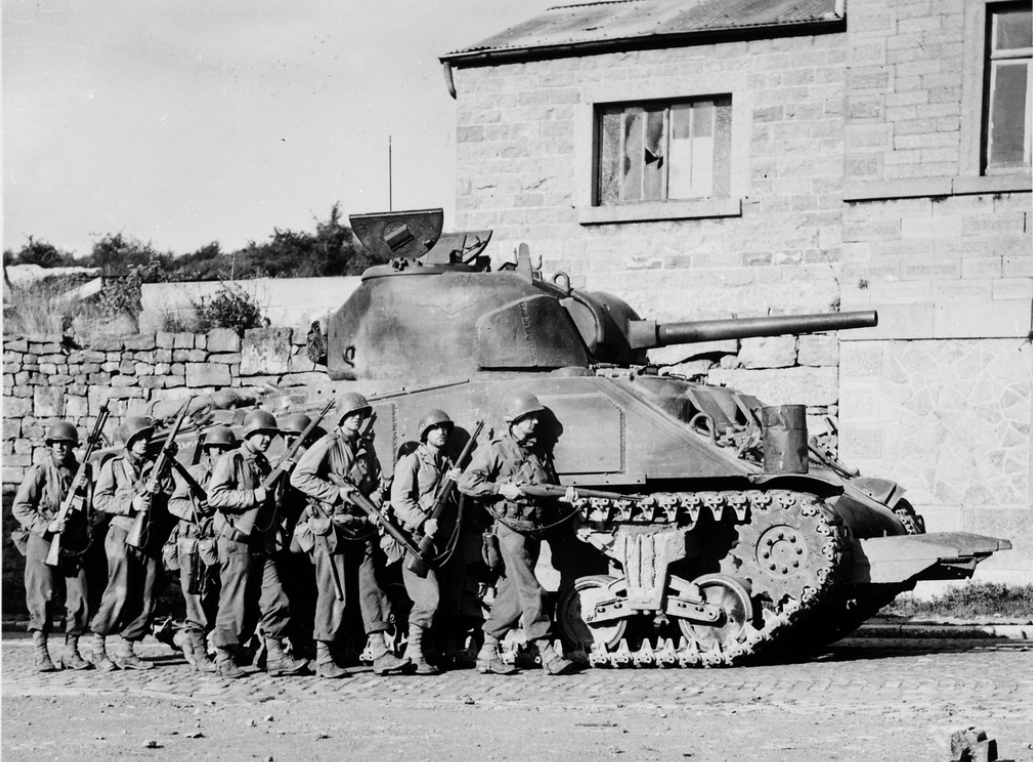
Jack Lee could have hesitated. He could have treated Gangl’s appeal as a trap, or a distraction, or one more German problem in a war coughing up its last smoke. Instead, he volunteered for the rescue mission and took a small force towards Castle Itter. The defenders were badly outnumbered. One Sherman tank, known as Besotten Jenny, was placed at the castle entrance and later destroyed by an 88 mm gun.
Lee was making a battlefield calculation under miserable conditions, with too few men and too many lives depending on the answer. Inside the castle, the old order of Europe was huddled in corridors and rooms, men who had once commanded armies and governments, now reduced to waiting, arguing, and, when told to stay safely away, sometimes refusing. There is something almost theatrical about French dignitaries and generals taking up arms in an Austrian castle while Americans and anti Nazi Germans held the walls. Yet the comedy dies when the shells begin to land.
Jean Borotra gives the story its most cinematic moment. The former tennis champion volunteered to slip out through enemy positions and carry word to the relief force. He succeeded, and the rescuers arrived before the castle was overrun. In another age, his run would have belonged to sport. At Itter, it became a line between survival and massacre.
Why Battle of Castle Itter still speaks
Castle Itter is often called one of the strangest battles of the Second World War. That description is fair, though it can make the event sound like a curiosity, a bizarre footnote for people who enjoy oddities. I think it deserves better.
Its strangeness gives the story colour. Its clarity gives it force.
At Castle Itter, ideology had reached its final, poisonous form. The SS attackers had no meaningful victory left to win. Berlin was gone as a centre of command. The Reich was finished in all but paperwork and burial. Still they came, because fanaticism does not need hope. It only needs targets.
The defenders were bound together by something thinner than ideology and stronger in that hour, the immediate obligation to stop murder. They did not need to agree about the past to agree about the next five minutes. They did not need to forgive one another to fight side by side. That is why the story carries such force. It offers no easy absolution. It offers responsibility under pressure.
On This Day in 1945, Castle Itter showed that history’s final scenes are rarely tidy. The war in Europe was nearly over, yet men were still dying in courtyards and stairwells. Peace was approaching, but it had not arrived quickly enough to save Josef Gangl. Liberation was close, but close is not the same as safe.
For me, the lesson is that, in extremis, a person may still be judged by the life they choose to defend. At Castle Itter, some men clung to a dead evil and tried to kill for it. Others, carrying all the burdens and contradictions of their past, stood against them.
That is why this small battle endures. For one violent afternoon in the Tyrol, history placed honour, guilt, courage and survival inside the same battered walls, and asked who would hold the line.