

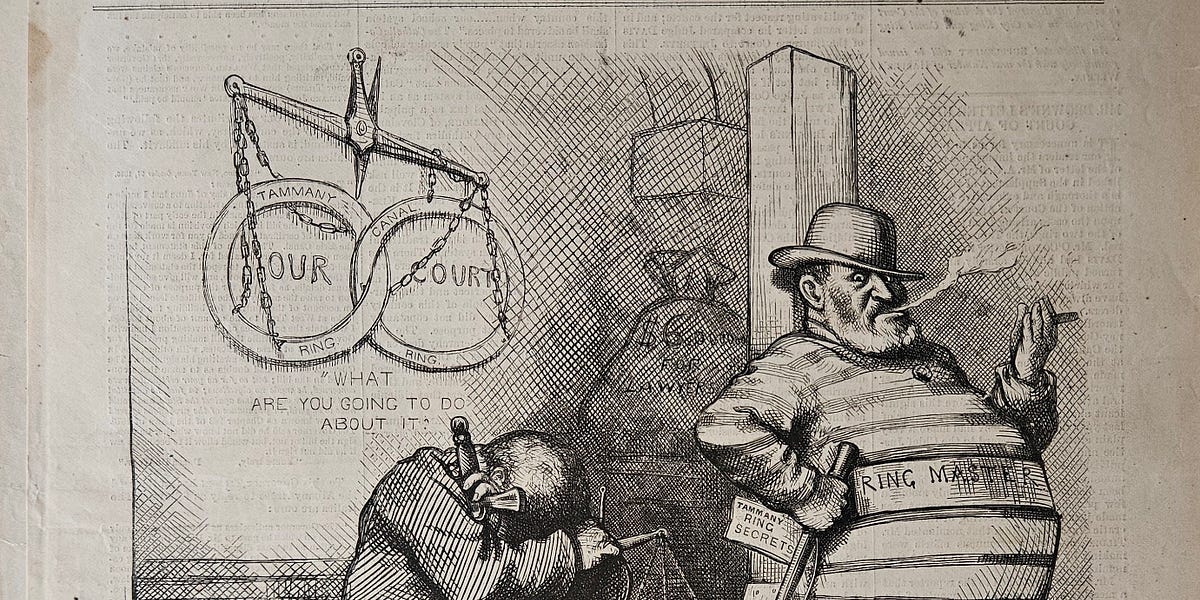
On this day in 1875 a man once hailed as the master of New York politics slipped into a wagon outside his Madison Avenue home and gambled everything on the dark streets ahead of him. William Magear Tweed, known to every newspaper reader in America as Boss Tweed, had been given a supervised visit away from his cell. Instead of returning to the prison that had shrunk his empire, he chose to run.
I have always been drawn to the moments when history pivots quietly, when a single decision exposes an entire era. Tweed’s escape belongs to that category. It was not simply a criminal breaking free, it was the last desperate act of a political titan whose rise and collapse revealed both the ingenuity and the rot in nineteenth-century American democracy.
As a history writer, I find myself returning to Tweed because his world looks strangely familiar. Grasping his story is not about judging a man long gone; it is about understanding the warning he left behind for any society willing to listen.
Power Built on Swagger and Shadow
Before he became a fugitive rowing across the Hudson under the winter sky, Tweed had towered over New York City. His power did not come from office alone; it came from presence. Witnesses described him striding through city hall with the confidence of a man who owned every corridor. Even the mayor bowed before him. That image, sketched by those who watched him sweep past in fine clothes and good humour, explains why ordinary voters embraced him for so long.
Tweed understood how to make politics feel personal. He delivered help to the poor, favours to neighbourhoods and jobs to allies. He placed himself at the centre of every flow of money and influence in a city growing at a speed no government had yet learned to manage. Railways, parks, bridges, museums, even the zoo, all became stages on which he could strengthen his grip.
There was skill in this. You do not control a metropolis without charisma and nerve, and Tweed had both. But beneath that swagger sat a web of falsified accounts, padded contracts and friendly companies paid from the public purse. In his circle, a man’s loyalty determined his fortune, and loyalty could be bought.
For years this system thrived because few dared to challenge it. Those who tried were bullied, sued or pushed from public life. Many New Yorkers admired the rewards Tweed delivered and shrugged at the cost. Corruption was tolerated because it seemed predictable, even comforting. It took outsiders, people who had not learned to fear him, to question the spectacle.
Exposure That Shook a City
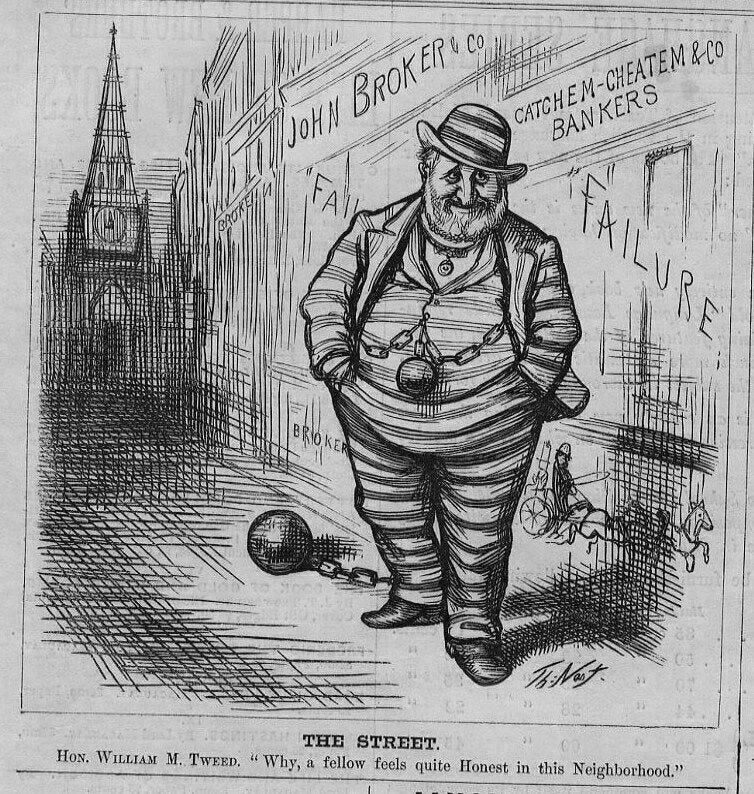
When the truth emerged, it arrived with the force of a storm. Reporters uncovered secret accounts, exaggerated payments and evidence of money disappearing into the pockets of Tweed and his friends. Others added their voices with broadsheets and biting cartoons. The stories showed a civic government hollowed by greed.
Tweed’s response revealed how deeply he had come to believe in his own invincibility. He offered vast sums to halt the investigation. He ordered lawsuits to drain the resources of those criticising him. He stood for reelection even after arrests and indictments. For a time, the public even rewarded him. That, perhaps, is the most unsettling part of the saga. A man already under a mountain of evidence still held the loyalty of thousands.
Change came only when proof piled high enough to convince the courts. Tweed was finally found guilty of more than two hundred counts of corruption, a number that still feels almost unreal. His downfall happened slowly, then all at once. Those who had relied on his influence scattered. Public patience snapped. Even he had to accept that the machine he built could no longer protect him.
Yet the legal victories did not erase the damage done during his years in power. They merely drew a line under them.
Lessons From a Desperate Escape
Which brings us back to December 1875. A disgraced political giant crouched beneath a sack in the back of a wagon, hoping the police helping a derailed streetcar would not recognise him. This was not just an escape attempt; it was the final chapter of a man who once defined his city.
Tweed travelled through the night, rowed across the Hudson, hid in farmhouses and beach huts, then slipped onto ships bound first for Cuba and then Spain. It was a fugitive’s odyssey that ended with a governor recognising him from a magazine caricature. Even then, crowds gathered to cheer him when he was returned to New York. It is hard to imagine a clearer picture of the distorted loyalty he inspired.
His death in prison less than two years later closed the tale, but the questions he raised have not faded. Tweed’s story is a study of how power expands when left unchallenged, how communities can ignore wrongdoing when the benefits feel immediate, and how charisma can blind a public to the cost of corruption.
As I read and write about history, I try to resist easy lessons. But Tweed’s life, from triumph to disgrace, forces a point that still matters. Corruption grows in silence. It thrives when people accept it as part of the landscape. And it collapses only when ordinary citizens, journalists, courts and communities decide they have had enough.
Tweed believed he could outrun justice, yet what ultimately defeated him was not the guards outside his cell, nor the soldiers on the docks in Spain. It was the truth carried persistently by those who refused to look away.
Enduring Meaning for Today
Marking this anniversary is more than a nod to the past. It is a reminder that democracy depends on scrutiny and that influence can curdle into something dangerous when left unchecked. Tweed knew the weaknesses of the system he manipulated, and he exposed them ruthlessly. His career shows how easily public trust can be exploited, especially in a fast growing city where fortunes rise and fall quickly.
I write about these episodes because they drag the modern age into sharper focus. Political scandals may change their clothing over time, but the core remains the same. There will always be those who see public office as a ladder rather than a responsibility. There will always be citizens tempted to accept short term gain in exchange for long term harm. And there will always be a need for people brave enough to challenge power when others step back.
On this day, when we think of a heavy figure slipping through the shadows of New York, clutching a pocket watch and praying for a clear path, we should remember that his escape did not erase the truth. His flight only confirmed it. Influence without accountability will always fall apart in the end.
Tweed’s story is not a relic. It is a caution written in bold strokes, and it deserves to be read whenever we find ourselves wondering how much power is too much for any one person to hold.