

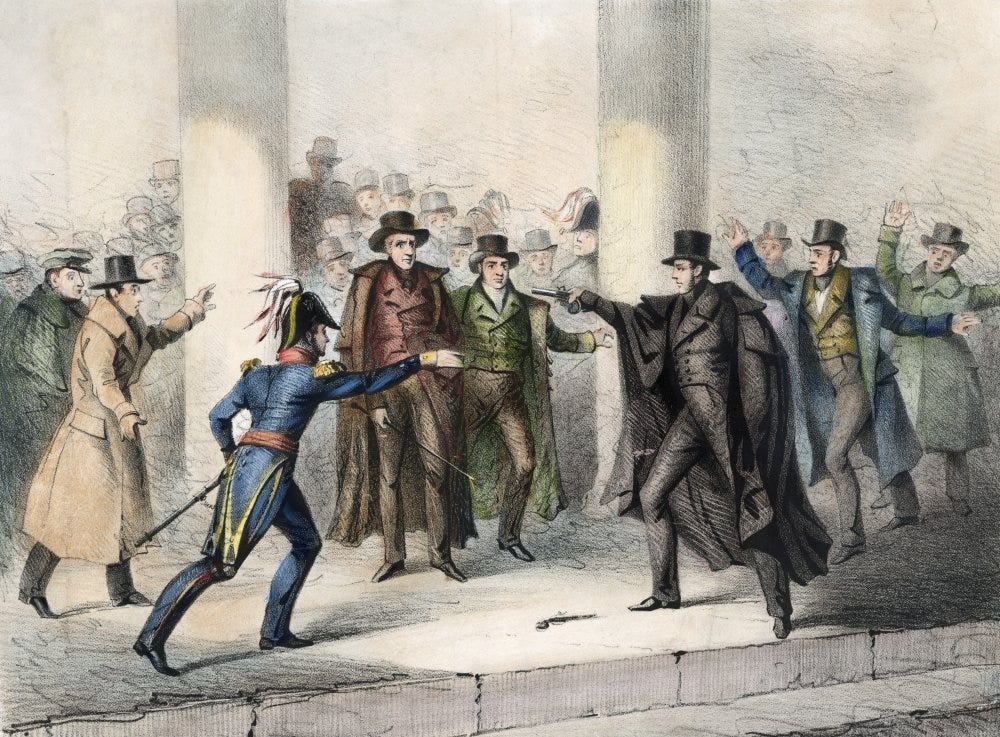
On this day in 1835, the United States came within a breath of political catastrophe. A sitting president stood exposed in a public place, a lone man stepped forward with murder in mind, and only chance prevented history from veering onto a darker road. The attempted assassination of Andrew Jackson remains one of the most revealing episodes of his turbulent presidency, not because blood was spilled, but because it was not.
This was no grand battlefield or secret chamber. It unfolded in daylight, at a funeral, on the steps of the Capitol. It was messy, human, and charged with the anger of an era already tearing at itself.
A charged city and a weakened president
By January 1835, Washington was a city simmering with grievance. Jackson was nearing the end of his presidency, physically diminished but politically explosive. He walked with a cane, leaned on aides, and carried the marks of a life spent courting violence, both literal and rhetorical. Nearly a hundred duels were attributed to him, some exaggerated, others chillingly real. His reputation for personal combat was matched only by his appetite for political confrontation.
He had enemies everywhere. Senators openly spoke of his removal. His vice president had resigned to oppose him. Newspapers printed threats and counter threats as though they were statements of fact. This was a capital where men spoke of murder in the same breath as policy.
Into this atmosphere came the funeral of a congressman, drawing crowds and dignitaries to the Capitol. Jackson attended despite his frailty. It was a public act, almost defiant, a reminder that he remained present and unafraid. That decision nearly cost him his life.
Two pistols and a moment of chance
As Jackson exited the Capitol portico, a man stepped forward and raised a pistol at close range. The aim was true. The intent was unmistakable. The trigger was pulled.
Nothing happened.
A second pistol followed, brought up with urgency as the president turned towards the sound. Again, the trigger was pulled. Again, nothing.
What followed was as revealing as the failure itself. Jackson did not retreat. He charged. Cane raised, fury overtaking fear, he struck the would be assassin until bystanders intervened. The image is almost theatrical, an ageing president beating a gunman in public while the crowd looked on in disbelief.
It would later be calculated that the odds of both pistols misfiring were extraordinarily low. Yet chance, mechanical failure, or some unknowable combination spared the republic its first presidential assassination.
The man was seized and removed. Jackson, shaken but unbowed, made a declaration before entering his carriage. He claimed he knew who was behind it.
That statement mattered. It inflamed everything that followed.
Rumour, blame and a nation looking for villains
Within hours, Washington turned on itself. In a city already poisoned by suspicion, the question was not why the man had acted, but who had put him up to it. Political rivals were named openly. Former allies were accused. Newspapers split along factional lines, some insisting the attack was the product of inflammatory rhetoric, others hinting at cynical theatre designed to win sympathy for a fading president.
Jackson himself believed the attack was part of a wider conspiracy. He had old feuds, some bitter, some personal. Men who once stood beside him in war and politics now stood across from him in hatred. In his mind, the failed assassination was simply the natural end of years of threats and slander.
Yet amid the noise, one fact was oddly overlooked. No one questioned the attacker.
Madness mistaken for politics
When doctors finally examined the man who pulled the triggers, a different story emerged. He claimed shifting motives, none of which survived scrutiny. Revenge for a murdered father. Ruin caused by government policy. Each explanation collapsed under even modest investigation.
The truth was stranger and more unsettling. He believed himself to be an English king, denied his inheritance by forces beyond his control. His behaviour over previous years told the same story. Sudden disappearances. Grandiose dress. Violent outbursts. Delusions accepted and even encouraged by children who mocked him as royalty.
This was not the mind of a political agent. It was the mind of a man lost to illness.
That conclusion arrived too late to stop months of damage. Accusations had already scarred reputations. Friendships had hardened into vendettas. Jackson’s own willingness to see enemies everywhere had deepened the wounds.
At trial, the spectacle confirmed what medicine had already concluded. The verdict was swift. Not guilty by reason of insanity.
For many, the relief was palpable. A lone, unwell man was easier to accept than a coordinated attempt to tear down the state. It allowed the nation to step back from the edge without admitting how close it had come.
What January 30th still tells us
On this day in 1835, the United States learned how fragile authority can be when politics becomes personal and language turns violent. The attempted assassination of Andrew Jackson did not arise in a vacuum. It was born in an atmosphere where threats were normalised, where enemies were dehumanised, and where suspicion outran evidence.
Jackson survived, but the episode stripped away comforting illusions. A president could be reached. The machinery of power offered little protection against a determined individual. And the public, quick to assign blame, could do real harm before facts had a chance to surface.
It also exposed something uncomfortable about Jackson himself. His instinctive certainty that rivals were responsible spoke to a man shaped by combat, real and imagined. That certainty fuelled investigations that ultimately found nothing, yet left bitterness in their wake.
History remembers this moment because it was the first of its kind. No sitting president had been shot at before. Others would not be so fortunate in years to come. Jackson’s survival was exceptional, not typical.
Yet the deeper lesson lies elsewhere. It lies in the danger of a political culture so overheated that madness is mistaken for conspiracy, and chance is interpreted as design. On January 30th, 1835, two pistols failed, but the warning they delivered should not be missed.
Excellent piece on how poitical paranoia shapes responces to violence. The detail about the pistols' mechanical failure being statistically improbable but still chalked up to conspiracy theories really highlights how people default to pattern-seeking even when randomness is the actual answer. I've seen similar dynamics in more recent events where everyone wants a villain when sometimes its just chaos manifesting in realy life.