

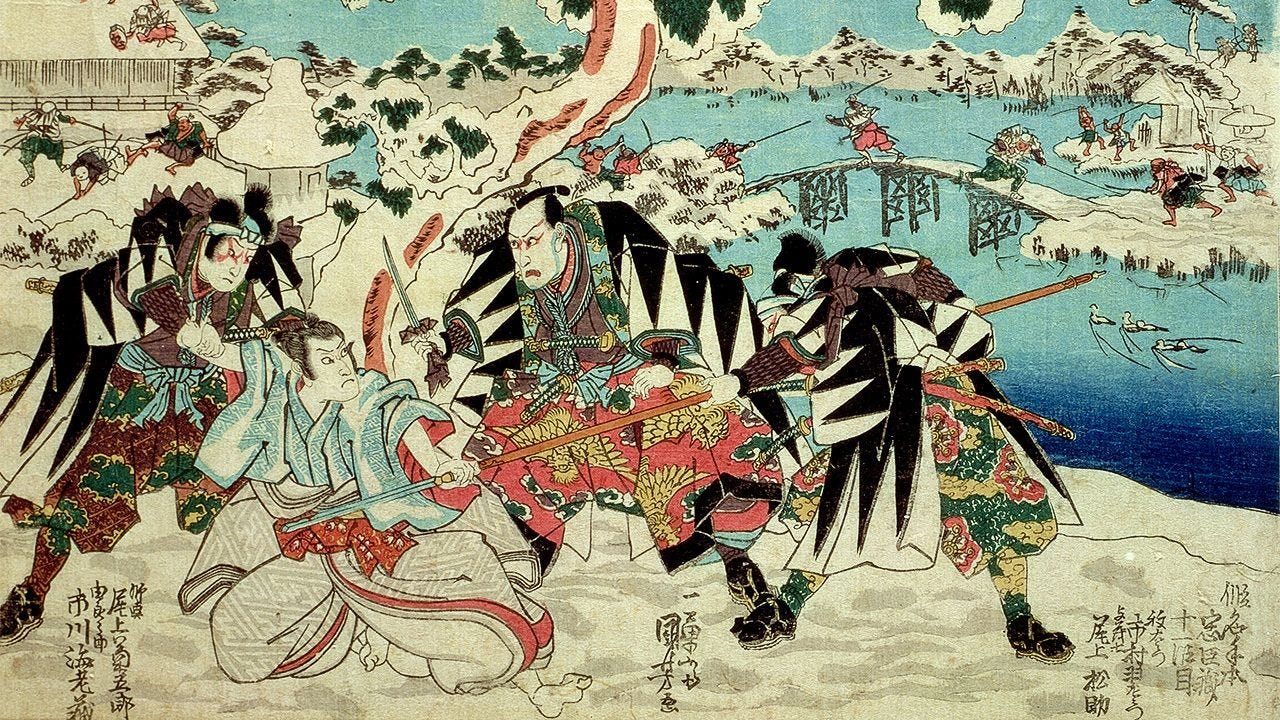
On this day in 1703, forty six men knelt, one after another, and accepted death by ritual command. They did so calmly, deliberately, and with the full knowledge that history would judge them long after their bodies were gone. In an age when honour was law and obedience was survival, the 47 Ronin forced Japan to confront an uncomfortable truth. Sometimes loyalty demands defiance, and sometimes justice lives beyond the rulebook.
This is not a tale of reckless violence or romantic mythmaking. It is a story rooted in a rigid society where reputation outweighed life, where hierarchy was absolute, and where a single impulsive moment could destroy an entire clan. What happened on 4 February 1703 was the end of a long moral reckoning, one that began not with swords drawn, but with a quiet insult delivered in a palace corridor.
Court insult that shattered a clan
The spark came two years earlier inside Edo Castle, the administrative heart of Tokugawa Japan. Asano Naganori, a feudal lord from Ako, had little patience for court ritual. He valued battlefield honour over ceremonial polish, a dangerous attitude in a place where appearances mattered as much as loyalty.
The man responsible for overseeing protocol was Kira Yoshinaka, an experienced and deeply political master of ceremonies. He and Asano disliked one another, not quietly, and not privately. When Kira publicly insulted Asano’s family, it struck at the one thing a samurai could not afford to lose, face.
Asano drew his dagger and struck Kira within the palace walls. The wound was not fatal. The consequences were. Drawing a weapon in the shogun’s court was unforgivable. Within hours, Asano was ordered to commit seppuku. His lands were seized, his family ruined, and his retainers cast adrift as ronin, masterless men in a society that distrusted them.
The imbalance was obvious. One man was dead, the other lived on, scarred but politically protected. The law had been followed, yet justice felt unfinished.
Waiting years for vengeance
The former retainers of Asano did not rush to avenge him. That restraint mattered. Under the leadership of Ōishi Yoshio, they dispersed, took humble work, and lived as though they had accepted their disgrace. Some drank heavily, others married, many were mocked as failures. It was all theatre.
For nearly two years they waited, knowing that the authorities expected revenge and watched for it. Only when vigilance faded did they move. On a winter night in December 1702, they converged on Kira’s mansion in Edo. Snow softened their footsteps. Discipline kept them silent.
They overwhelmed the guards, searched room by room, and finally found their target hiding in a shed. Kira was offered the chance to die with honour, using the same dagger that had ended Asano’s life. He refused. The sword did the rest.
At dawn, the ronin carried Kira’s severed head through the city. Instead of fear, they met cheers. Kira had few friends among the people. They laid the head at Asano’s grave at Sengaku-ji, completing the act they believed duty demanded.
They did not flee. They waited.
Shogun’s impossible decision
Public sentiment favoured the ronin. Many saw them as the embodiment of loyalty, men who had sacrificed everything to restore their master’s honour. The authorities saw something else, a carefully planned act of murder that challenged the state’s monopoly on justice.
The shogun faced a dilemma. To pardon the ronin outright would undermine the law. To execute them as criminals would insult the very code that sustained samurai rule. The solution chosen was a compromise that satisfied no one fully and everyone just enough.
On 4 February 1703, the ronin were ordered to commit seppuku. It was punishment, but it was also recognition. They died as samurai, not as thieves. One young messenger was spared due to his age and role. The rest accepted their fate without protest.
In that decision, the shogunate preserved order while acknowledging something deeper, that loyalty carried moral weight even when it crossed legal lines.
Why the story endures
The tale of the 47 Ronin refuses to fade because it sits at the fault line between law and conscience. It asks whether obedience should ever outweigh justice, and whether honour can exist within rigid systems of power.
For modern readers, the appeal is not found in the violence, but in the patience. These men waited years, knowing the cost, choosing the moment carefully. Their restraint challenges the idea that revenge is impulsive or crude. In their world, it was disciplined, deliberate, and final.
Their story has been retold endlessly in theatre, literature, and film, not because it offers easy answers, but because it does not. Were they heroes or criminals. The question still matters, which is why people continue to stand before their graves, leaving incense and coins, weighing the same dilemma in quieter ways.
On this day, 4 February 1703, the ronin died. What they left behind was something harder to resolve, a legacy that refuses to sit comfortably in either praise or condemnation. That tension is why their story still speaks, three centuries on.
Love how you framed the waiting period as "theatre" - that detail really stuck with me. The idea that they played disgrace for two years shows incredible self-control, especially in a culture where public shame was basicaly death anyway. What gets me is the shogun's dilema at the end - neither pardoning nor executing cleanly solved anything, which feels very human. We still face that tension today when formal justice and moral intuition dont line up. The visit to Sengaku-ji at dawn with Kira's head must have been quite a scene for witnesses.