

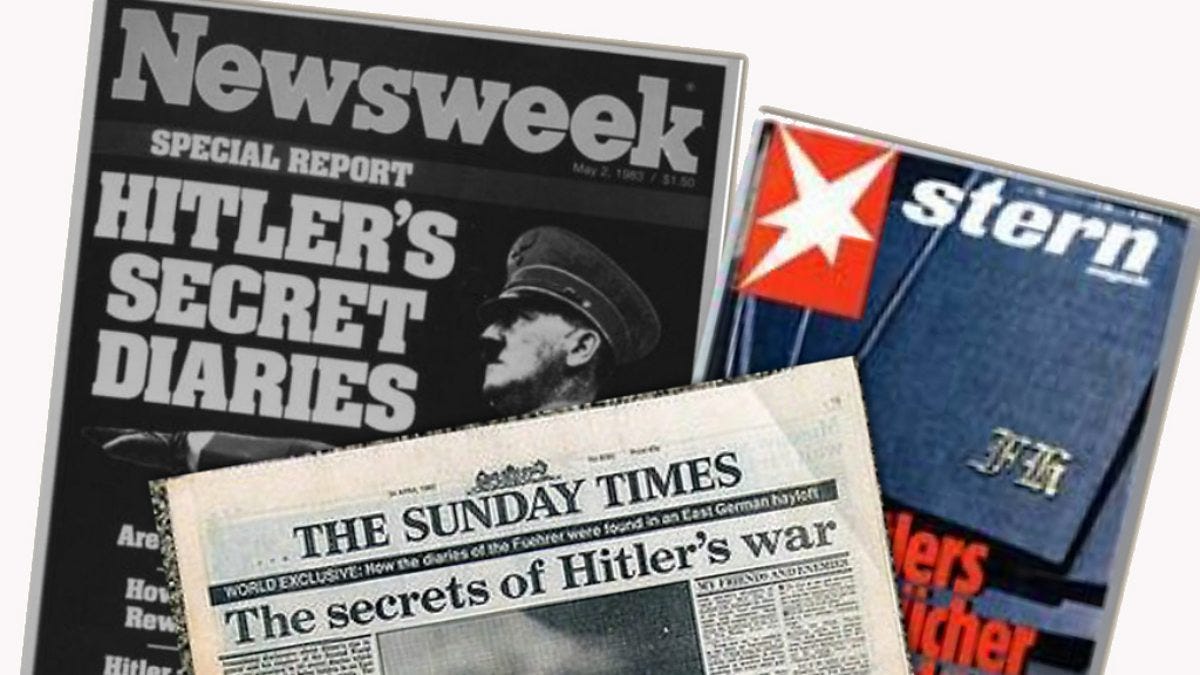
On This Day, 6 May 1983, one of the most infamous historical frauds of the modern age was publicly exposed. The so called Hitler Diaries, once presented as a discovery capable of reshaping our understanding of the Third Reich, were confirmed as forgeries. What had been sold as a private window into Adolf Hitler’s mind turned out to be a shabby construction of modern paper, modern ink, copied errors and brazen nerve.
My opinion is simple. The real scandal was never that a forger forged. That is what forgers do. The deeper shame was that educated, experienced and powerful people wanted the diaries to be real so badly that they lowered the drawbridge for him.
Konrad Kujau, the man behind the fraud, was no master craftsman operating at the summit of deception. He was a gifted chancer with a feel for appetite. He understood that the market for Nazi relics was not driven by sober historical need alone. It was fed by fascination, greed, vanity and the gloomy glamour that still clings to evil when people stare at it for too long.
The diaries were said to be part of Hitler’s lost private papers, supposedly connected to the chaos of April 1945, when Berlin was collapsing and documents were being moved out of the Führerbunker. There really had been an evacuation effort, and one aircraft carrying Hitler’s belongings crashed near the end of the war. That small historical truth gave Kujau the crevice he needed. A lie often enters history wearing one genuine button on its coat.
Nazi memorabilia created the perfect trap
The Hitler Diaries hoax did not grow in clean soil. It grew in a murky world of collectors, secret deals and private obsessions. Kujau had already been selling Nazi material and adding forged details to increase its value. From there, the step towards entire invented diaries was less a leap than a slide.
Gerd Heidemann, the journalist who helped bring the diaries into the public arena, believed he had found the scoop of a lifetime. The scale of the supposed discovery helped silence common sense. Sixty volumes carried an air of authority. Quantity became a disguise for quality. People looked at the pile and mistook abundance for authenticity.
That is the lesson I keep returning to. Fraud rarely succeeds because everyone involved is stupid. It succeeds because clever people become emotionally invested in a conclusion before the evidence has earned it. Once a story promises fame, money and access to a forbidden chamber of the past, doubt starts to look like disloyalty.
The diaries offered something dangerously seductive. They promised intimacy with Hitler, the monster caught in private thought, the dictator stripped of ceremony and exposed page by page. Yet that promise should have made people more careful, not less. Any document claiming to revise the record of the twentieth century should be handled like nitroglycerine. Instead, it was handled like a trophy.
Credibility failed before science arrived
When forensic examination finally came, the fraud had nowhere to hide. The paper contained materials that did not belong to Hitler’s lifetime. The ink was modern. The bindings had been artificially aged. The initials on the covers were wrong, with Kujau reportedly using “FH” rather than “AH” after misreading decorative Gothic lettering. The supposed diary entries also carried factual errors, some traced to published reference material Kujau had copied.
By then, reputations were already bleeding. Stern had paid millions of Deutsche Marks for the diaries and sold rights to other publications. Historians were drawn into the storm. Editors lost their posts. Kujau and Heidemann were later convicted and imprisoned for their roles in the affair.
It is tempting to treat the whole business as farce, with tea stained pages, fake signatures and a forger who later became a celebrity seller of “genuine forgeries”. There is comedy in it, certainly, the kind that leaves a sour taste. Yet the stakes were serious. These diaries concerned Hitler, the Holocaust, the Second World War and the memory of millions. A forged shopping list is one thing. A forged Hitler diary is an assault on the public record.
History is not merely a pile of old paper. It is a trust. Every archive, every diary, every letter and photograph asks us to behave with patience. When we fail, the past becomes a stage on which the loudest impostor gets the best lighting.
May 6 still matters for historical truth
The exposure of the Hitler Diaries on 6 May 1983 remains important because it shows how easily the hunger for revelation can outrun discipline. We live in an age even more vulnerable to that weakness. A sensational claim now travels faster than any archivist can examine it. A forged image, a false quotation or a convenient document can circle the world before doubt has put on its shoes.
That makes this anniversary more than a curiosity. It is a warning with its sleeves rolled up.
As a history writer, I believe the past deserves drama, colour and life. Old stories should breathe. They should be brought into the modern era with energy, with pace, with humanity. Yet they must never be improved by invention. The moment we decorate history at the expense of truth, we stop serving memory and start serving ourselves.
The Hitler Diaries hoax endures because it exposed a weakness in the culture around history. It showed that some people wanted access to Hitler’s private thoughts more than they wanted proof. It showed that prestige can be as gullible as ignorance. It showed that money, secrecy and haste are a dangerous editorial committee.
Konrad Kujau supplied the fake pages, but the world around him supplied the market. That is why the story still bites. The forger needed ink, paper and nerve. The buyers brought the rest.
On This Day 1983, the fraud collapsed. The diaries were stripped of their false importance and reduced to what they always were, cheap notebooks dressed up for a masquerade. Yet the lesson survived the scandal. History can absorb many things, doubt, revision, argument, fresh evidence. What it cannot survive, at least not honourably, is the surrender of judgement.
The past will always attract myth makers. Our duty is to make them work harder than Kujau ever had to.