

History often turns on grand speeches or sweeping political victories. Yet sometimes the turning point begins with something quieter, more personal, and far more powerful. A parent refusing to be ashamed of their child.
On this day in 1973, a small gathering in New York planted the seeds of what would become PFLAG. The meeting itself was modest. Around twenty parents sat together in a church hall, some anxious, some uncertain, many still struggling with emotions they did not yet know how to voice.
At the centre of the room stood a mother who had decided that silence was no longer acceptable.
Her name was Gene Manford.
What began that evening was more than a support group. It was a declaration that the fight for equality would not be waged only by those directly targeted by prejudice. Families would stand beside them.
And that simple act carried enormous weight.
Violence That Forced a Mother to Speak
The chain of events that led to the founding of PFLAG did not begin with an organised campaign. It began with an act of brutality.
In April 1972, Gene Manford’s son, Morty Manford, was violently attacked outside a New York hotel after confronting a public display of homophobic mockery. The assault happened in view of police officers who failed to intervene. No one stepped forward to protect him.
For Gene Manford, the episode revealed something stark. Violence and discrimination against gay people were tolerated, even shrugged off.
The message implied by society was clear enough. Being gay was something to hide. Something to apologise for.
Yet Gene had already witnessed the consequences of that shame. Years earlier, she had lost another son to suicide. Only after his death did she discover that he too had struggled with his sexuality.
That knowledge changed how she understood the hostility around her. The tragedy was not that her sons were gay. The tragedy was that the world had taught them to feel ashamed of it.
When Morty lay injured in hospital after the assault, Gene reached a simple conclusion. If society would not defend her son, she would.
Public Pride That Challenged Silence
Gene Manford’s first step was strikingly bold for the early 1970s. She wrote publicly to a major newspaper, identifying herself as the mother of the man who had been beaten.
At the time, many families concealed such facts. Parents often feared that acknowledging a gay child would invite stigma upon the entire household.
Gene did the opposite. She said she was proud of her son.
Those words mattered because they cut through a cultural assumption that had long isolated gay people from their own families. Public support from parents was rare. When it appeared, it carried moral force.
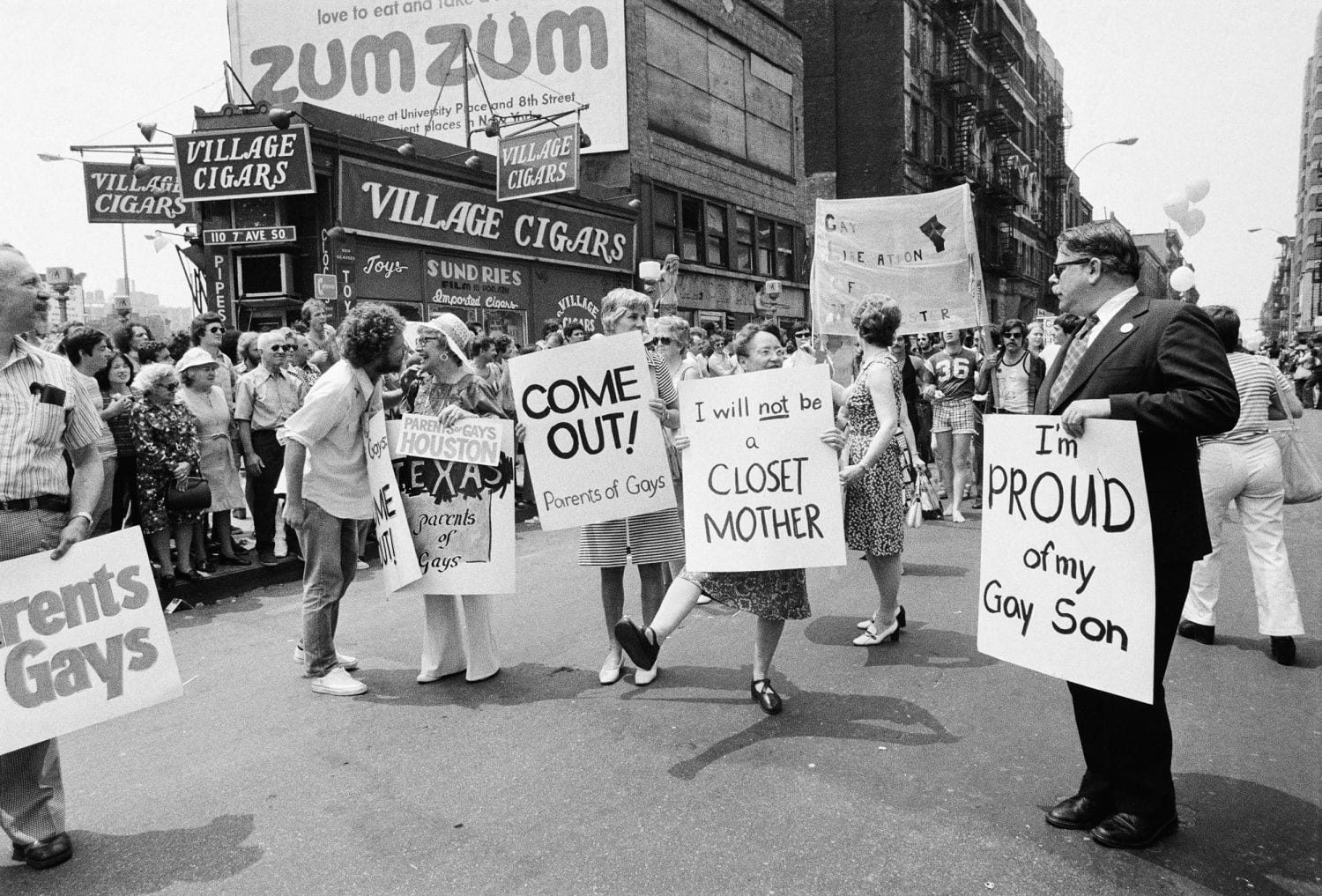
Soon after, Gene took her stand even more visibly. She marched beside Morty in a New York pride demonstration, carrying a handmade sign that called on parents to support their children.
The response surprised her.
Young men and women in the crowd approached with tears in their eyes. Some hugged her. Others asked if she might speak with their parents, hoping her voice could reach people who refused to listen to them.
In that moment, Gene Manford saw the gap that needed to be filled. Activists were fighting for change in the streets and in politics. Yet families were often left alone with confusion, fear and misinformation.
Parents needed a place to talk honestly.
That idea led directly to the gathering held on March 11, 1973.
Meeting That Changed the Conversation
The first meeting of what was then called “Parents of Gays” was not a triumphant rally. It was awkward, emotional and at times uncomfortable.
Many of those present were still wrestling with their beliefs. Some struggled to accept their children’s identity. Others feared the judgement of neighbours or relatives.
Gene Manford did not lecture them. She spoke about love, loss and fear. She told them about her sons and about the cruelty that society often directed at people like them.
Her argument was disarmingly simple.
If parents could not accept their own children, how could the wider world ever learn to do so?
Not everyone was persuaded that evening. One father insisted he could never be proud of what he considered a lifestyle choice.
Yet enough people felt the force of Gene’s words to continue meeting. The small group decided to gather regularly. Soon friends and relatives began attending as well.
From that modest start, the organisation adopted a new name, Parents and Friends of Lesbians and Gays, eventually known simply as PFLAG.
Its purpose was clear. Families would support their children openly and challenge the prejudice that surrounded them.
Legacy That Reached Beyond One Family
The growth of PFLAG reflected a truth that politicians eventually recognised. Every gay person had parents, siblings and extended family members. That meant millions of people had a personal stake in the fight for dignity and equality.
Support groups spread across the United States, appearing in cities such as Los Angeles, Chicago and Washington. What began as a handful of conversations in a church hall became a national movement.
PFLAG members spoke publicly, marched in demonstrations and met lawmakers. Their voices carried a particular influence because they came not from activists alone but from mothers, fathers and grandparents.
They were not demanding rights for themselves. They were defending their families.
This approach reshaped the debate around sexuality. Instead of being framed solely as a political struggle, the issue increasingly became a matter of family life and basic human respect.
Even as tragedies struck, the movement continued. The assassination of Harvey Milk in 1978 shocked the country and strengthened the resolve of campaigners. The AIDS crisis of the 1980s brought immense loss, including the death of Morty Manford himself.
Yet Gene Manford remained committed to the cause her son had championed. Grief did not silence her.
By the time she died in 2013, public attitudes in the United States had shifted dramatically. When she first stepped forward in the early 1970s, large majorities believed homosexuality was morally wrong. Four decades later, acceptance had become the mainstream view.
It would be naïve to attribute that transformation to a single individual. Social change rarely works that way.
Still, it is equally naïve to overlook the power of a single example. Gene Manford’s decision to stand beside her son demonstrated that courage often begins at home.
Quiet Courage That Still Echoes
Looking back from the present day, the founding of PFLAG may appear inevitable. Social movements often acquire a sense of momentum when seen in hindsight.
Yet history reminds us that such progress usually begins with individuals willing to risk disapproval.
Gene Manford was not a seasoned campaigner when she stepped forward. She was a mother who refused to accept that her child should live in fear or shame.
Her message carried a clarity that political slogans rarely achieve. Love your children. Defend them when they are treated unjustly. Speak openly when silence protects prejudice.
Those ideas resonate far beyond one moment in 1973.
They remind us that social change rarely arrives fully formed through legislation alone. It grows in living rooms, around kitchen tables and within families prepared to challenge the assumptions of their time.
On this day in history, a mother chose pride over silence.
The ripple from that decision still travels.