

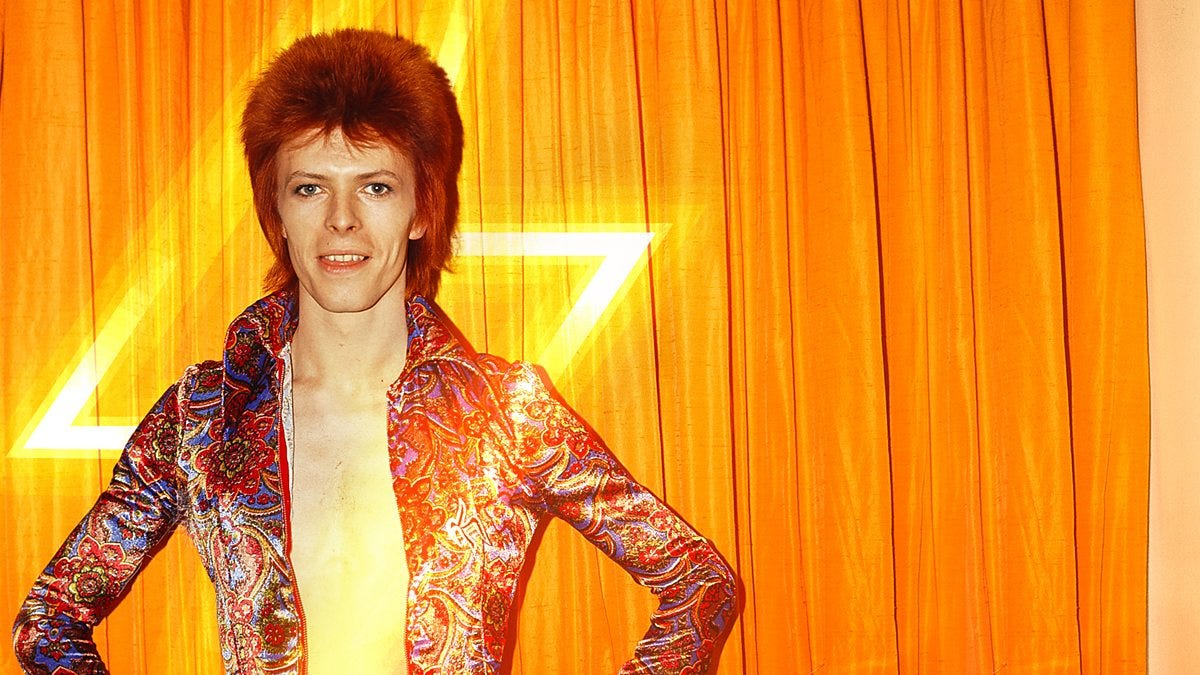
On This Day in 1972, something quietly seismic happened in a London pub. There was no stadium, no press frenzy, no sense that history had clocked in for work. A small crowd gathered, a band walked on, and a man stepped forward who insisted he was not himself. He was Ziggy Stardust, a visitor from elsewhere, bringing music as both warning and gift. By the time the night was over, pop culture had acquired a new language.
This moment matters because it was not a clever costume change or a marketing wheeze. It was a declaration. David Bowie did not simply perform songs that evening, he performed an idea. He tested whether an audience would accept that art could be lived, not just played. The answer, delivered quietly at first and then with thunder, was yes.
Difference as destiny
Long before Ziggy Stardust took shape, difference had already marked Bowie out. As a teenager, a schoolyard fight left him with a permanently dilated pupil in one eye. It was an accident, a misfortune, and later a visual signature. More importantly, it seeded a way of seeing himself. He looked unusual, and he knew it. Rather than hide it, he learned to lean into it.
That instinct would define his career. Bowie was never content to fit neatly. Early bands came and went, television appearances fizzled, record deals promised more than they delivered. Even when success arrived with Space Oddity, it felt provisional, as if the public had applauded a moment rather than a man. There is something deeply human in that frustration. Many artists hover on the edge of recognition, sensing that the door is unlocked but stubbornly stuck.
Bowie’s response was not to knock louder but to step through as someone else.
Reinvention as survival
The creation of Ziggy Stardust was not an act of escapism, it was an act of survival. Bowie understood that the industry, and perhaps the audience, needed to be shocked into paying attention. He also understood that music alone was no longer enough. The late sixties and early seventies were already bending the rules of gender, fashion and performance. Glam rock was opening doors. Bowie walked through them carrying a mirror.
Ziggy was an alien rock star, bisexual, doomed, radiant, fragile. He was theatre and prophecy rolled into one. The look drew from everywhere. London street markets, Japanese kabuki theatre, contemporary cinema. Cropped neon hair, heavy makeup, clothes that refused to explain themselves. This was not fancy dress. It was a complete worldview, presented without apology.
Crucially, Bowie committed to it. When Ziggy walked on stage, David Bowie did not peek out from behind the curtain. The audience was asked to believe or walk away. That demand for engagement changed the terms of performance. It invited people to consider identity as something fluid, chosen, and performative.
On This Day, a small stage sparked a revolution
The first full appearance of Ziggy Stardust took place on February 10th, 1972. The venue was modest. The audience numbered around sixty. Yet the performance burned with intent. Bowie introduced himself as Ziggy, launched into songs that blurred character and confession, and held the room for two hours.
Word travelled quickly, as it always does when something genuinely new appears. Within months, Ziggy Stardust and the Spiders from Mars were standing under studio lights on Top of the Pops, performing Starman to millions. That performance, barely four minutes long, split the nation. Some viewers recoiled. Others stared, transfixed. No one forgot it.
What they were responding to was not simply the music. It was the permission. Ziggy offered a way of being that did not ask for approval. In living rooms across Britain, young people saw possibility flicker on screen. You could be strange. You could be beautiful. You could refuse the narrow lanes set out for you.
Why Ziggy still matters
Ziggy Stardust did not last long. Bowie retired the character a year later, understanding perhaps that to linger would dull the blade. But the impact endured. Ziggy showed that pop stars could be artists in the fullest sense, shaping narratives, questioning norms, and changing how audiences saw themselves.
On This Day, it is worth remembering that this transformation did not arrive fully formed. It was built from setbacks, reinventions, and an unshakeable belief that difference was not a flaw but a resource. Bowie’s genius lay not only in his talent, but in his courage to stand in front of people and say, this is who I am today.
In the years that followed, Bowie would shed Ziggy and create again and again, new sounds, new faces, new questions. Yet it was Ziggy Stardust who lit the fuse. The alien who came to Earth with a guitar and left with the future.
On This Day in 1972, pop music grew up. It learned that identity could be art, and art could be dangerous, tender, and thrilling all at once. A small pub bore witness. The rest of the world caught up soon enough.