

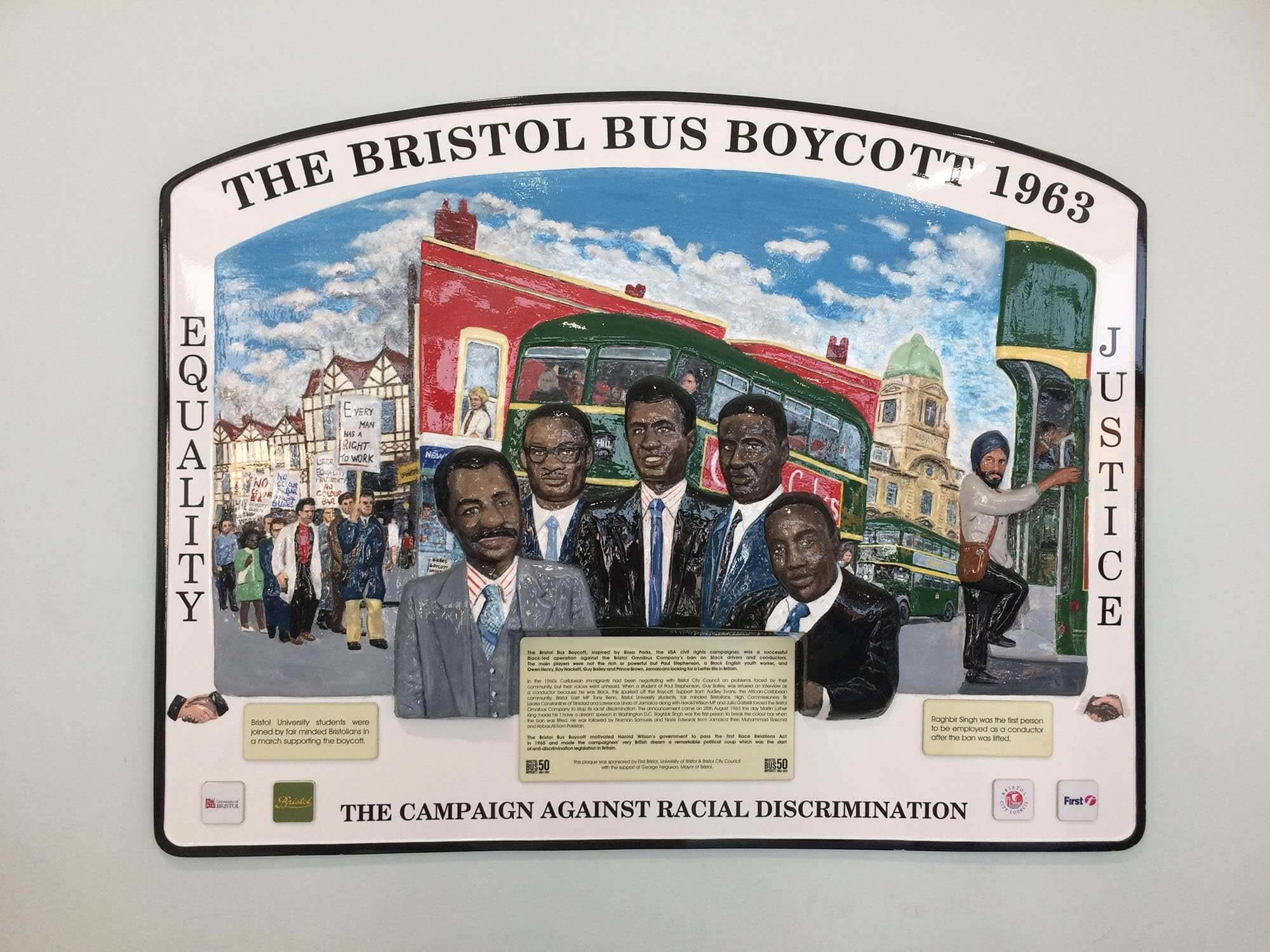
On this day in 1963, the streets of Bristol became the setting for a quiet revolt that carried the weight of something far greater than local transport policy. It was a test of conscience, a moment when the country was asked to decide whether its post-war promises meant anything at all.
Fifteen years earlier, the arrival of the Empire Windrush arrival had been framed as a hopeful beginning. Men like Sam King stepped onto British soil believing they were answering a call, that they were needed to rebuild a nation bruised by war. What they encountered instead was a reality that fell short of the rhetoric.
By the early 1960s, that tension had hardened into something unmistakable. Opportunities were limited, doors were closed, and prejudice had become embedded in everyday life. In Bristol, it revealed itself in a way that was as blunt as it was indefensible.
Roots of Discrimination in Post-War Britain
The policy at the centre of the dispute was simple in wording and stark in consequence. Black and Asian workers were barred from working as drivers or conductors for the Bristol Omnibus Company. They could, if permitted, work behind the scenes. Out of sight. Out of mind.
This was not written into law. It did not need to be. Agreement between management and union ensured it was enforced just the same. It rested on fear, on assumptions about public reaction, and on a quiet acceptance that exclusion could be justified if it kept the peace.
For years, the arrangement went largely unchallenged. That, in itself, is telling. Injustice does not always provoke outrage. Often, it settles into the background, normalised by repetition.
But pressure has a way of building. In Bristol, it began to gather among those who refused to accept that this was simply the way things were meant to be.
Boycott That Challenged the Status Quo
The spark came through organisation and intent. Led by figures such as Paul Stephenson, the West Indian Development Council set out to expose what many preferred to ignore. Evidence was gathered. Stories were shared. The truth became harder to deny.
What followed was a tactic drawn from across the Atlantic, inspired by the stand taken by Rosa Parks in the Montgomery Bus Boycott. If a system relies on participation, then withdrawing that participation becomes a powerful act.
The boycott began on April 30th, 1963. It did not arrive with noise or spectacle. Instead, it unfolded in small, deliberate choices. People chose not to board buses. Students marched. Support gathered momentum.
What gave the movement its force was not only the resolve of those directly affected, but the willingness of others to stand alongside them. That shift, from isolation to solidarity, marked a turning point. It suggested that the issue was no longer confined to one community, but had become a question for the wider public.
There was resistance, of course. Some dismissed the campaign as disruptive. Others clung to the old justifications. Yet the boycott endured, week after week, chipping away at both revenue and reputation.
Legacy That Reshaped Equality Laws
The outcome, when it came, was both practical and symbolic. The ban on employing Black and Asian bus workers was lifted. Individuals such as Raghbir Singh took up roles that had previously been denied to them, marking a visible change in the city’s daily life.
But the significance of the boycott extended far beyond Bristol. It fed into a growing national conversation, one that reached the corridors of power. Politicians like Tony Benn and Harold Wilson recognised both the injustice and the public mood.
Within a year, the groundwork had been laid for the Race Relations Act 1965, a piece of legislation that sought to address discrimination in public spaces. It was not perfect. It did not resolve everything overnight. But it marked a clear step towards accountability.
The boycott showed that change did not always begin in Parliament. Sometimes, it started at a bus stop, in the decision to refuse what had long been tolerated.
Reflection on a Defining Moment
Looking back, what stands out is not only the injustice that sparked the Bristol Bus Boycott, but the restraint and determination with which it was confronted. There was no grand stage, no single dramatic gesture. Instead, there was persistence.
It is tempting to view moments like this as inevitable, as if progress unfolds on its own timetable. The truth is less comforting. Without pressure, without voices willing to challenge what others accept, little shifts at all.
On this day in 1963, Bristol offered a reminder that the direction of a society can be altered by those prepared to question it. The buses kept running, but something else had begun to move as well, a recognition that fairness could not remain conditional.
That idea, once set in motion, proved harder to contain than any policy designed to exclude.