

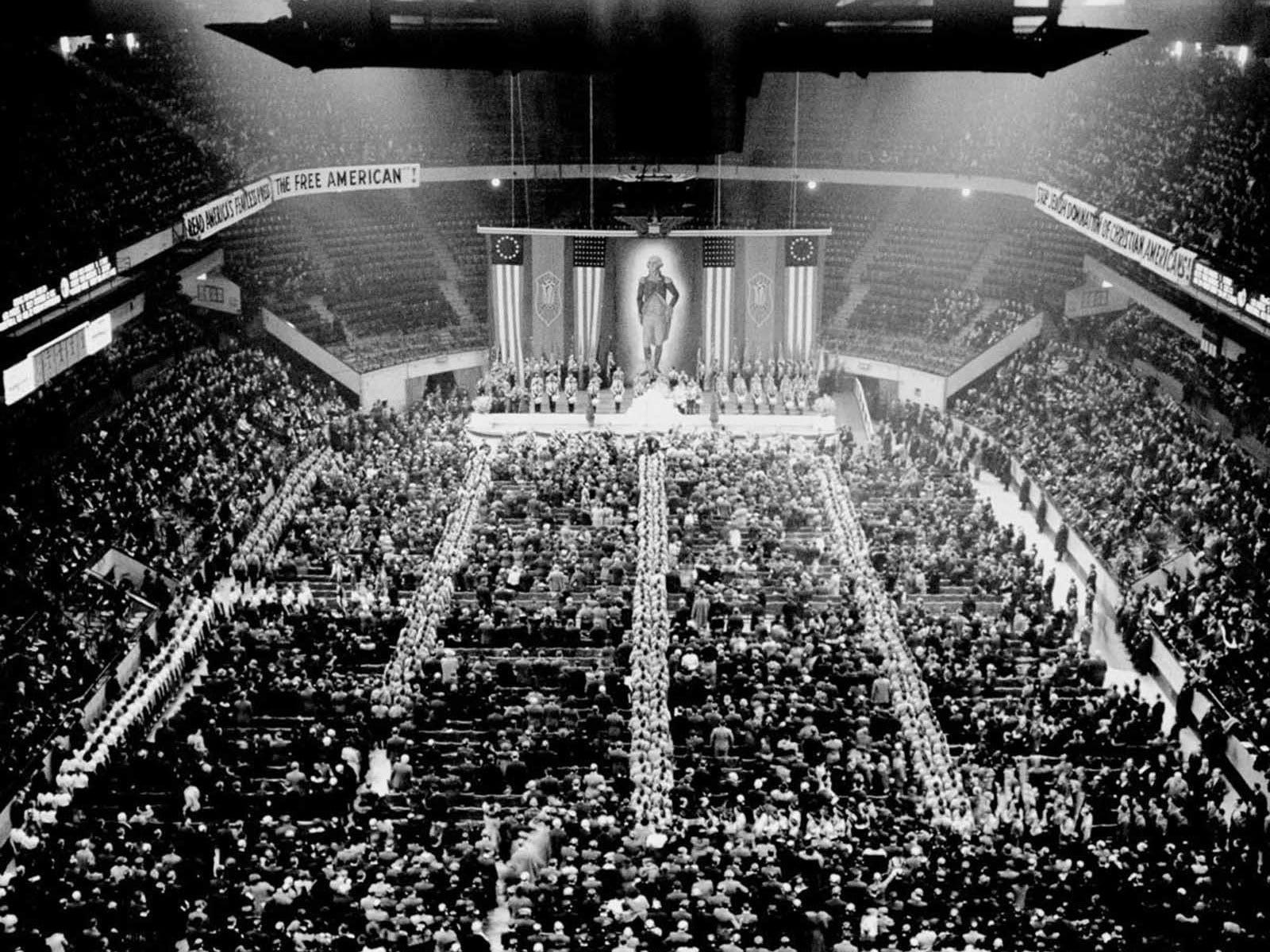
On 20 February 1939, beneath the bright lights of Madison Square Garden, 22,000 people gathered for what was billed as a patriotic rally. They came wrapped in the Stars and Stripes. They came to cheer George Washington. They came, so they were told, to defend American values.
They also came to salute Adolf Hitler.
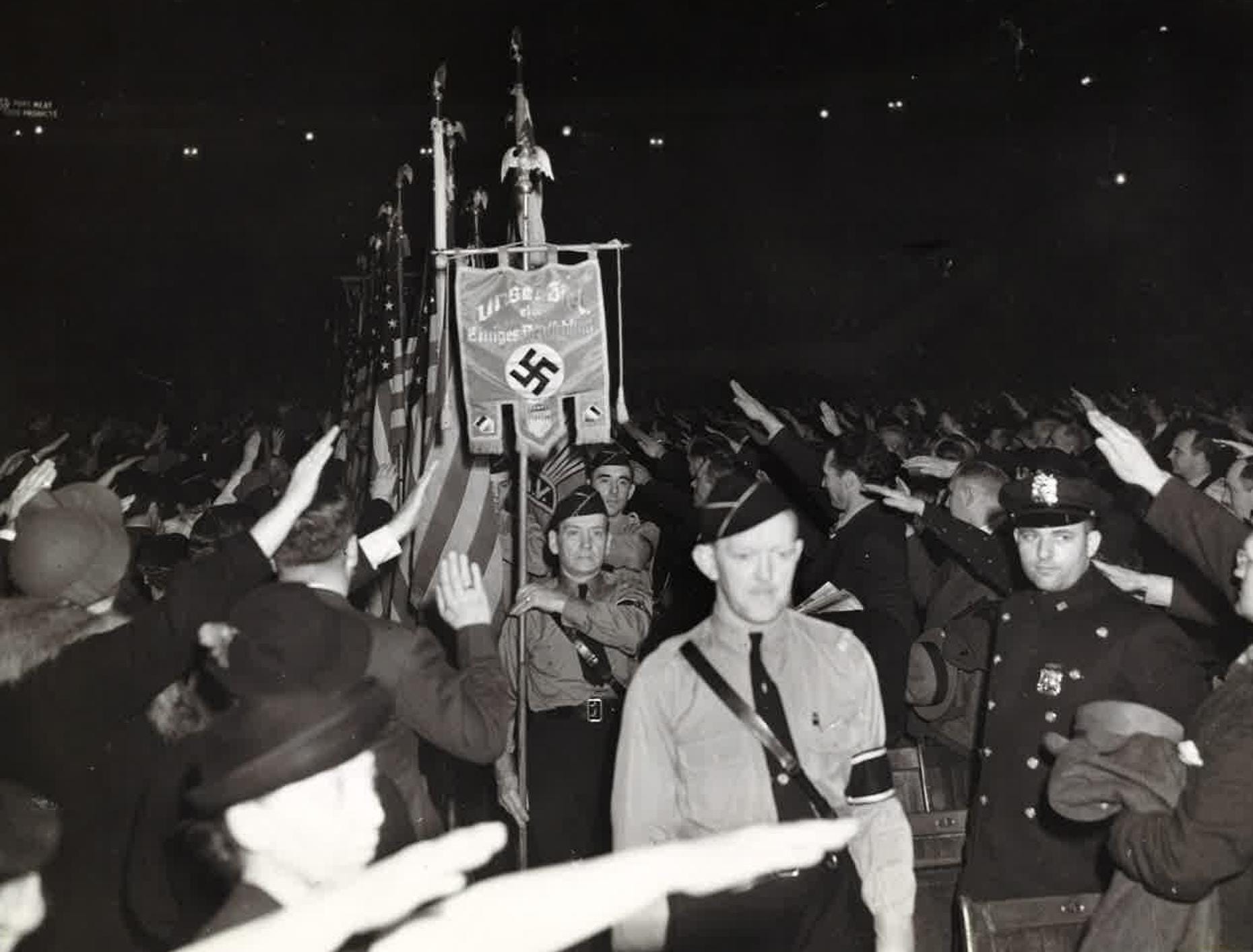
The image still jars. A vast portrait of George Washington, flanked not only by American flags but by towering swastikas. Uniformed stewards patrolling the aisles. Speeches railing against Jews, against communists, against anyone deemed alien to a narrow vision of the republic. It was theatre, calculated and brazen, staged in the heart of New York.
For many, the shock lies in the location. We prefer to imagine extremism as something that happens elsewhere, in darker corners of history. Yet on that winter evening in 1939, Nazism stood under the rafters of one of America’s most famous venues and spoke in the language of Americanism.
Gathering Storm in Manhattan
The rally was organised by the German American Bund, a group that presented itself as a cultural association for German Americans. In truth, it functioned as an unapologetic advocate for Hitler’s regime. Its leader, Fritz Julius Kuhn, understood the potency of spectacle. He understood that flags and familiar symbols could soften even the most poisonous message.
Kuhn’s genius, if one can use the word, lay in wrapping fascism in the garb of American patriotism. He spoke not of dictatorship but of renewal. Not of persecution but of protection. He railed against shadowy conspiracies and claimed that only his movement could save the United States from moral decay.
The timing was deliberate. Europe stood on the brink. Adolf Hitler had annexed Austria and dismembered Czechoslovakia. In November 1938, the pogrom known as Kristallnacht had shattered Jewish homes and synagogues across Germany. Reports of smashed glass and burning books reached American shores, stirring horror and disbelief.
Yet isolationism held firm in many quarters. There were those who insisted that Europe’s troubles were none of America’s concern. There were others who believed that fascism could never take root in American soil. It was this complacency that the Bund exploited.
New York’s mayor, Fiorello La Guardia, faced an unenviable choice. Ban the rally and risk turning its organisers into martyrs for free speech, or allow it and trust that exposure would reveal its ugliness. He chose the latter, deploying thousands of police officers to keep order. The decision remains contested, a reminder that democratic freedoms are tested most severely when they are extended to those who would dismantle them.
Inside the arena, the atmosphere swelled with rehearsed indignation. Outside, tens of thousands protested. They outnumbered those within by a margin reported as five to one. New York had not surrendered its conscience.
Courage Under the Swastika
History often turns on the acts of individuals who refuse to remain silent. On that night, one young Jewish plumber, Isidor Greenbaum, forced his way to the stage. He did not carry a weapon. He did not strike a blow. He lunged for the microphone cable and pulled.
For a moment, the tirade ceased. In that brief silence, he shouted his defiance of Hitler before being beaten and dragged away. Arrested and fined for disorderly conduct, he paid the price demanded by the law. He also paid a physical price at the hands of stewards who believed they were defending patriotism.
His protest did not end the rally. Kuhn resumed speaking. The crowd roared again. Yet the image of a lone man challenging a sea of raised arms has endured. It exposed the moral absurdity of the occasion. A self proclaimed movement for American greatness required the silencing of a single dissenting voice.
Greenbaum was not alone in his resistance. Among those observing events was the journalist Dorothy Thompson, one of the earliest American critics of Hitler. Years earlier, she had been expelled from Germany for her unflattering portrait of the Nazi leader. From her column and radio broadcasts, she warned that hatred dressed as nationalism could find admirers anywhere.
Her warnings were often dismissed as alarmist. America, she was told, was different. It had institutions, traditions, safeguards. And yet here were swastikas in Manhattan.
Greenbaum later enlisted when the United States entered the war. Thompson continued to write. Their methods differed, their stages were separate, but both understood a simple truth. Democracy survives only when defended, not in theory but in action.
Lessons from February 1939
The immediate aftermath of the rally seemed to vindicate those who had argued that exposure would discredit the Bund. Public revulsion was widespread. Membership in the organisation stalled. When Germany invaded Poland later that year, igniting the conflict that would become the World War II, sympathy for overtly pro Nazi groups in America withered.
Kuhn himself was later convicted of embezzlement and imprisoned, before being deported to a ruined Germany after the war. The grand ambitions proclaimed under the lights of Madison Square Garden dissolved into ignominy.
Yet it would be complacent to treat 20 February 1939 as a mere historical curiosity, a grotesque sideshow in the prelude to war. The rally revealed how easily extremist movements can cloak themselves in the symbols of the nation they seek to reshape. It showed how economic anxiety and cultural uncertainty can be harnessed and redirected towards scapegoats.
It also demonstrated the fragility and strength of democratic society in equal measure. Fragile, because 22,000 people were willing to cheer rhetoric that echoed Berlin. Strong, because far more turned out to oppose it, and because institutions held firm.
There is a temptation, when looking back, to view the past as inevitable. We know what followed. We know the scale of devastation that Nazism would unleash. The men and women filing into Madison Square Garden in 1939 did not possess that clarity. Some were true believers. Others were curious. A few may have convinced themselves that the event was harmless theatre.
History is seldom so forgiving. Ideas have consequences. Words spoken into a microphone can prepare the ground for deeds far more terrible.
On this day in 1939, fascism tried to present itself as compatible with American identity. It borrowed Washington’s image. It draped itself in the flag. It spoke of law, order and national pride. For a few hours, it commanded a stage in the world’s most modern city.
But it did not command the future.
The enduring image is not of Kuhn at the podium, nor even of the swastikas flanking the first President. It is of a man dragged from a stage for shouting that Hitler would not be welcomed. It is of thousands outside in the cold, insisting that hate, however loudly proclaimed, did not define them.
When we mark 20 February in the calendar of history, we do so not only to recall a shameful spectacle. We do so to remember that vigilance is the quiet price of liberty. The events at Madison Square Garden remind us that democracy is not self sustaining. It relies on citizens prepared to challenge falsehood, to confront prejudice, and, when necessary, to risk standing alone.
That lesson belongs not only to New York in 1939, but to any society tempted to believe that it is immune.