

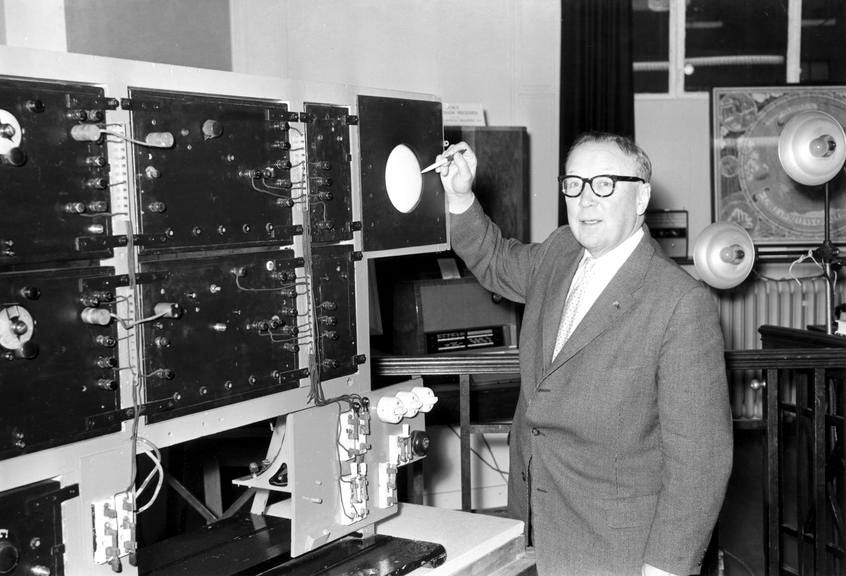
On this day in 1935, in a muddy field near Daventry, a quiet revolution began.
A Scottish physicist named Robert Watson-Watt stood beside a converted delivery van, his boots sunk into the hard winter ground, and waited for a flicker on a cathode ray screen. A Royal Air Force aircraft was circling eight miles away at five thousand feet. If his calculations were right, invisible radio waves would strike the aircraft, bounce back, and register as a pulse.
It sounds modest now. It was anything but.
That pulse marked the birth of radar as a practical weapon of defence. Within five years, it would help decide whether Britain stood or fell.
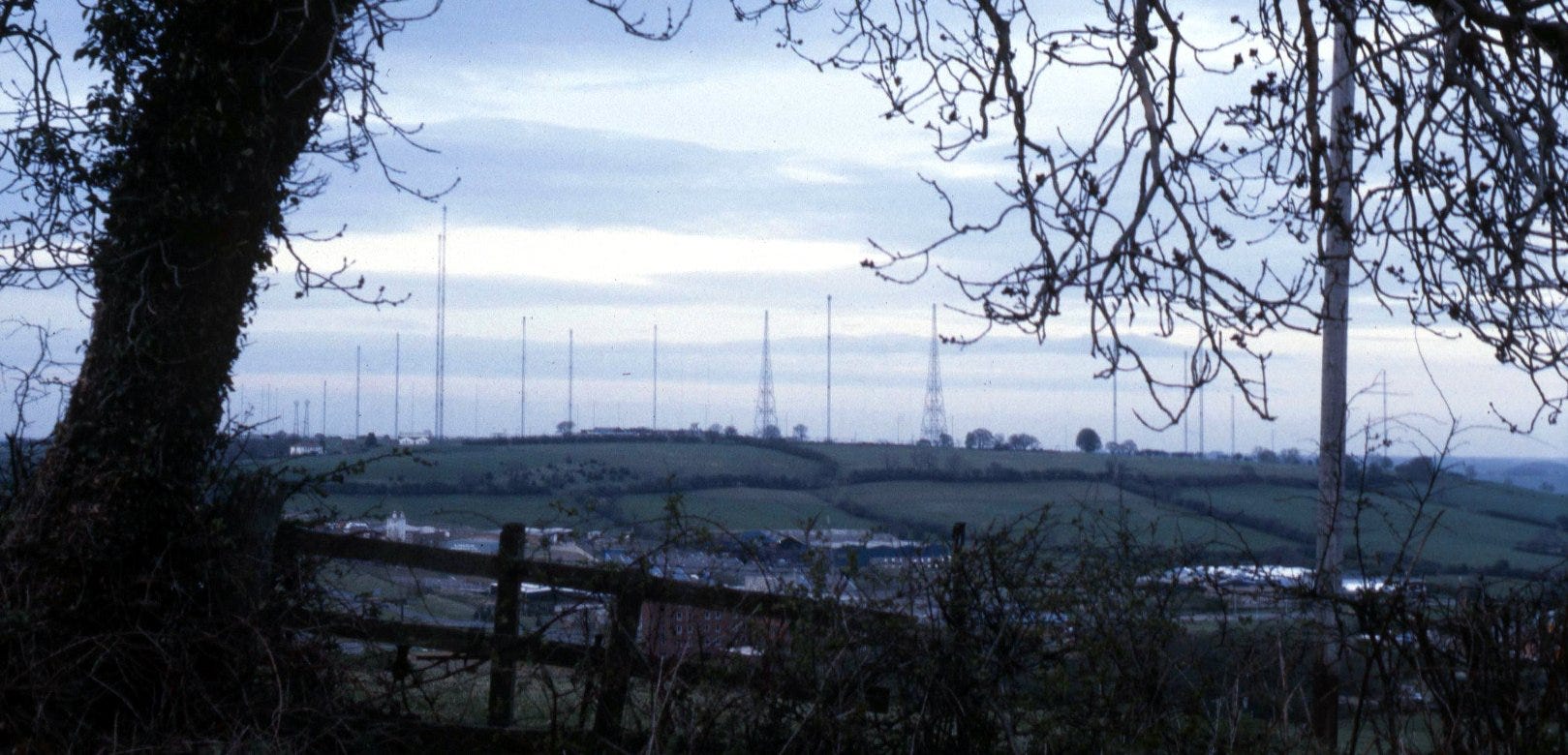
I have always felt a private connection to that moment. As a child, I used to pass the great radio masts at Daventry in the back seat of the family car. They seemed impossibly tall, skeletal guardians against the sky. I did not know then what had happened in the surrounding fields. I only sensed that something important had once been set in motion there.
I was right.
The immediate trigger for the experiment was fear. Rumours had reached the Air Ministry that Germany was developing a so called death ray, capable of destroying aircraft with beams of radio energy. Watson-Watt dismissed the idea as fantasy. Physics did not support it.
But the rumour forced a better question. If radio waves could not destroy aircraft, could they detect them?
The answer required more than theory. It demanded proof in open air, beyond laboratory benches and neat equations. So Watson-Watt and his colleague assembled a makeshift receiving system in a field near Daventry, using a nearby BBC transmitter as their source of radio waves.
When the aircraft passed through the signal, the reflected waves returned to their receiver. The screen flickered. The plane, invisible to the naked eye, had been found by echo.
In that instant, Britain stepped into a new age of warfare.
Air Ministry Calculations and Chain Home
The demonstration impressed the Air Ministry enough to release funding, though not extravagantly. Britain in the mid 1930s was still burdened by the economic aftershocks of the Great Depression. Every pound required justification.
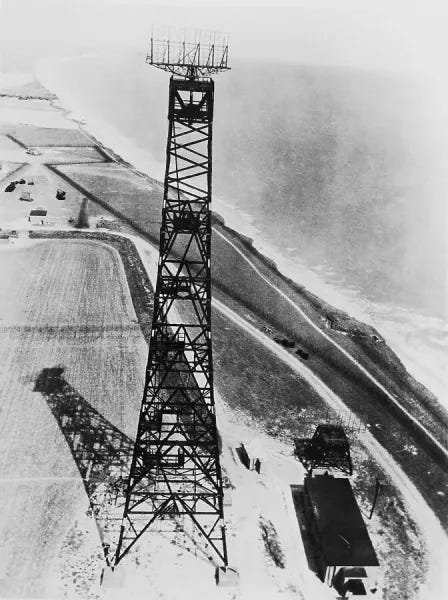
What followed was not a single invention, but a system. Towers rose along the east and south coasts of England, tall steel structures strung with transmitting aerials. By 1938 they were linked into a coordinated network known as Chain Home.
Chain Home could detect incoming aircraft at distances of up to one hundred miles. It could provide roughly fifteen minutes warning, a slender margin, but in aerial warfare fifteen minutes is the difference between order and chaos.
Crucially, radar data did not stand alone. Reports from ground observers, intelligence intercepts and plotting rooms were fed into a central command structure. Decisions were made calmly, based on information rather than guesswork. Fighter squadrons were scrambled only when necessary, directed precisely to their targets.
This was not technological theatre. It was disciplined integration.
And it worked.
Battle of Britain Turning Point
When war came in September 1939, the full weight of German air power had already been demonstrated in Poland and later in France. Air superiority preceded ground invasion. Bombers and fighters shattered airfields and infrastructure. Resistance collapsed with frightening speed.
By the summer of 1940, Britain stood alone in western Europe. An invasion seemed likely. The Luftwaffe’s task was clear, destroy the Royal Air Force and clear the path across the Channel.
Here radar proved decisive.
Thanks to Chain Home, Britain’s fighter squadrons did not need to patrol aimlessly, burning fuel and exhausting pilots. They could remain on the ground until incoming formations were confirmed. Controllers could direct Hurricanes and Spitfires to intercept at optimal height and position.
The result was efficiency in defence against numerical superiority.
During the height of the Battle of Britain, a large majority of German raids were intercepted. Losses mounted. Plans for invasion were postponed and then abandoned.
When German strategy shifted towards bombing cities in what became known as the Blitz, it signalled failure in the primary objective. Air superiority had not been achieved.
Radar did not win the battle alone. Pilots bore the mortal risk. Ground crews worked with relentless precision. Yet without early warning, without coordination, courage might have been squandered in confusion.
Watson-Watt’s flicker in a field had matured into a shield.
Legacy Beyond 1940
Radar did not remain static. It evolved rapidly through the war, improving in range, resolution and portability. It guided night fighters, protected convoys at sea, and aided anti aircraft batteries. It played a vital role in the Atlantic campaign against U boats.
After the war, radar shaped civilian life as well. Air traffic control, weather forecasting, maritime navigation, even speed enforcement on motorways all trace their lineage to that February experiment in 1935.
Yet I find myself drawn back to the simplicity of the beginning.
No grand laboratory. No cinematic fanfare. Just wooden poles, wire, a van, and a man waiting for proof.
History often pivots on such understated moments. We celebrate speeches and battles, but behind them lie calculations scribbled in notebooks, risks taken by individuals willing to test an idea in open ground.
As a history writer, I am wary of easy myth. Radar was not a miracle device dropped from the sky. It was the product of method, scepticism, refinement and administrative will. It required civil servants prepared to fund it, officers prepared to trust it, engineers prepared to build it at scale.
But the spark mattered.
On this day in 1935, Britain glimpsed a future in which information would shape warfare as decisively as firepower. The ability to see beyond sight altered strategy forever.
And for me, those tall masts at Daventry will never again be anonymous structures on a childhood journey. They stand as monuments to foresight, to disciplined innovation, and to the stubborn belief that preparation can steady a nation when storm clouds gather.
History rarely announces itself with a trumpet. Sometimes it arrives as a faint pulse on a screen, observed by a man who dares to believe that a flicker can change the fate of a country.