

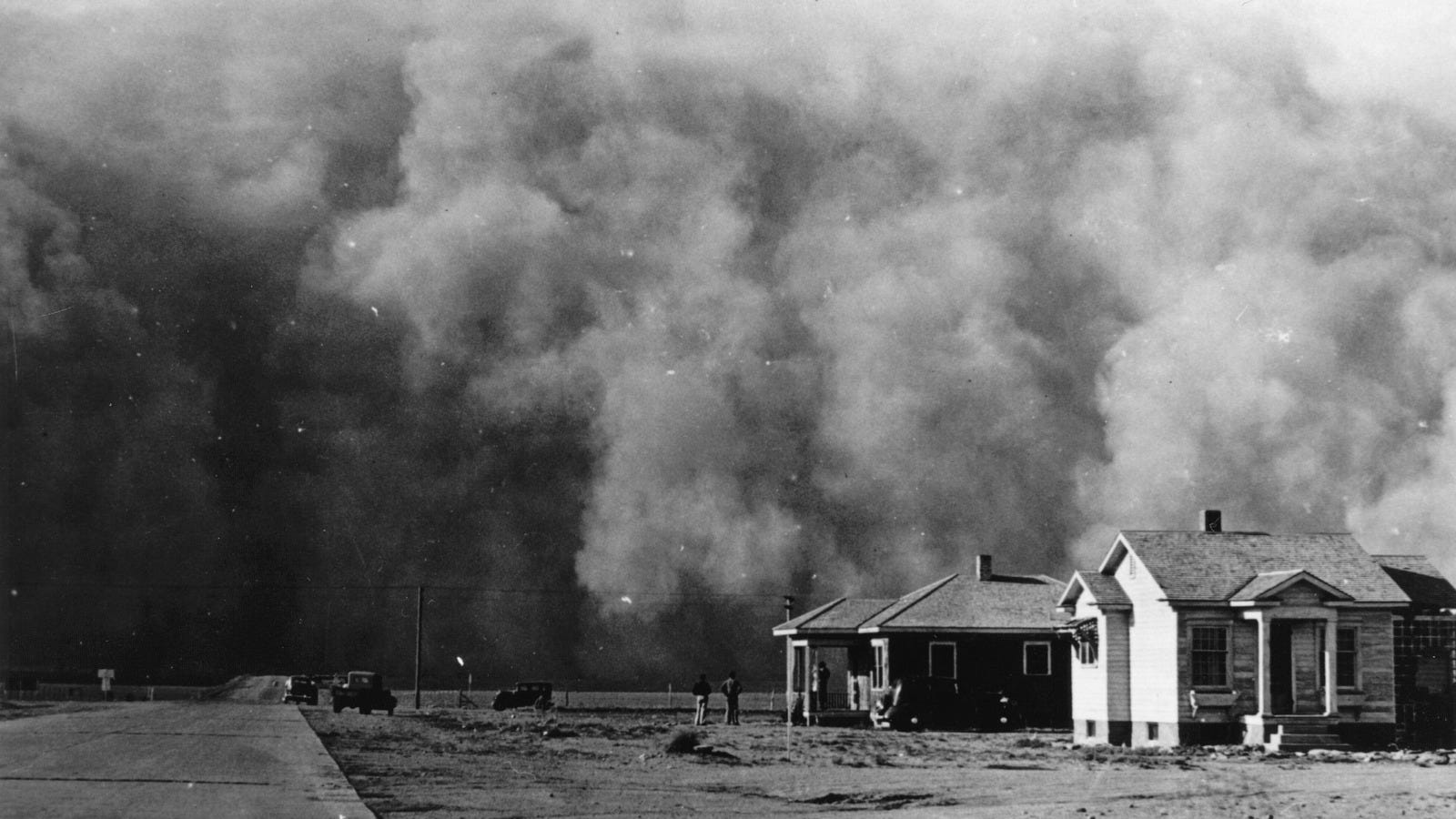
On this day in 1935, the American Plains witnessed a spectacle so vast, so suffocating, that it seemed the land itself had risen in revolt. The event would come to be known as Black Sunday, a moment when the sky darkened not with cloud, but with soil. It advanced like a living wall, swallowing farms, towns, and hope in its path.
There is a temptation to treat such an event as meteorological drama, a violent quirk of nature. That would be a mistake. This was no isolated storm. It was the consequence of years of drought, reckless farming, and a fragile ecosystem pushed beyond its limits. When the wind rose that April afternoon, it carried not only dust, but the quiet ruin of thousands of lives.
Families across Texas, Oklahoma, and beyond saw the horizon vanish. Children who had been playing moments before were rushed indoors. Doors were sealed, windows stuffed, breaths held. Yet the dust came anyway. It crept through cracks, settled into lungs, and coated every surface. The world shrank to darkness and grit.
Lives Caught in the Storm
For those who lived it, Black Sunday was not a single day, but a dividing line. Before it, there remained a fragile optimism that the land might recover. After it, that hope thinned, like the soil itself.
Farming families endured a daily siege. Crops failed repeatedly. Livestock perished. The air itself became hostile. Dust pneumonia, an ailment born of inhaling fine particles, claimed lives quietly and cruelly. Survival demanded endurance that bordered on the heroic.
What lingers most in the historical record is not simply the scale of the disaster, but the intimacy of its impact. A child stepping outside to feel the sun, only to see it blotted out minutes later. A mother wiping dust from a table she had cleaned moments before. A father staring across land that no longer yielded anything but despair.
This was hardship stripped of romance. It was relentless, grinding, and deeply human.
Migration and the Weight of Displacement
Black Sunday accelerated a movement already underway. Families began to leave. They packed what little they had and headed west, chasing rumours of work, of fruit, of survival.
This migration reshaped the social fabric of America. Entire communities dissolved as people sought refuge elsewhere. The journey itself was uncertain, often humiliating. Those who arrived in places like California found not relief, but overcrowded camps, suspicion, and fierce competition for meagre opportunities.
The Dust Bowl migrants became symbols of endurance, though that word risks softening the reality. They were displaced not by war, but by a slow environmental collapse, one that exposed the precariousness of rural life when nature and policy failed in tandem.
It is here that the story of Black Sunday intersects with something enduring, something visual.
Image That Defined an Era
Amid the hardship emerged one of the most recognisable images of human struggle, captured by Dorothea Lange. Her photograph, Migrant Mother, distilled the suffering of an entire generation into a single frame.
The woman’s gaze, distant and burdened, spoke of exhaustion and resilience in equal measure. Her children, turned away, seemed to cling not just to her body, but to the last vestige of stability in an unstable world.
The photograph did more than document. It confronted. It forced those far removed from the Dust Bowl to reckon with its human cost. It became a silent argument for compassion, for intervention, for change.
What makes this image so powerful is its honesty. There is no embellishment, no attempt to dramatise. It simply presents reality, and in doing so, it resonates across decades.
Legacy Carved in Dust
Black Sunday remains a stark reminder of what can happen when environmental mismanagement meets economic vulnerability. It is easy, from a modern vantage point, to view it as a relic of another age. That would be complacent.
The lessons are uncomfortably relevant. Soil erosion, climate instability, and the fragility of agricultural systems continue to challenge societies worldwide. The Dust Bowl was not merely a historical episode, it was a warning.
Yet within that warning lies something else. The resilience of those who endured. The capacity to adapt, to move, to rebuild. It was not uniform, and it was not always successful, but it was undeniable.
As a history writer, I find myself drawn not only to the scale of events like Black Sunday, but to their human texture. History breathes through individuals, through moments of fear, decision, and survival. The storm itself lasted hours. Its consequences stretched across years, even generations.
On this day in 1935, the sky darkened, and the land seemed to vanish. What remained were people, struggling, enduring, and, in some cases, leaving everything behind in search of something better.
That is the story worth telling. Not the storm alone, but the lives it reshaped.