

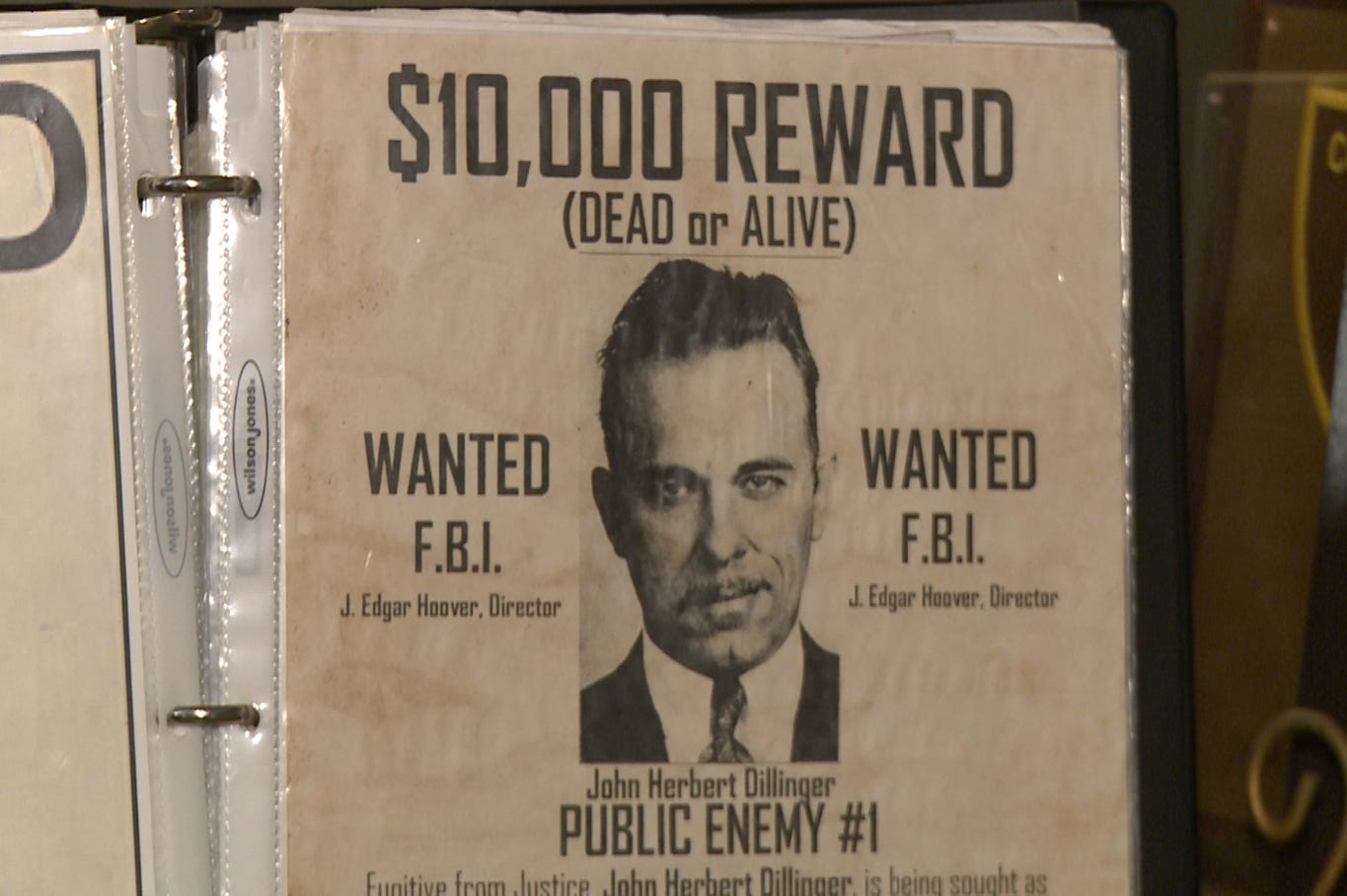
On This Day, 3 March 1934, a prisoner walked out of the Lake County Jail in Crown Point, Indiana, and into American folklore. His name was John Dillinger. By nightfall he was no longer merely a bank robber awaiting trial for murder. He was the most wanted man in the United States.
The escape itself has been told and retold, embroidered and disputed, yet it endures because it speaks to something larger than one man’s nerve. Dillinger’s jailbreak was theatre played against the bleak backdrop of the Great Depression. It was a spectacle of defiance that many ordinary people, battered by foreclosures and failed banks, found difficult to condemn outright.
America’s Hunger for Outlaws
By late 1933, the country was exhausted. The crash of 1929 had torn through savings, farms and pride. Banks had shuttered their doors. Families had been evicted. Against that sour landscape, the figure of the bank robber took on a curious glow.
Dillinger had not begun as a folk hero. He was a small town criminal who learned his trade in prison, forming alliances that would later become the core of his gang. Once released, he wasted little time. In August 1933 he helped rob a bank in Bluffton, Ohio, flashing a grin at tellers while accomplices waved submachine guns and fired shots to cow resistance. It was ruthless, efficient and brazen.
Soon after, he and his associates raided a police station in Peru, Indiana, stealing a sawed off shotgun, pistols, rifles and a Thompson submachine gun. Three days later they struck a bank in Greencastle, Indiana, escaping with a fortune in Depression money. In Wisconsin, another robbery turned violent, hostages were taken and blood was spilled.
Law enforcement agencies circulated his photograph across the Midwest. Newsreels showed his face before feature films in packed cinemas. The intention was to warn the public. The effect was the opposite. Audiences cheered.
Part of Dillinger’s appeal lay in the stories that clung to him. One tale claimed he returned a farmer’s deposit during a robbery, saying they were after the bank’s money, not a working man’s. Whether true or not, it fitted the mood of the times. Many Americans felt betrayed by financial institutions. Dillinger appeared to be striking back.
This is not to excuse him. A police officer, William Patrick O’Malley, was shot dead during a botched escape from a bank in East Chicago, Indiana, in January 1934. Dillinger later suggested he had little choice. The widowed family might have disagreed. Romance has a habit of smoothing the hard edges of violence.
Capture, Celebrity and Crown Point
Dillinger’s run could not last. In January 1934 he was arrested in Tucson, Arizona, after a hotel fire drew attention to members of his gang. He was extradited to Indiana to stand trial for murder and lodged in what local officials proudly described as an escape proof jail in Crown Point.
Even in custody he cultivated his image. Photographs show him relaxed, arm draped over the shoulder of the very prosecutor tasked with putting him away. It was bravado, certainly, but also calculation. Dillinger understood publicity. Every image reinforced the idea that he was untouchable.
Behind the cell door, though, the stakes were stark. Conviction could mean the electric chair. If he was to survive, he would have to move.
Wooden Gun, Real Consequences
On the morning of 3 March 1934, Dillinger put his plan into action. According to the most famous version of events, he had carved a pistol from a piece of wood and darkened it with shoe polish. When a guard opened his cell for exercise, Dillinger pressed the fake gun into the man’s side and marched him down the corridor.
Other guards were herded into cells. At some point, real firearms were obtained, whether smuggled in, stolen from the jail’s arsenal, or provided through bribery. The precise mechanics remain debated. What is certain is that Dillinger left the building armed and in control.
Outside, he commandeered the sheriff’s car and drove away, heading towards Chicago. In that act lay his fatal miscalculation. By transporting a stolen vehicle across state lines, he triggered federal jurisdiction under the National Motor Vehicle Theft Act. The Bureau of Investigation, soon to be the Federal Bureau of Investigation, now had clear authority to pursue him.
Within days he was declared Public Enemy Number One.
The irony is sharp. The escape that cemented his legend also ensured that the full weight of the federal government would bear down on him. What had been a regional manhunt became a national crusade.
Legend and Reckoning
Dillinger’s freedom lasted less than five months. On 22 July 1934, federal agents tracked him to the Biograph Theater in Chicago. As he emerged into the humid night, he was shot and killed in a hail of bullets. He was thirty one years old.
In death, as in life, the details blurred into myth. Some insisted he had never used a wooden gun at Crown Point. Others believed corrupt officials had simply let him walk out. Each variation added another layer to the story.
What interests me, looking back on this day in 1934, is not the craftsmanship of the escape but the climate that allowed it to resonate. Dillinger thrived in a period of economic despair and public distrust. He projected confidence when many felt powerless. He robbed institutions that had, in the eyes of some, robbed them first.
Yet the ledger cannot be balanced by sentiment. Banks were not his only victims. Innocent people were terrorised. Law officers died. Communities were left to reckon with the damage long after the headlines moved on.
The United States in the early 1930s was grappling with modernity. Fast cars, automatic weapons and instant mass media created a new kind of criminal celebrity. Dillinger mastered that stage. He smiled for cameras, understood the value of a good story, and seemed to relish the chase.
But the state was modernising too. His dash across the Indiana state line forced a shift in law enforcement, strengthening federal involvement in interstate crime. In that sense, his jailbreak helped accelerate the very machinery that would hunt him down.
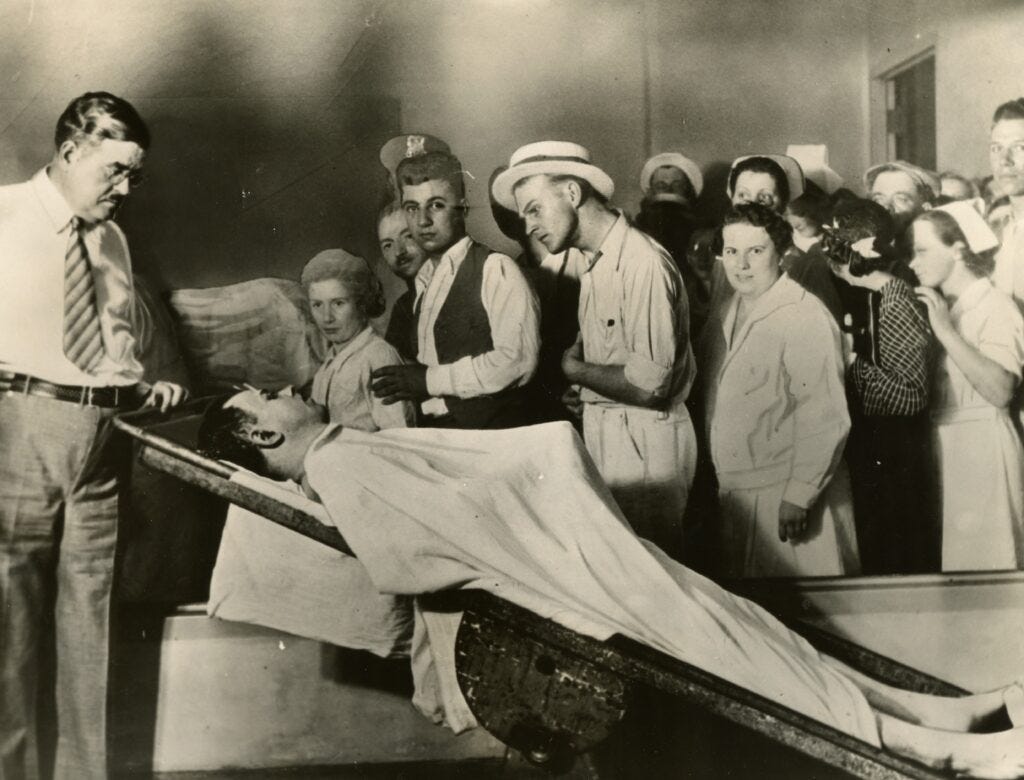
On This Day 1934, the doors of a supposedly impregnable jail swung open and a fugitive sped into history. The image of the wooden gun, whether fact or embellishment, endures because it captures the audacity of the moment. A carved block of wood held against the ribs of authority, daring it to blink.
Dillinger’s story sits at the uneasy junction of hardship and hero worship. It reminds us how quickly anger can turn an outlaw into an icon, and how readily myth can muffle the sound of gunfire.
As a historian, I am drawn not to the glamour but to the tension beneath it. The man who strode out of Crown Point that March morning was both a product of his time and an architect of his own undoing. His escape was real. So were the consequences.