

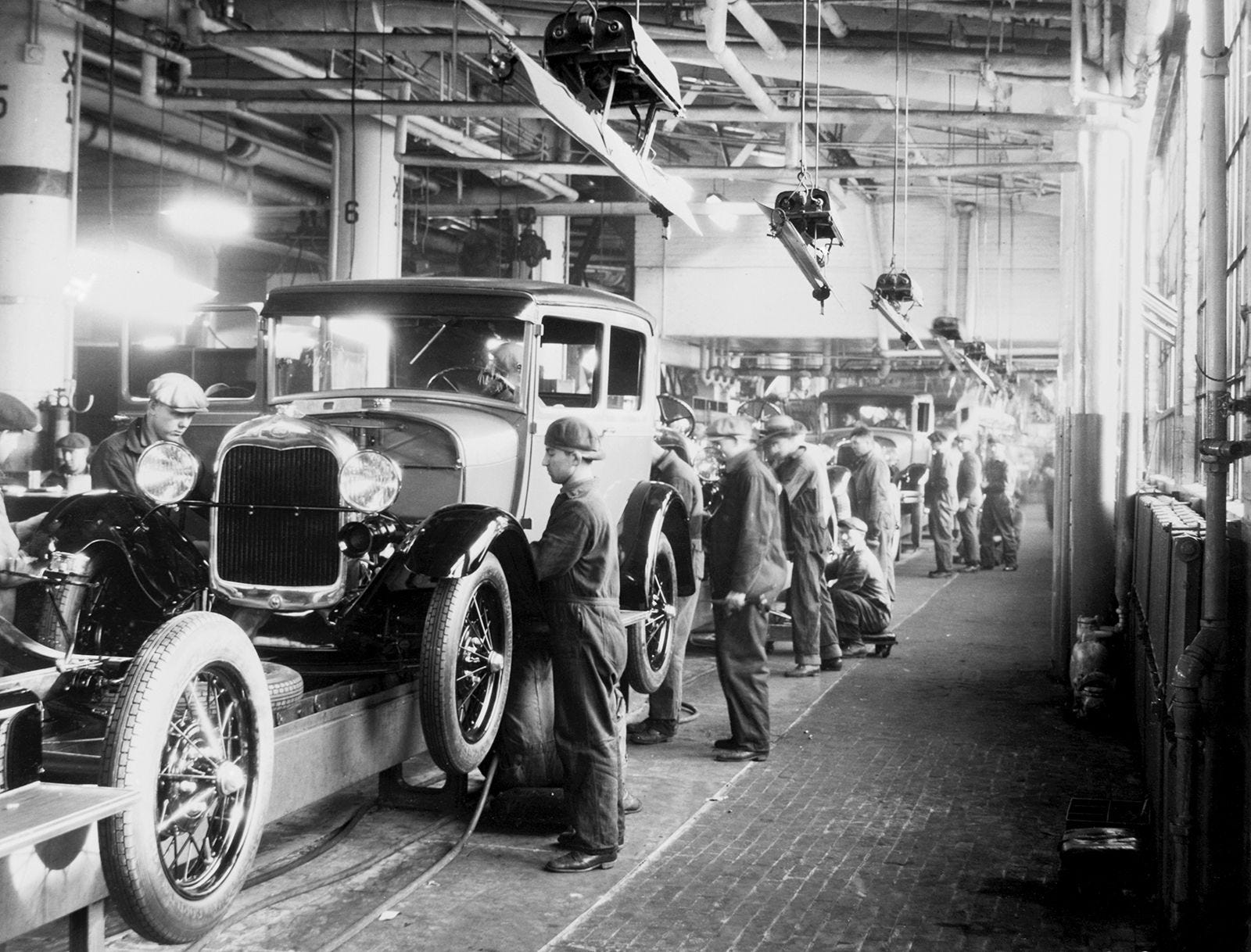
On This Day, 1 May 1926, something remarkable happened in Detroit. The machines did not roar. The yards did not tremble. The Ford Motor Company’s factory workers began a five day, 40 hour working week, with office staff following later that summer.
That silence matters. It was not emptiness. It was an argument.
Henry Ford, a man more often associated with speed, noise and ruthless production, had decided that a shorter working week could strengthen his business rather than weaken it. He was no soft sentimentalist. He did not arrive at the five day week by drifting into benevolence. He came to it through calculation, observation and a deep instinct for efficiency.
That is why the story still carries such force. Ford’s move was not merely about giving workers Saturday off. It was about recognising a truth that many employers, then and now, resist until exhaustion proves it for them. Human beings are not machines, even when they are placed beside machines. Work improves when people have enough life left in them to do it well.
Henry Ford’s genius was practical before it was generous
Ford’s first great motoring triumph was not born in corporate polish. It began in the awkward intimacy of invention, with a crude machine, bicycle wheels, an engine, and a man prepared to break open a shed door because his creation would not fit through it.
The quadricycle’s first outing in 1896 was short and imperfect, yet it contained the shape of what followed. Ford saw that the motor car could be more than a rich man’s toy. The arrival of the Model T in 1908 gave that belief its working body. The car was simple to drive, comparatively cheap to repair, and priced to reach the American middle classes.
That was Ford’s real revolution. He did not merely build cars. He built a system in which ordinary people could imagine owning one. The Model T altered transport, industry and the rhythm of daily life. By 1918, half of all cars in the United States were Model Ts, a figure that shows how completely Ford had seized the American road.
Yet the same system that made Ford powerful also made his factories punishing places. The moving assembly line, introduced in 1913, drove production forward with astonishing force. It also reduced labour to repetition. A worker no longer built a car in any rounded sense. He performed one task, again and again, as the vehicle moved past him.
That was efficient, certainly. It was also draining. Ford’s genius was to understand that efficiency has a breaking point.
Five dollars a day was the warning before the weekend
In 1914, Ford stunned American industry by introducing the five dollar day, more than doubling pay for many of his workers. Competitors saw madness. Ford saw arithmetic.
High turnover was expensive. Training men who quickly left was wasteful. A better paid worker stayed longer, learned faster and produced more reliably. Ford did not need to wrap the policy in saintliness. Its value was visible on the factory floor.
This is where Ford becomes most interesting and most uncomfortable. He could be fiercely anti union. He wanted control. He preferred to outmanoeuvre labour unrest rather than submit to organised pressure. Yet in doing so, he sometimes gave workers changes that more orthodox employers resisted.
That contradiction should not be tidied away. History is rarely improved by sanding down its rough edges. Ford was not a plaster saint of labour rights. He was a complicated industrialist who believed that the best way to preserve authority was to make his system work better than the alternative.
The five day week followed that same logic. Ford had watched the cost of fatigue. He had seen what monotony could do to morale. He understood that a factory could lose money through accidents, errors, absenteeism and churn as surely as through idle machinery.
A rested worker was not a luxury. He was an asset.
Leisure became part of the production line
Ford’s most modern insight may have been that leisure had economic value. He believed that workers with time away from the factory would live fuller lives, consume more, and return with better energy. He argued that leisure for working men should not be treated as wasted time or a privilege reserved for the comfortable.
That idea still sounds bracing because it refuses the old moral suspicion of rest. There has always been a hard voice in public life that treats tiredness as proof of virtue. Ford, hardly a dreamy reformer, cut through that with the cold eye of a manufacturer. If men were less exhausted, they worked better. If they had a Saturday, they had a stake in the world beyond the gate.
The change was not painless. Some workers feared losing income. Critics predicted industrial decay. Other business owners accused Ford of giving ground to labour pressure. Early figures did show a dip in production and profit. Yet the broader result was more important. Ford remained a giant. The factory did not collapse. The argument for a shorter week became harder to dismiss.
Over time, the principle travelled beyond Ford’s own plants. In 1938, the Fair Labor Standards Act set America’s first federal minimum wage, restricted child labour, and introduced overtime rules. Later, the 40 hour threshold became the standard against which overtime was measured. Ford had not written the law, but his 1926 experiment helped prove that the modern working week could survive contact with profit.
That is the lesson worth carrying from On This Day 1926. Progress in work rarely arrives as pure kindness. It often comes when pressure, profit and principle collide, and someone powerful realises the old arrangement has become inefficient as well as unfair.
Henry Ford did not give the world the weekend in a moment of tenderness. He helped legitimise it because he saw what the exhausted body was costing the machine.
That does not make the achievement smaller. It makes it sharper. The five day week was not a retreat from ambition. It was a smarter form of ambition, one that admitted the worker had a life beyond the whistle and that industry, for all its steel and smoke, still depended on human stamina.
Nearly a century later, as debates continue over remote work, four day weeks, burnout and productivity, Ford’s Saturday silence still speaks. It tells us that the future of work is not found by squeezing people until they have nothing left. It is found by asking what they might build when they are allowed to recover.