


On this day in 1922, France carried out the execution of Henri Désiré Landru, a man whose crimes unfolded not in dark alleyways but in the classified columns of respectable newspapers. His weapon was not a knife brandished in rage, but a fountain pen and a promise of marriage.
Landru’s story is bound tightly to the anxieties of the First World War. While millions of Frenchmen fought and died in the mud of the Western Front, he hunted in parlours and boarding houses, seeking women left alone by loss, separation, or hope deferred. His execution at Versailles marked the end of one of the most disturbing criminal sagas in modern French history.
Wartime Loneliness and Calculated Deceit
By 1915, France was exhausted. Casualty lists lengthened. Cities filled with widows and women who had not yet received the telegram but feared its arrival. The war altered the social balance. Men were absent. Uncertainty ruled daily life.
Into this vacuum stepped Landru.
He placed lonely hearts advertisements under assumed names, presenting himself as a prosperous industrialist displaced by the German occupation of northern France. He wrote in warm, attentive tones. He spoke of stability, marriage, and shared futures once the war ended. For women facing isolation and financial strain, the offer of companionship carried weight.
His method was careful and methodical. He targeted women who possessed modest savings or property. Once trust was secured, he persuaded them to place their finances under his control. Then they disappeared.
At first, their absences raised little alarm. Wartime France was chaotic. Travel was common. Communication faltered. A woman leaving Paris for the countryside might not immediately be missed. Families who questioned the circumstances often encountered indifference from authorities. In that era, working class women did not command urgent attention from officialdom.
Landru relied on that indifference.
Voices That Refused to Be Silenced
What undid him was not brilliant detective work at the outset. It was persistence from those who refused to accept silence as an answer.
Sisters began to compare notes. One woman, uneasy about her sibling’s sudden disappearance after an engagement, wrote letters and visited officials. She was dismissed. Another family, wealthier and more socially connected, experienced the same vanishing act. They too encountered hesitation from police.
Gradually, a pattern emerged.
Descriptions of the suitor matched. The timeline aligned. The financial entanglements were identical. What appeared at first as isolated domestic dramas began to look like something far darker.
The turning point came when Landru was recognised in public with yet another prospective bride. A shop assistant recalled his face. A shipping address was obtained. The police, now presented with a dossier assembled by determined relatives, finally made an arrest in April 1919.
Under questioning, Landru denied murder. He admitted to fraud, but insisted the women had left of their own accord. Without bodies, he believed the state could prove little.
Evidence in Ash and Bone
Investigators searched his properties, including a rented house in the countryside west of Paris. Neighbours had once complained about thick, foul smoke rising from his chimney. At the time, it had been dismissed as domestic nuisance.
Now, the search took on urgency.
In a garden shed and furnace, police discovered charred bone fragments, scraps of clothing, and human teeth. There were no intact bodies, but there was enough to suggest systematic destruction. Landru had kept a meticulous notebook recording dates, train fares, expenditures, and coded entries alongside the names of women who had since vanished.
Among the names were eleven women who were never seen again.
The image that lingered with the public was not of a frenzied killer but of a small, bearded man tending a fire, feeding it piece by piece. The horror lay in the banality. Smoke from a chimney on a summer night. A parcel carried to a pond. Nothing theatrical, everything deliberate.
Trial of a Modern Bluebeard
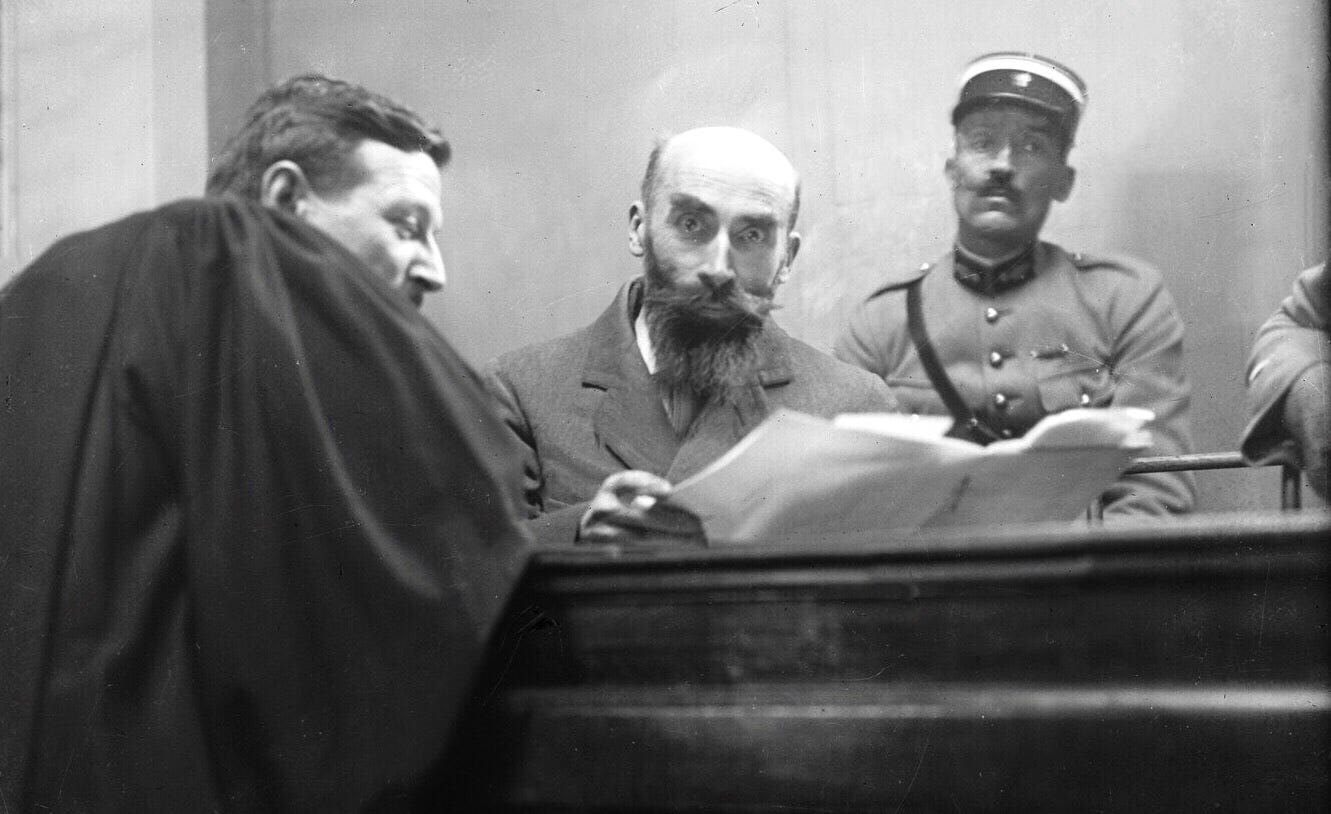
The trial of Henri Désiré Landru in 1921 became a sensation. Crowds gathered. Journalists filled the courtroom. He was charged with eleven murders and dozens of fraud offences.
His defence was formidable. Counsel argued that while Landru might have deceived women financially, there was no definitive proof of murder. No complete bodies. No direct eyewitness to the killings. The prosecution relied on circumstantial evidence, patterns, and forensic fragments.
But the most powerful testimony did not come from laboratory analysis.
It came from women.
Relatives took the stand and described how their sisters and daughters had been swept up by promises of marriage, persuaded to hand over savings, then vanished. Their accounts were calm and direct. One witness, facing Landru in court, refused to lower her gaze. Her composure cut through the theatrics of legal argument.
Another witness recalled seeing smoke from Landru’s chimney and a suspicious figure disposing of a heavy object near water on a moonlit night. These memories, once insignificant, now carried weight.
Piece by piece, the prosecution constructed a narrative of methodical murder. The jury was persuaded. Landru was found guilty on all eleven counts of murder and most of the fraud charges.
France had its answer.
February 25, 1922: Justice at Versailles
On the morning of February 25, 1922, the gates of the prison at Versailles opened before dawn. The guillotine stood ready, its efficiency honed by generations.
Landru, once defiant and sharply groomed during trial, had withered in custody. Witnesses described him as thin, subdued. The execution was swift. Within seconds, it was over.
The state had exacted its penalty.
For many in France, the execution brought grim closure. Yet the case left uncomfortable questions. How had he operated for so long? Why were early complaints ignored? Would the outcome have differed if the missing women had held greater social standing?
Landru’s crimes exposed more than individual depravity. They revealed institutional complacency. The women who first sought help were brushed aside. Only when a male complainant added his name to a formal complaint did the machinery of investigation begin to move in earnest.
That detail deserves remembrance.
Legacy of Henri Désiré Landru
Henri Désiré Landru has often been described as France’s Bluebeard, a reference to the folktale of the aristocrat who murdered his wives. The comparison is convenient but incomplete. Landru did not rely on inherited power. He exploited bureaucracy, prejudice, and wartime dislocation.
He understood paperwork. He kept accounts. He altered identities with ease. In a sense, he was a modern criminal, navigating an age of rail travel, postal correspondence, and expanding urban anonymity.
His case influenced criminal investigation in France, particularly the handling of missing persons and forensic remains. The discovery of teeth and bone fragments, carefully catalogued, demonstrated that absence of a body did not equal absence of proof.
More quietly, it stands as a testament to civilian courage. Without the persistence of sisters, friends, and daughters who refused to accept official indifference, Landru might have continued his deception. The war created chaos, but it was personal tenacity that restored order.
On this day in 1922, the blade fell. It marked the end of a calculated predator who cloaked himself in respectability. Yet history asks us to look beyond the spectacle of execution.
It asks us to remember the women whose trust was betrayed, the families who would not be silenced, and the lesson that evil can thrive in ordinary settings when institutions fail to listen.
Landru sought to profit from loneliness in a time of national trauma. Instead, he secured a grim place in the annals of French crime.
His fire has long since gone out. The smoke has cleared. What remains is a warning carried forward through history, that vigilance often begins not with authorities, but with those who refuse to look away.
Great article. I'm currently watching the ITV documentary about John Wayne Gacy, a tough watch, and noticed several similarities with this crime. It seems Landru's killing spree was motivated by financial greed, and Gacy's by sadistic pleasure, but both targeted victims that could 'disappear' and the reports of their missing be ignored by the police. Again, it was women who would not allow their loved ones be forgotten or dismissed. Unfortunately, though, the lessons of 1920s France were not remembered by 1970s America.
"vigilance often begins not with authorities, but with those who refuse to look away".