

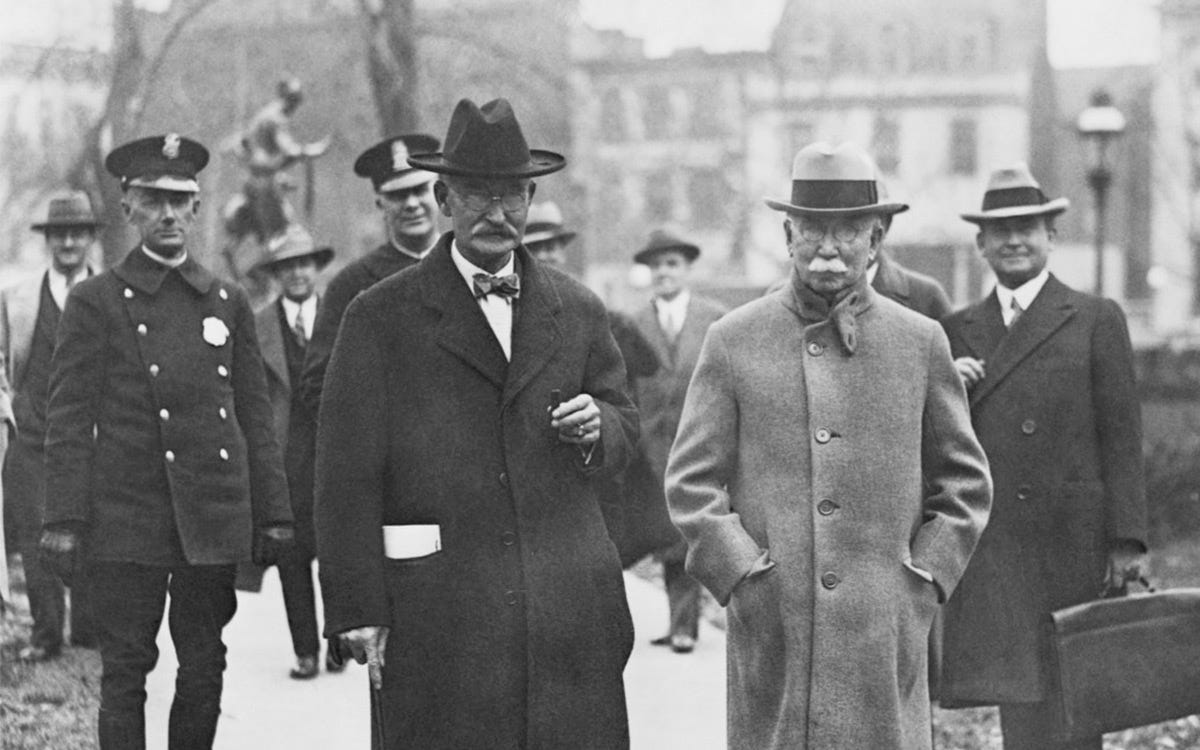
On This Day in 1922, a quiet signature set off one of the most damaging political scandals in American history, the Teapot Dome scandal. What looked, at first glance, like routine administration of federal resources was in truth a calculated abuse of power, sealed behind closed doors and carried out with the sort of confidence that comes from believing no one is watching.
At the centre stood Albert Fall, a man who had climbed from frontier politics to the upper ranks of government. He was trusted, well connected, and, crucially, placed in charge of valuable naval oil reserves. These reserves, including land in Wyoming known as Teapot Dome, existed for national security, a safeguard for the United States Navy in times of crisis. They were not meant for private gain.
Yet, with remarkable speed and secrecy, drilling rights were handed out to oil magnates without competitive bidding. Among them were Edward Doheny and Harry Sinclair, men whose wealth and influence stretched deep into political circles. The arrangement was dressed up as necessity. In reality, it was something far murkier.
Corruption Beneath the Surface
The mechanics of the scandal were both simple and audacious. Cash changed hands. Favours were returned. Public assets became private opportunity.
Fall received what was described as a loan, a sum so large it transformed his fortunes almost overnight. Debts disappeared. Property was improved. The signs were there for anyone willing to look closely enough. But in politics, as in life, truth often waits behind convenience.
The justification offered at the time leaned on urgency. Oil reserves, it was claimed, risked depletion. Quick action was needed. Yet this explanation never quite settled. It felt rehearsed, a line repeated often enough in the hope it might become believable.
What makes this episode striking is not simply the corruption itself, but the confidence with which it was carried out. There was no immediate fear of exposure, no sense that accountability would follow swiftly. That confidence speaks volumes about the political climate of the era, one shaped by patronage, loyalty, and a belief that influence could outpace scrutiny.
At the top of this system sat Warren G. Harding, whose presidency would become inseparable from the scandal. Whether through negligence or misplaced trust, the administration became entangled in a web that would outlast Harding himself.
Investigation and Exposure
The truth, when it came, did not arrive with a bang but with persistence. Rival companies, shut out of the deals, began asking questions. Journalists followed. Eventually, the matter reached the Senate, where one man refused to let it drift into silence.
Thomas Walsh approached the case with patience rather than spectacle. He understood that corruption rarely reveals itself under pressure alone. It requires time, detail, and the slow assembling of facts that cannot be ignored.
For months, little seemed to happen. Hearings stalled. Witnesses deflected. Documents vanished. It might have ended there, another controversy fading into the background of political life. But Walsh continued, gathering evidence piece by piece.
The breakthrough came not from a confession, but from a pattern. A man once struggling financially was suddenly living well beyond his means. Bank records told a story that words could not conceal. Large deposits appeared without clear origin. The explanation of a friendly loan rang hollow.
When Edward Doheny admitted to providing the money, the defence collapsed under its own weight. The distinction between loan and bribe was no longer convincing. Public suspicion hardened into certainty.
Legacy of Teapot Dome
The consequences were historic. Albert Fall became the first cabinet member in American history to be imprisoned for crimes committed in office. It was a moment that resonated far beyond the courtroom, a signal that even those at the highest levels could be held accountable.
Yet the damage extended further. The reputation of Warren G. Harding suffered deeply. Once admired, his administration came to symbolise a period of compromised integrity. The scandal reshaped how Americans viewed their government, fostering a scepticism that would echo through later decades.
What endures about Teapot Dome is not just the wrongdoing, but the reminder it offers. Power, when left unchecked, tends towards misuse. Systems designed to protect public interest can be bent, quietly and effectively, when oversight is weak or absent.
There is also a lesson in how the truth emerged. Not through sudden revelation, but through steady, determined inquiry. It serves as a testament to the importance of scrutiny, whether from journalists, politicians, or the public itself.
On This Day in 1922, a signature marked the beginning of a scandal. In the years that followed, it became a benchmark for political corruption, a story told not simply for its drama, but for what it reveals about governance, accountability, and the fragile line between duty and self interest.
History has a way of circling back to such moments. They remind us that integrity in public office is not guaranteed, it is demanded, protected, and, when necessary, fought for.