

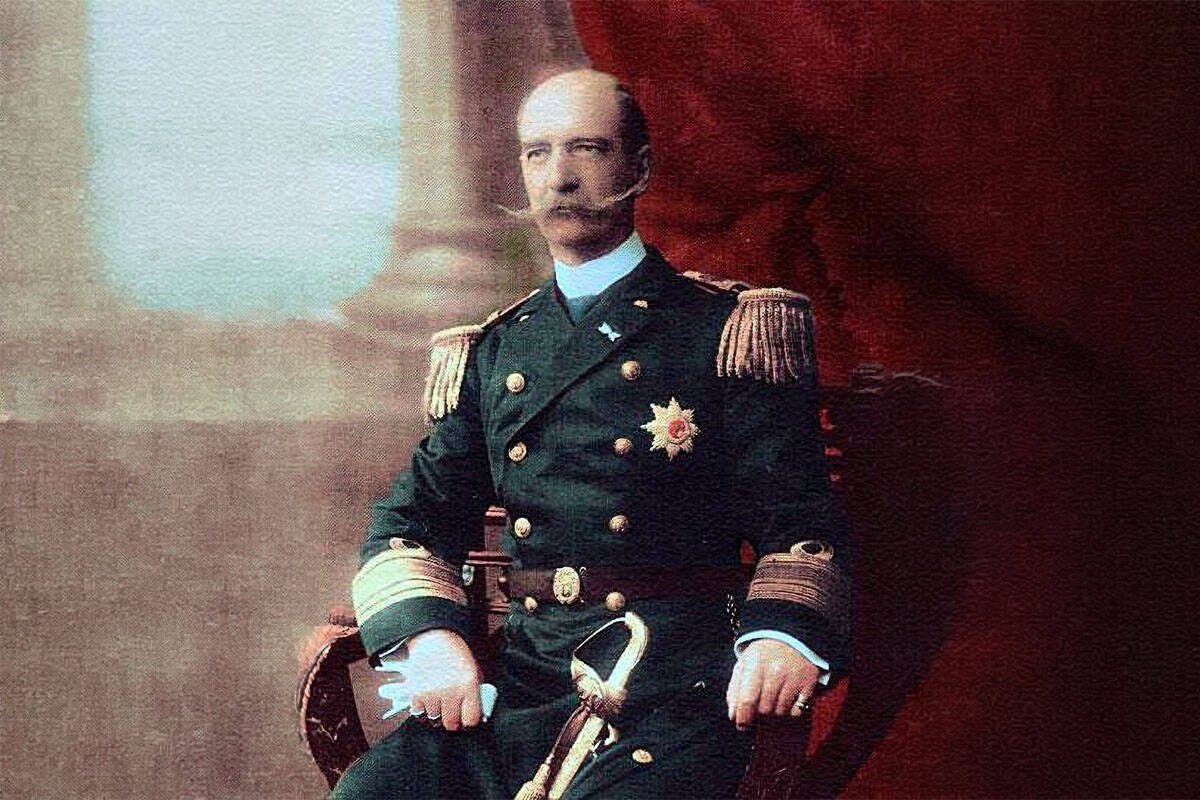
On this day in 1913, the late afternoon light settled gently over Thessaloniki, and with it came a scene that might have passed unnoticed in any ordinary city. A man in his sixties, composed and unhurried, walked the waterfront with little ceremony. He nodded to passers by, exchanged a word or two, and carried himself with the ease of someone who believed he belonged there.
He was not merely a citizen. He was King George I of Greece, a ruler who had spent five decades trying to narrow the distance between crown and country.
There was something deliberate in his simplicity. He preferred walking to being carried, conversation to command, presence to distance. Where others might have hidden behind guards and gates, he made a point of being seen. It was a style that brought him affection, though perhaps it also left him exposed.
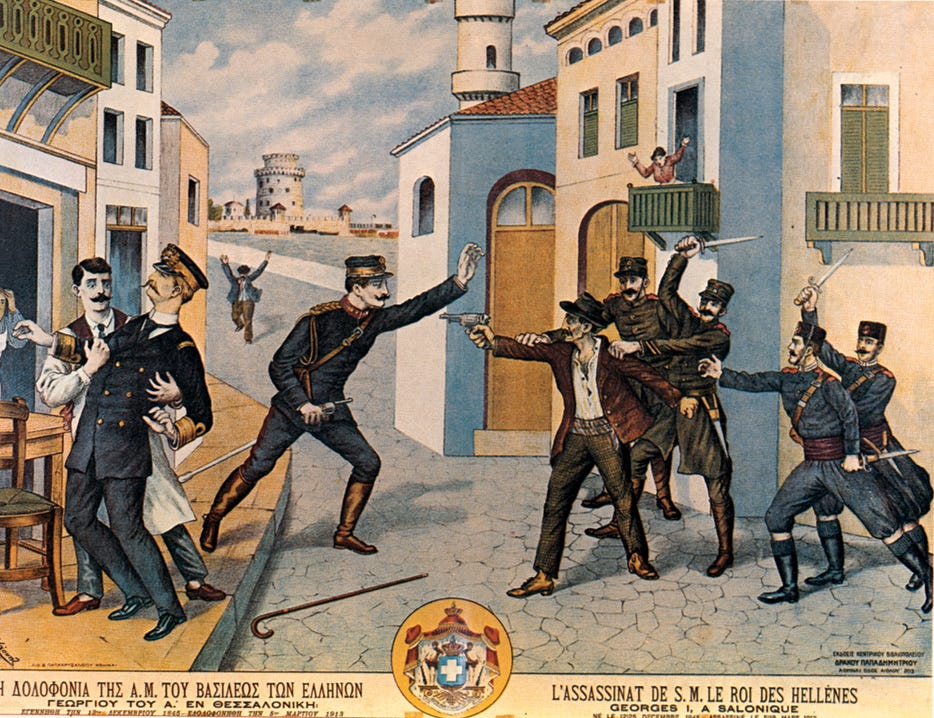
Moments later, the crack of a pistol broke that fragile calm. The king fell where he stood. Within minutes, the longest reigning monarch in Europe was dead on a public street.
Rise of a reluctant king
George had not been born to rule Greece. He arrived as a young Danish prince, chosen not by inheritance but by political necessity. Greece, newly independent and uncertain of itself, needed a figure who could steady its course. Foreign blood was thought to offer neutrality, a fresh start after internal division.
At first, the appointment carried the weight of exile. He left behind his home, his language, and the certainty of a life already mapped out. Yet what followed was not reluctant duty alone. He adapted, and more than that, he engaged.
He learned the language of his adopted people. He walked their streets. He supported reforms that edged Greece closer to a modern constitutional state. Under his reign, political power began to stretch beyond the palace walls and into the hands of elected representatives.
This was not the work of a revolutionary. It was steadier than that, quieter, shaped by compromise and persistence. Over time, it helped transform a fragile kingdom into something more cohesive.
Conflicts that shaped a reign
No ruler of Greece in that era could escape the long shadow of the Ottoman Empire. The desire to reclaim lands tied to Greek identity ran deep, and it drew the country into repeated conflict.
Some of these efforts ended in disappointment. Military failures brought humiliation, and with it, anger directed toward the throne. At one point, George narrowly survived an earlier attempt on his life, blamed by some for national setbacks.
Yet history rarely moves in straight lines. Later campaigns brought success, most notably the capture of Thessaloniki during the Balkan conflicts. It was a moment of triumph that seemed to vindicate years of struggle and reform.
When George arrived in the city soon after, he did so not as a distant figurehead but as a participant in that victory. His presence was intended to confirm Greece’s claim, to show that this place now belonged firmly within the nation’s grasp.
That intention makes the manner of his death all the more striking. The city he came to secure became the place where his reign ended.
Assassination in Thessaloniki
The killing itself was abrupt, almost banal in its execution. There was no grand conspiracy proven in court, no sweeping political manifesto delivered with the shot. The assassin later claimed impulse, illness, a moment of instability.
Whether that explanation satisfies is another matter.
What is clear is the symbolism. A king who prided himself on accessibility, who walked without heavy protection, was struck down in the very act that defined his connection to the people. It was both personal and public, a private vulnerability exposed in the most open of spaces.
His death did not come at a moment of decline. Greece had reason for confidence, fresh from military success and territorial gain. That made the shock sharper. Stability, it turned out, had been more fragile than it appeared.
Aftermath and uncertainty
The removal of George I did not simply create a vacancy on the throne. It unsettled the balance he had spent decades trying to maintain.
His successors inherited a country facing mounting pressures. Rivalries in the region persisted, and the approach of a wider European conflict would soon test Greece beyond anything it had previously endured. Internal divisions sharpened, political tensions deepened, and the monarchy itself became a point of contention rather than unity.
Within little more than a decade, the institution that had once been seen as a stabilising force was swept aside. Greece declared itself a republic, and the royal family departed into exile.
It is tempting to draw a straight line from the gunshot in Thessaloniki to the collapse that followed. History rarely offers such clean connections. Yet it is equally difficult to ignore how the loss of a steady, if imperfect, figure left a gap that proved hard to fill.
Legacy of George I
George’s reign invites a measured judgement. He was neither a visionary who reshaped the nation overnight nor a relic clinging to outdated power. He stood somewhere in between, navigating the pressures of his time with a mixture of caution and adaptability.
His greatest strength may have been his understanding that authority could not rely solely on distance. By stepping into the everyday life of his country, he built a form of trust that endured for decades.
That same instinct, however, carried its own risk. Accessibility can humanise power, but it can also expose it. On that March evening in 1913, the line between king and citizen vanished entirely, and with it, the protection that might have saved him.
There is a quiet irony in that. The very quality that defined his rule became the setting for its end.
Why this moment still matters
Looking back from the present, the assassination of George I feels like more than an isolated act of violence. It marks a turning point where optimism gave way to uncertainty, where a long period of relative stability fractured into something far more volatile.
Moments like this remind us how much history can hinge on the ordinary. A walk, a greeting, a pause in the street. These are not the grand scenes we expect to carry consequence, yet they often do.
On this day in 1913, Greece lost a king in the most public and unguarded of ways. What followed was not immediate collapse, but a gradual unravelling that would reshape the nation’s future.
History does not always announce its turning points with ceremony. Sometimes, it speaks in a single shot, echoing across a harbour as the light begins to fade.