

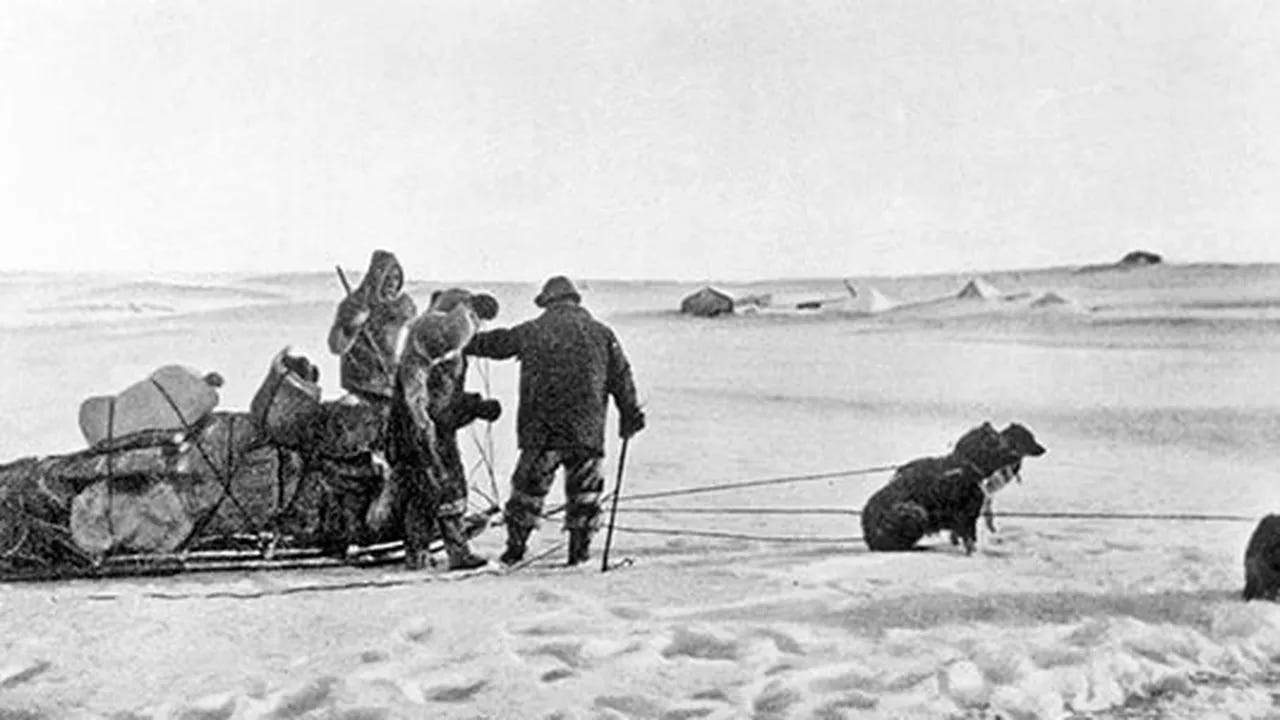
On this day in 1909, the ice at the very top of the world became a stage for ambition, pride and a dispute that history has never quite settled. The North Pole, that shifting crown of frozen ocean, offered no applause, no witnesses beyond a handful of exhausted men and their Inuit guides. Yet from that silence came one of exploration’s loudest arguments.
For a generation raised on maps with blank spaces, the Pole represented the last great geographical prize. By the early twentieth century, the race to claim it had become personal. It was not simply about reaching a place, but about being first, and being believed.
Race Across Moving Ice
The Arctic does not sit still. It drifts, cracks and reforms. Travellers chasing the North Pole were not marching across solid ground, but navigating a restless sheet of ice that could carry them away from their goal even as they slept.
Years before the decisive claim of 1909, one determined American surgeon turned explorer had already pushed deep into this hostile world. He travelled with Inuit companions who understood the rhythms of the ice, men whose knowledge made survival possible. Together they drove dog sledges across vast distances, measuring their position with fragile instruments in temperatures that punished even the smallest mistake.
At last, after weeks of grinding effort, he believed he had arrived at the Pole in April 1908. He planted a flag, took meticulous notes, and recorded the shadows cast by a simple pole in the endless daylight. It was the sort of detail that speaks to a man who knew he would need proof.
But the Arctic is as cruel on the return as it is on the approach. A navigational error sent the party far off course. Supplies were missed, the sun vanished for months, and survival became the only aim. By the time they struggled back to civilisation, the triumph had already begun to fade into uncertainty.
Clash of Ambition
A year later, on April 6th, 1909, another expedition stood on the ice and declared success. This leader had spent decades pushing north, enduring failure and injury, returning again and again with stubborn resolve. This final journey, he believed, would secure his place in history.
His party, including the skilled explorer Matthew Henson and several Inuit companions, advanced with discipline and experience. Yet even in the moment of victory, doubt crept in. Overcast skies complicated navigation. At one point, they appeared to have overshot the Pole and had to turn back, retracing their own tracks to confirm their position.
There is something telling in that image, men circling their own footprints on a featureless plain, trying to pin down a point that has no marker. The Pole offers no monument, no fixed sign. It exists only in measurements, and measurements can be questioned.
When news reached the expedition leader that a rival had already claimed the prize, the triumph hardened into something else. What followed was not merely a scientific dispute, but a campaign to control the story.
Evidence Lost, Reputation Won
The controversy that unfolded was shaped as much by circumstance as by character. The earlier claimant had gathered notes and observations intended to prove his achievement. Yet much of this evidence never reached the outside world. Crucial records were lost before they could be presented, leaving his account exposed to doubt.
His rival, by contrast, returned with the backing of influential institutions and a narrative that fit the expectations of the time. Recognition followed swiftly. He was celebrated as the man who had conquered the Pole.
But history has a way of revisiting its verdicts. Decades later, closer examination of the surviving records from both expeditions revealed gaps and inconsistencies. The certainty that once crowned one man the victor began to erode. The question that seemed settled in 1909 reopened, and has never been fully closed.
Legacy of Uncertainty
The North Pole remains a place that resists ownership. It drifts atop deep ocean, far removed from the fixed geography that defines most human achievement. Perhaps it is fitting that its discovery is wrapped in ambiguity.
What stands out, more than the argument over who arrived first, is the reliance on Inuit expertise. Both expeditions depended heavily on indigenous knowledge of travel, survival and navigation. Without it, neither journey would have come close to success. Yet for many years, recognition focused narrowly on the expedition leaders, leaving others in the margins of the story.
There is also the matter of proof in an age before modern technology. Today, a satellite reading would settle the question in seconds. In 1909, everything rested on handwritten notes, celestial observations and the credibility of the men involved. When those records were incomplete or missing, belief became as important as fact.
In the end, the race to the North Pole tells us as much about human nature as it does about exploration. Ambition drove men into one of the harshest environments on Earth. Pride shaped the stories they told when they returned. And history, cautious and often sceptical, continues to weigh their claims.
On this day in 1909, a flag was planted in the ice and a declaration was made. Whether it marked the first true arrival at the top of the world remains uncertain. What is beyond doubt is that the journey there, and the dispute that followed, left a lasting imprint on the story of exploration.