

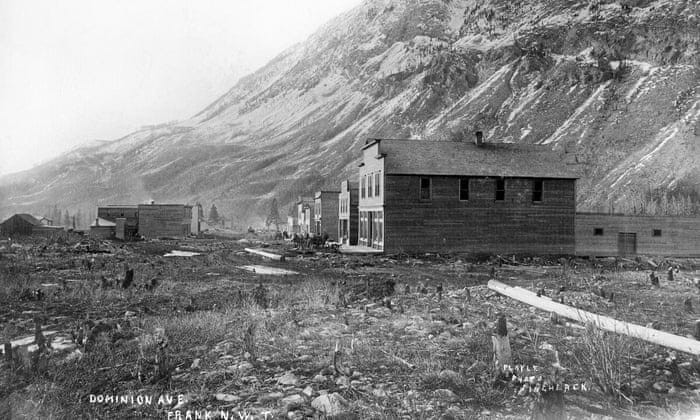
On this day in 1903, long before dawn had properly claimed the sky, the mountain above the small coal town of Frank in Alberta gave way. It did not crumble politely. It roared. It moved with a violence that turned earth into weapon and silence into aftermath. In a matter of minutes, a community built on industry and optimism was broken open.
The people of Frank had chosen their lives in the shadow of Turtle Mountain because coal promised stability. Work was steady, families settled, railways connected them to a wider world. Yet the same mountain that held their livelihoods carried a warning that had long been ignored. Indigenous communities had named it with a quiet clarity, the mountain that moves. That knowledge, rooted in observation and respect, had not translated into caution among those who came later.
In the end, the mountain kept its own counsel.
Lives Beneath Rock and Dust
The violence of the slide was immediate and unforgiving. More than 120 million tonnes of limestone tore free and cascaded down the slope. Homes disappeared, rail lines were buried, and lives were cut short without warning.
Yet amid the ruin, there were acts of endurance that speak to something stubborn in human nature. Beneath the ground, a group of miners found themselves trapped, their route to the surface sealed by debris. Air thinned, water crept in, and time became an enemy measured in breaths. Among them, a miner named Dan McKenzie forced himself to keep working when strength had nearly gone. His decision to strike at a softer seam of coal was not heroic in the romantic sense, it was practical, desperate, and utterly necessary. That final effort opened a path to daylight.
When the survivors emerged, they did not find relief waiting. They found a town unrecognisable.
Above ground, survival took different forms. A railway worker, Sid Shaet, grasped the scale of the disaster quickly enough to act. With communication lines severed and a passenger train approaching, he ran across unstable ground and burning rock to deliver a warning in person. That run saved dozens of lives, though it could not undo what had already happened behind him.
In the wreckage of homes, others fought quieter battles. A teenage girl, Jesse Leech, pinned beneath the remains of her house, stayed conscious by sheer will. She called out, sang to comfort her younger sister, and held on until rescuers returned. Their survival, like many that day, sat uneasily beside the loss of those closest to them.
These were not grand gestures designed for history books. They were instinctive responses to chaos. Yet they define the human side of the Frank Slide more than any statistic ever could.
Warning Signs Ignored
It is easy, with the benefit of hindsight, to frame the disaster as inevitable. The mountain had shown signs of instability. Cracks had appeared, small rockfalls had been noted, and the geological structure was far from sound. Mining activity itself may have contributed to weakening the already fragile formation.
Still, the town grew.
That choice speaks to a familiar pattern. Economic opportunity often outweighs caution, especially when danger is gradual rather than immediate. The coal seams beneath Frank offered work, and work meant survival for families who had little interest in abstract risk. The mountain stood, and so they stayed.
The tragedy lies not only in what happened, but in what was quietly known beforehand. The name given to Turtle Mountain was not poetic. It was practical. It described behaviour. Ignoring it did not change the truth behind it.
Aftermath and Uneasy Recovery
When daylight fully arrived, it revealed a landscape transformed into something closer to a battlefield than a town. Entire sections of Frank had vanished beneath rock. The railway was severed, buildings flattened, and the air carried the weight of dust and grief.
Rescue efforts began quickly, though hope faded as hours passed. Some survivors were pulled from the wreckage in what could only be called miraculous circumstances. Others were not found at all.
In the days that followed, authorities faced a difficult decision. The mountain had not settled completely. Small falls continued, reminders that the danger had not passed. An evacuation was ordered, and for a time the town stood empty, its future uncertain.
Eventually, residents returned. Life resumed in a reduced, cautious form. Yet the sense of security that had once defined the place was gone. The disaster had carved itself into memory, not just as an event, but as a lesson.
Enduring Lessons from the Frank Slide
The Frank Slide remains one of the deadliest rockslides in North American history. Seventy seven people lost their lives, a significant portion of the town’s population. But numbers alone do not capture its meaning.
What endures is the reminder that landscapes are not static. They carry histories of movement, stress, and change that do not always align with human timelines. The mountain above Frank did not fail suddenly in its own terms. It failed after years of warning signs that went unheeded or underestimated.
There is also something to be said about resilience. The stories that emerge from that morning are not tidy. Survival came with loss. Courage appeared alongside fear. No one walked away untouched.
That complexity is what gives the Frank Slide its lasting weight. It is not simply a tale of disaster. It is a moment where human determination met natural force, and where the outcome was shaped by both.
On this day in 1903, a town learned, in the hardest possible way, that the ground beneath it was never as certain as it seemed.