


On this day in 1900, a quiet hillside on Crete yielded a secret that had slept for millennia. Beneath layers of earth and time, fragments of a forgotten civilisation began to surface, and with them, a language no one could read. What followed was not a single moment of revelation, but a long, obsessive pursuit that stretched across decades, personalities, and disciplines.
As a history writer, I find this story irresistible, not only for what was uncovered, but for how it forces us to rethink the origins of European thought itself.
Discovery at Knossos sparks a linguistic mystery
The initial breakthrough came under the direction of Arthur Evans, an English archaeologist whose methods and instincts were as distinctive as his attire. At Knossos, he unearthed the remains of a Bronze Age palace complex, a labyrinth of rooms that hinted at administrative sophistication and cultural depth.
Among the ruins lay clay tablets inscribed with curious markings, lines, loops, and symbols that clearly formed a system of writing. Evans named one of these scripts Linear B. It was neither alphabet nor pictograph in any obvious sense. It sat somewhere in between, resistant to easy classification.
These tablets dated to around 1500 BCE and represented the earliest known writing system in Europe. Yet they were mute. For decades, scholars could catalogue them, compare them, even admire them, but they could not understand them.
This silence became its own kind of presence, a persistent challenge that drew in minds from across the academic world.
Alice Kober builds the foundation
The real progress began not with a dramatic revelation, but with painstaking, almost invisible labour. Alice Kober, a scholar of formidable discipline, approached the problem with rigour rather than speculation.
She catalogued symbols, tracked their frequency, and mapped their relationships. Her work was methodical, almost mechanical in its precision. Where others chased grand theories, she built a framework.
Kober recognised patterns that suggested the script was syllabic. She also identified recurring structures that hinted at grammatical inflections, something closer to an organised language than a symbolic code.
Her contribution was foundational, though incomplete. She died young, before she could see the problem resolved. Yet without her groundwork, the final breakthrough would almost certainly have remained out of reach.
History often remembers the moment of triumph. It less often remembers the quiet labour that makes such moments possible.
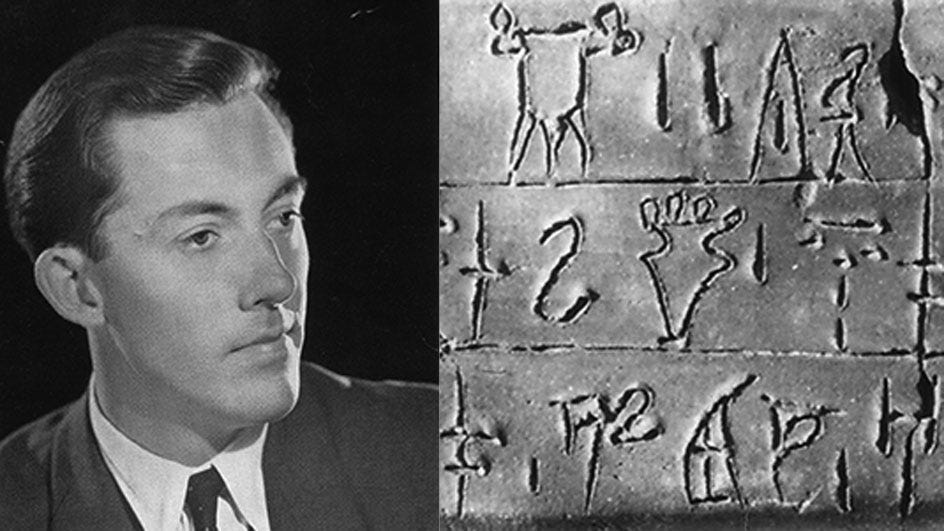
Michael Ventris cracks the code
Enter Michael Ventris, an unlikely figure in the academic world. He was not a university-trained linguist but an architect with an enduring fascination for ancient languages.
From a young age, he had been captivated by the mystery of Linear B. It became an obsession that followed him through school, through war service, and into adulthood.
Ventris approached the problem differently. Building on Kober’s structural insights, he began testing bold hypotheses. One of his key insights was geographical. By comparing tablets found on Crete with those discovered on the Greek mainland, he identified symbol groups that appeared only in specific locations.
He proposed that these might represent place names.
This was the turning point. By assigning phonetic values based on known locations, Ventris began to unlock the script. Gradually, the symbols resolved into sounds, and the sounds into words.
His conclusion was startling. Linear B was not an unknown or isolated language. It was an early form of Greek, centuries older than previously recorded Greek texts.
This discovery pushed the roots of Greek civilisation far deeper into the past than anyone had imagined.
John Chadwick confirms a historic shift
Ventris did not work alone in the final stages. He collaborated with John Chadwick, a classical scholar whose expertise in ancient Greek dialects helped validate and refine the findings.
Together, they confirmed that the tablets recorded administrative details, inventories of goods, livestock counts, and resource management. These were not poetic texts or grand narratives, but the paperwork of a functioning society.
Yet their significance was immense. They revealed a structured, bureaucratic culture operating in the Aegean world centuries before classical Greece emerged.
This was not a primitive precursor. It was a complex system with its own order and logic.
Legacy of Linear B and the Minoan question
The decipherment of Linear B did more than solve a puzzle. It reshaped historical understanding. It demonstrated that the Mycenaean civilisation was Greek-speaking, linking it directly to later Greek culture.
However, it also sharpened another mystery. The earlier script, Linear A, associated with the Minoan civilisation, remains undeciphered. Unlike Linear B, it does not appear to encode Greek.
This raises a compelling question. What language did the Minoans speak, and what does it mean that their voice is still beyond our reach?
For all that has been uncovered, there is still silence at the heart of Crete’s past.
Enduring fascination of a solved mystery
There is a curious human element to this story that cannot be ignored. Ventris achieved what many considered impossible. He solved one of archaeology’s greatest puzzles. Yet the aftermath was not triumphant in the way we might expect.
He struggled with the weight of success, the loss of purpose that followed the solution of a lifelong obsession. His death at a young age adds a sombre note to what might otherwise be told as a clean narrative of intellectual victory.
It reminds us that discovery is not always a neat arc. It is often tangled with personal cost, uncertainty, and unresolved questions.
Why this moment still matters
On this day in 1900, the first fragments of Linear B emerged into the light. At the time, no one could have known what they would eventually reveal.
Today, we can see the full arc. From excavation to analysis, from frustration to breakthrough, this story captures the essence of historical inquiry. It is slow, uncertain, and deeply human.
More importantly, it changes how we understand Europe’s past. It tells us that the roots of Greek language and administration stretch further back than once believed. It bridges the gap between myth and record, between legend and ledger.
And it leaves us with a final, lingering thought. If one lost language could reshape history so profoundly, what might still lie buried, waiting for its moment to speak?