

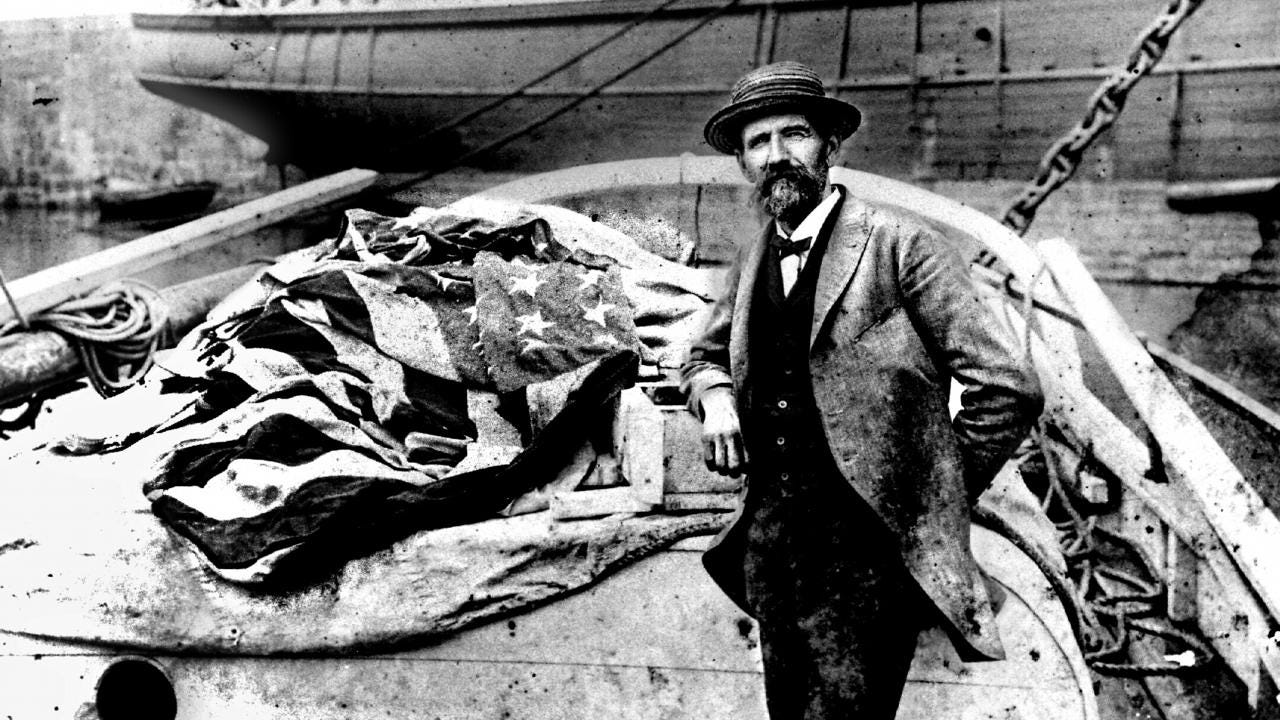
On this day in 1895, a solitary figure eased a modest sloop away from Boston Harbour and into the long argument between man and sea. The man was Joshua Slocum, a seasoned mariner with more scars than savings, and a temperament shaped as much by grief as by salt air. His vessel, the Spray, was no gleaming symbol of progress. It was a resurrection, rebuilt plank by plank from decay, much like the life he had been trying to steady.
There was no theatrical farewell. No swelling emotion. Instead, a stiffness hung in the air as he left behind his wife and son, offering instruction rather than affection. It was an exit that spoke volumes. Slocum was not setting sail for applause. He was chasing something quieter, more personal, and infinitely more dangerous.
Roots of Obsession
Slocum’s relationship with the sea began in defiance. As a boy in Nova Scotia, he built toy boats only to see them destroyed by a disapproving father. Yet each time they were broken, he rebuilt them. That persistence would define his life.
He ran away young and found his place not on land, but on water. Over years, he circled the globe in fragments, working aboard ships, commanding others, and eventually building a life that merged family and ocean. His first marriage brought companionship and children, many born at sea, but tragedy followed. Loss, illness, and misfortune reshaped his world, leaving him unmoored in more ways than one.
By the time the Spray came into his hands, a rotting hull abandoned to the elements, Slocum saw not ruin but possibility. It was less a gift than a challenge. He accepted it fully.
Crafting a Vessel, Defying an Era
The late nineteenth century was an age tilting towards steam power. Iron hulls and engines were rewriting the rules of maritime travel. Slocum rejected all of it. His disdain for steamships was not mere nostalgia. It was conviction. He believed that true seamanship lay in wind, tide, and instinct.
Over months, he transformed the Spray into a vessel capable of near self-steering, a remarkable feat given his limited resources. Every decision was shaped by necessity. He lacked money, equipment, and, at times, support from those closest to him. Yet he pressed on with a stubborn clarity.
His ambition was audacious. No one had successfully sailed around the world alone. Many had tried. All had failed. Slocum believed he would be the exception, and more importantly, he believed the story would sustain him financially once complete.
Peril Without Witness
The journey that followed was not a smooth arc of triumph but a jagged line of endurance. Slocum faced storms that seemed determined to erase him, navigational challenges that demanded precision without proper instruments, and long stretches of isolation that tested the mind as much as the body.
Without a functioning chronometer, he relied on dead reckoning, an older and less forgiving method of navigation. It required constant calculation, observation of the heavens, and a steady nerve. One misjudgement could mean disaster.
In the Strait of Magellan, he battled fierce winds and treacherous currents, waiting weeks for the right moment to break through into the Pacific. Supplies dwindled. Opportunities to earn money through writing slipped away as deadlines passed unmet. The sea, indifferent as ever, offered no concessions.
Yet Slocum endured. Not through heroics in the grand sense, but through relentless competence. He adjusted, repaired, waited, and moved when the moment demanded it.
Isolation, Memory, and the Long Ocean
Crossing the Pacific brought not just physical strain but emotional reckoning. When he reached Sydney, memories of his first wife resurfaced with force. The sea may have been his refuge, but it also held echoes of what he had lost.
His voyage was not purely a technical achievement. It was deeply human, shaped by longing, regret, and a need to prove something that perhaps only he fully understood.
Even moments of absurdity found their way into the journey. A troublesome goat, taken aboard as a supposed companion, became a destructive nuisance, chewing through supplies and testing Slocum’s patience. It was eventually abandoned, a small but telling episode in a voyage defined by solitude.
Return Without Applause
When Slocum finally returned in 1898, completing his circumnavigation, the moment lacked spectacle. No crowds gathered. No immediate recognition awaited him. It was a quiet ending to an extraordinary undertaking.
Yet history has a way of catching up. His account, Sailing Alone Around the World, published the following year, secured his legacy. It was not merely a travelogue but a testament to resilience and self-reliance. The world began to understand what he had achieved.
Legacy Beyond the Horizon
Slocum’s voyage stands as a turning point in maritime history. It proved that a single individual, equipped with skill, determination, and an almost stubborn faith in their own ability, could accomplish what had previously seemed impossible.
His story resonates because it is not polished. It is raw, imperfect, and at times uncomfortable. He was not a sentimental hero. He was driven, flawed, and often distant from those around him. Yet it is precisely these qualities that make his achievement compelling.
He did not conquer the sea. No one ever truly does. Instead, he navigated it with a blend of respect and defiance, carving a path that others would follow.
His final voyage, years later, ended in mystery, his disappearance adding a fitting, if sombre, coda to a life spent in motion. The ocean, which had given him purpose, ultimately claimed him.
Enduring Relevance of a Lone Sailor
In an age where technology has reduced uncertainty, Slocum’s journey feels almost otherworldly. Today’s sailors have tools he could scarcely imagine, yet the essence of his achievement remains untouched.
It was never about the boat alone, or even the distance travelled. It was about the willingness to step away from safety, to embrace risk without guarantee of reward, and to trust in one’s own judgement when there is no one else to turn to.
On this day in 1895, a man set sail not simply to circle the globe, but to define himself against it. The world he left behind was changing rapidly. The world he returned to had already moved on. Yet his story endures, anchored in that moment when he chose to go.