

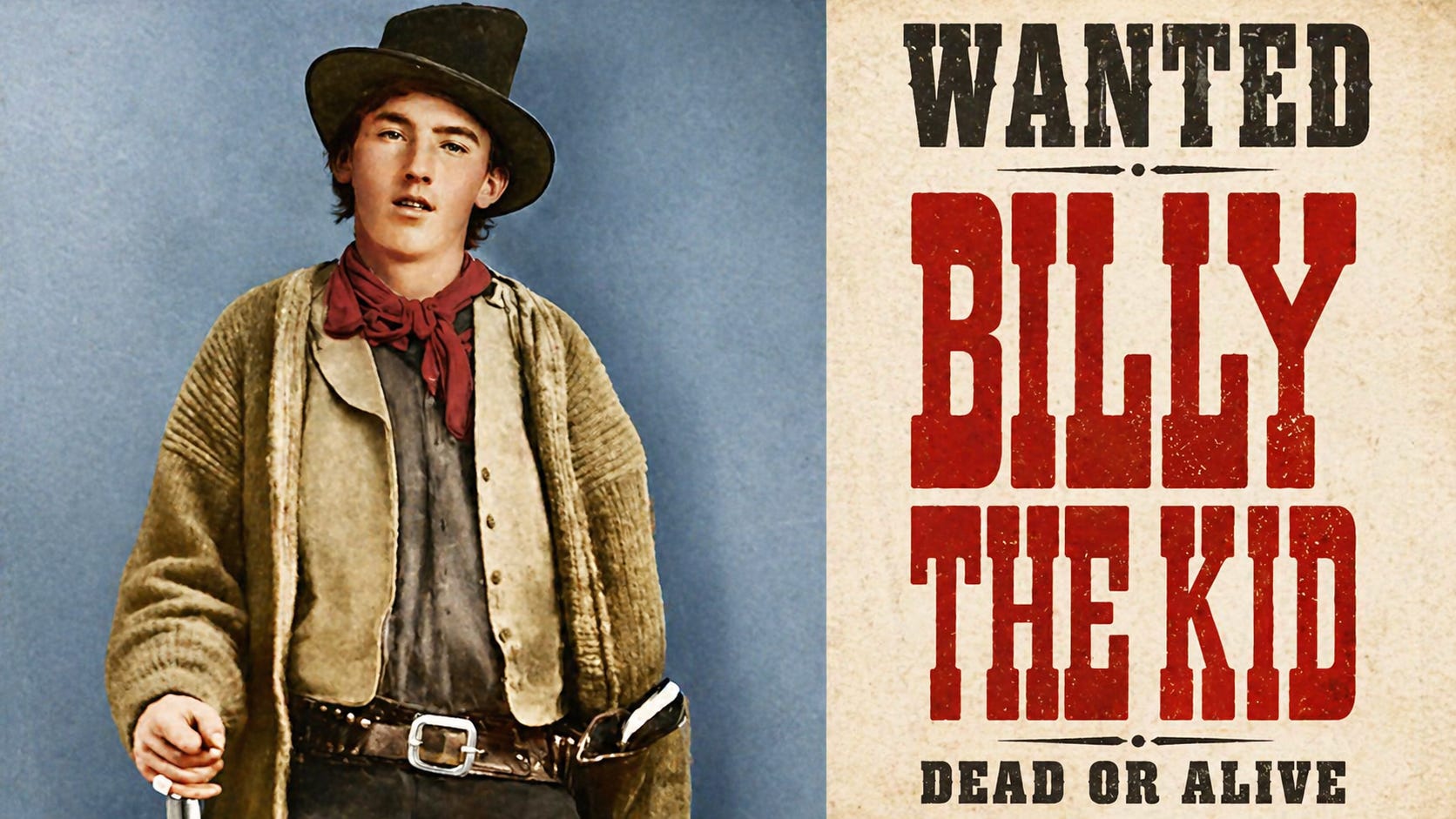
I can still remember the first time I watched the Young Guns films, with Emilio Estevez swaggering across the screen as Billy the Kid. It was not the gunfire that stayed with me, nor the dust and drama, but the sense that behind the legend stood something sharper, more human, and more troubling. That fascination has never quite left me.
On this day in 1881, that restless figure, born William H. Bonney and known to history as Billy the Kid, staged one of the most audacious jailbreaks ever recorded. It was not simply an escape. It was the moment his story slipped free of fact and settled into folklore.
Violence Breeds Reputation in Lincoln County
To understand the escape, one must first understand the soil from which it grew. Lincoln County in the late 1870s was not merely lawless, it was controlled. A small circle of businessmen, notably Lawrence Murphy and James Dolan, held a grip over trade, credit, and law enforcement. Their dominance was not subtle. It was enforced through intimidation and, when needed, blood.
Into this arrangement stepped John Tunstall, an outsider with ambition and a willingness to challenge the monopoly. His murder in 1878 was not just a killing, it was a signal. The rules would be written in gunpowder.
For Billy, then a young ranch hand, Tunstall’s death was personal. It ignited a loyalty that would define his short life. Alongside men like Dick Brewer, he joined a group later known as the Regulators, a band that blurred the line between lawmen and outlaws with unsettling ease.
Rise of a Reluctant Folk Hero
What followed was not justice in any clean sense. It was retaliation dressed in legal clothing. Deputised briefly, the Regulators hunted those tied to Tunstall’s murder. Some were captured, others killed under circumstances that still invite doubt.
When they turned their guns on William Brady, the county sheriff himself, any remaining illusion of lawful purpose evaporated. The killing made Billy notorious overnight.
Yet public opinion fractured. Some saw a killer. Others saw a young man pushing back against corruption that had gone unchecked for too long. This tension, between villain and avenger, is the space where Billy’s legend took root.
After Brewer’s death, Billy assumed leadership. It is here that I find him most compelling, not as a romantic figure, but as a young man carried forward by momentum he could no longer control. Each act of violence tightened the circle around him.
Capture and the Illusion of Justice
By late 1880, the chase had narrowed. Pat Garrett, newly appointed sheriff, tracked Billy to a bleak hideout at Stinking Springs. Surrounded and outnumbered, Billy surrendered.
His trial in 1881 was swift, almost perfunctory. Found guilty of murdering Brady, he was sentenced to hang. There is little evidence to suggest the outcome was ever in doubt. The machinery of law had caught up, and it intended to make an example of him.
He was returned to Lincoln, shackled and guarded, awaiting execution. It should have ended there, a grim but predictable conclusion. Instead, it became something else entirely.
Escape That Echoes Through History
On April 28th, 1881, Billy the Kid rewrote his own ending, if only for a short while.
Left under guard in the courthouse, he studied routines, watched habits, and waited. When his moment came, he moved with startling precision. A concealed weapon, a sudden strike, and one guard fell. Another was shot as he ran for help.
Billy freed himself from his shackles, armed himself further, and stepped into the open with a kind of grim theatre. Accounts suggest he called out before firing on the second guard, a detail that has lingered because it feels almost scripted, too perfect, too deliberate.
Within minutes, he was mounted and gone.
What strikes me is not just the violence, but the clarity of the act. This was not desperation alone. It was calculation. Billy understood that escape was not simply survival. It was transformation. By defying the hangman in such dramatic fashion, he ensured that his story would travel far beyond Lincoln County.
Legend Forged in Flight and Death
The escape bought him little time. Within months, Garrett tracked him down again and killed him. Yet by then, it hardly mattered.
Billy the Kid had already crossed the threshold from man to myth.
Stories multiplied. Some painted him as a cold killer, others as a symbol of rebellion against a rigged system. Decades later, claims even surfaced that he had survived, that he lived under another name. None were proven, yet they persisted, which tells its own story.
The truth, as ever, lies somewhere quieter. He was neither hero nor pure villain. He was a product of a violent place, shaped by loyalty, anger, and opportunity.
Why This Story Still Matters
What keeps Billy the Kid alive in our imagination is not the body count or the gunfights. It is the tension at the heart of his story.
He forces us to ask uncomfortable questions. When authority is corrupt, what does justice look like. When a young man is pulled into violence, where does responsibility truly lie.
And perhaps most of all, why do we continue to romanticise figures who lived by the gun.
Watching those old films years ago, I was drawn to the charisma, the energy, the sense of freedom. Looking back now, the story feels heavier. Less about rebellion, more about consequence.
On this day in 1881, Billy the Kid did more than escape a jail. He stepped into legend, leaving behind a trail that still challenges how we see crime, justice, and the stories we choose to tell.