

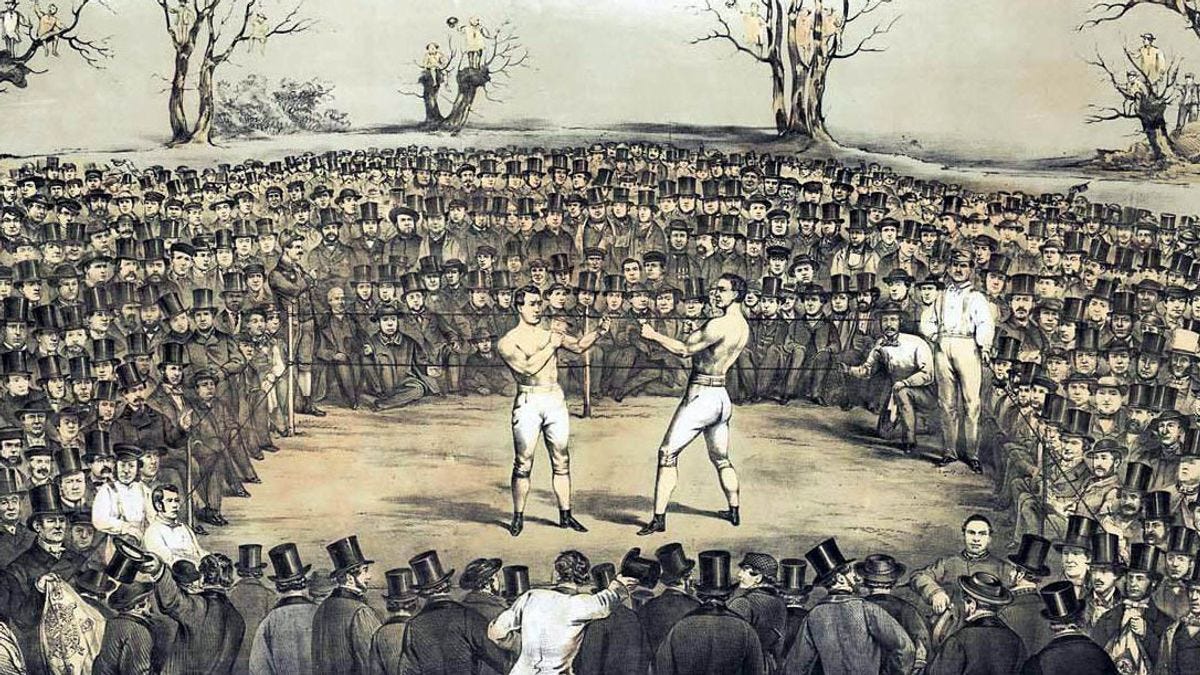
On This Day in 1860, in a muddy field in Hampshire, two men stepped forward and changed the course of sporting history. Tom Sayers and John Carmel Heenan met in what would come to be recognised as boxing’s first world championship contest. It was illegal, chaotic, and deeply compelling.
The setting tells its own story. Prizefighting, once tolerated and even admired in certain circles, had fallen out of favour. Deaths in the ring had stirred public unease, and the authorities had begun to act. Fights were no longer held openly in London but pushed into the countryside, hidden from the reach of the Metropolitan Police. Yet secrecy did little to dampen interest. Thousands travelled in anticipation, drawn by whispers of a transatlantic clash that carried more than money at stake. This was Britain versus America, reputation against ambition.
Sayers, already a national figure, was the smaller man but a master of skill and endurance. Heenan, younger and physically imposing, arrived with the confidence of a rising force. Their meeting felt inevitable, almost theatrical in its build. What unfolded was something far more raw.
Violence, Endurance and Spectacle
The fight began in the early morning and stretched beyond two relentless hours. There were no timed rounds in the modern sense, no gloves to soften the blows, and little restraint beyond a loose code that was still evolving. Each round ended only when a man fell.
Sayers fought with precision, relying on craft honed through years in the ring. Heenan brought power and aggression, pressing forward with the intent to overwhelm. As the contest wore on, both men began to break. Sayers suffered a severe arm injury, likely a fracture, yet continued. Heenan’s face swelled grotesquely, his vision fading as punishment accumulated.
By the later rounds, the contest had become less a display of technique and more a test of will. The crowd, drawn from every level of society, watched in rapture. Politicians, writers, labourers, all stood shoulder to shoulder, united by the spectacle of endurance unfolding before them.
There was a sense, even then, that this was something unprecedented. Not merely a fight, but an event.
Chaos at the Finish
The end came not through victory but interruption. As the fighters grappled deep into the contest, local police finally forced their way through the crowd. The authorities had caught up with the spectacle they had hoped to prevent.
The bout was stopped abruptly. No winner was declared. Both men were hurried away, leaving behind a crowd unsure whether to feel cheated or privileged.
Yet in truth, the lack of a result mattered little. Sayers and Heenan had given everything. The draw felt almost fitting, a shared claim to greatness rather than a disputed outcome.
In the days that followed, both fighters were celebrated. They divided the prize money and, more importantly, the acclaim. Public fascination only grew. What had been intended as a clandestine contest became a defining moment in sporting history.
Turning Point for Modern Boxing
The significance of that April morning runs deeper than the contest itself. The brutality and disorder of the fight forced a reckoning. Authorities, promoters, and sporting figures began to recognise that if boxing were to survive, it needed structure.
Within a few years, formal rules began to take shape. Timed rounds were introduced. Gloves became standard. The ten second count emerged as a way to manage knockdowns. These changes did not dilute boxing’s intensity, but they gave it legitimacy.
The fight between Sayers and Heenan stands at the centre of that transformation. It exposed the dangers of the old ways while proving the sport’s undeniable appeal. Without it, boxing might have remained on the fringes, hounded out of existence by law and public opinion.
Instead, it evolved.
Legacy of Sayers and Heenan
Neither man would enjoy a long life. Tom Sayers retired soon after and died young, his body worn by the demands of the ring. John Carmel Heenan returned to America, his fame fading as quickly as it had risen, and died in relative obscurity.
Yet their legacy endured. Every world title fight that followed, every packed arena, every global broadcast, carries an echo of that Hampshire field.
Modern boxing, with its bright lights and vast audiences, owes a quiet debt to two men who fought without such comforts. They stood in mud, surrounded by a restless crowd, and gave everything they had.
Enduring Impact on Sport
It is tempting to see progress in sport as a steady march, but history often turns on moments of raw disruption. The Sayers vs Heenan fight was one such moment. It forced change not through careful planning but through sheer intensity.
There is a certain purity in that. No grand design, no governing body dictating the future, just a contest so compelling that it reshaped its own world.
On This Day in 1860, boxing did not become civilised overnight. But it took its first undeniable step towards becoming a global sport, one that could command respect as well as attention.
And it began, as many great sporting stories do, with two men willing to endure more than most would dare.