

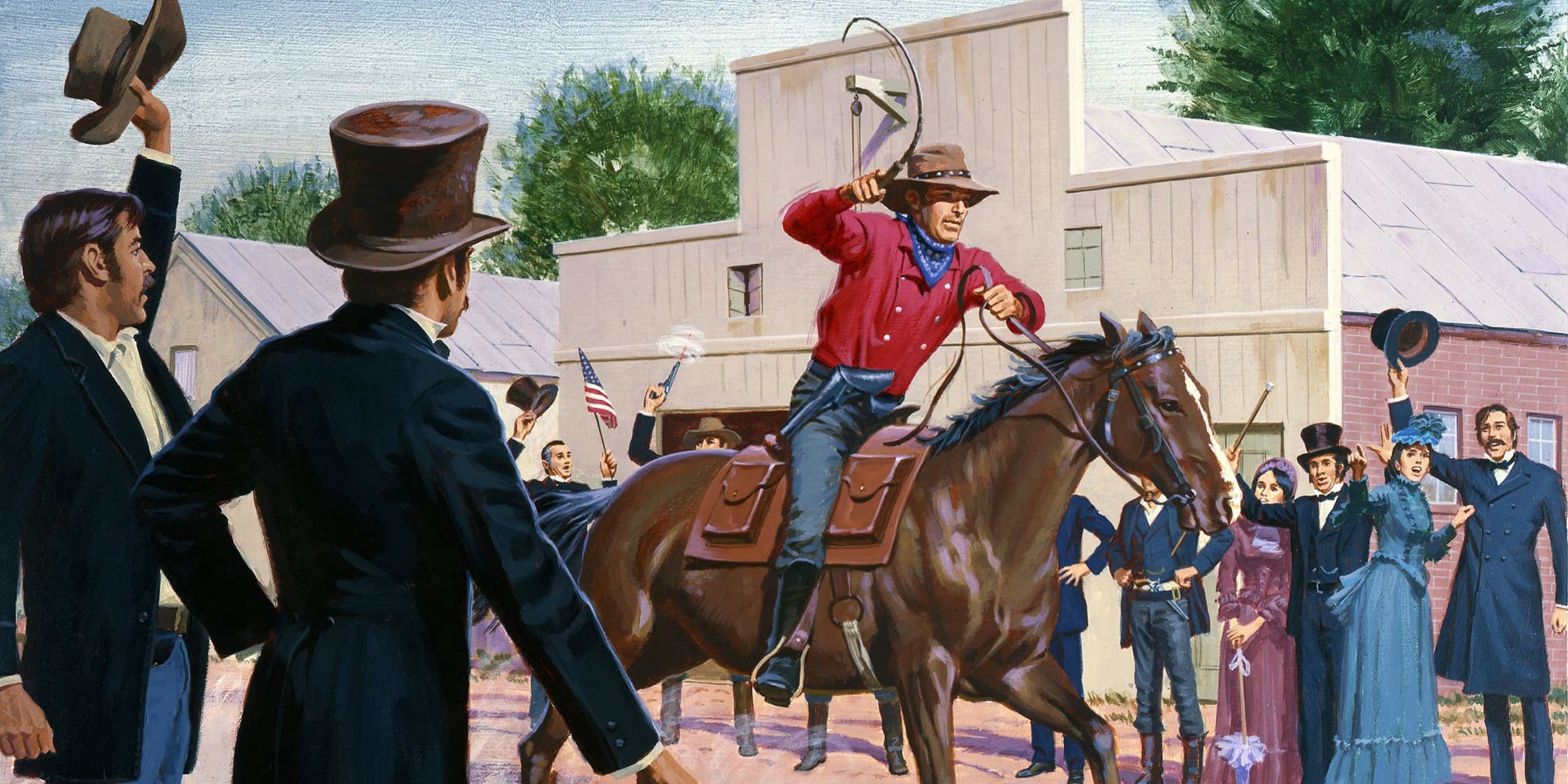
On This Day, 3 April 1860, the Pony Express began its first westbound journey from St. Joseph, Missouri, bound for Sacramento, California. It promised what sounded close to fantasy in its own age, delivery across roughly 1,800 miles in about ten days, using relays of riders and fresh horses scattered across the vast American interior. The service would survive for only eighteen months, and it never found financial stability, yet it secured something harder to buy and easier to remember, legend.
My view is simple. The Pony Express matters because it revealed the American West in its rawest terms, ambition dressed as necessity, enterprise fuelled by bravado, and young men asked to wager flesh and bone against distance, weather and violence. It was a mail service, yes, but it also carried the national appetite for speed. A country growing in size and confidence wanted its communications to move with the same urgency as its politics, commerce and dreams.
That urgency had hard business logic behind it. The founders, Alexander Majors, William Hepburn Russell and William Bradford Waddell, were already major freighting men. They hoped that proving a fast transcontinental route could help secure valuable government business. Letters were expensive, initially priced at 5 dollars for half an ounce, a staggering sum for ordinary people, so profit was always going to be a narrow gate. Still, the idea had enough audacity to tempt men who believed scale and speed might rescue their fortunes.
Men Behind the Legend
The enterprise was built in a rush. In a matter of months, the company assembled riders, horses, stations and staff across an enormous route. Stations stood roughly 10 to 15 miles apart, horses were changed frequently, and riders usually handed over the mail after 75 to 100 miles. Everything was organised around stripping away delay. The precious mochila, the leather mail pouch, mattered more than comfort and, in the harsh morality of the frontier, almost more than the rider himself.
There is something revealing in that arrangement. The Pony Express glorified individual courage, yet it depended on a drilled system. A lone rider thundering through dust makes the famous picture, but the real achievement lay in coordination, discipline and relentless timing. This was not romance wandering loose on the plains. It was logistics under pressure, made vivid by danger. That is one reason the story endures. We admire the rider, while recognising that the greater feat was to make the whole machine work at all.
Alexander Majors also set a stern moral tone, reportedly giving riders a Bible and binding them to an oath against drinking, swearing and disorderly conduct. That detail tells us much about the age. Men were being sent into remote country with speed as their creed, and their employers still wanted the old language of upright character wrapped around the venture. It feels severe now, perhaps even theatrical, yet it fitted a service that wanted to appear trustworthy while moving at reckless pace.
Riders, Risk and Reputation
The names that survive do so because they carried more than mail. Johnny Fry is often linked with the first westbound ride from St. Joseph, though historians note that the identity of the very first rider has long been disputed. Even so, Fry belongs to the mythology of that opening night, when the crowd gathered, speeches were made, a cannon sounded and the first horseman set off into darkness with the country’s expectations strapped to the saddle.
Then there is Billy Tate, only fourteen, whose death near Ruby Valley has the fierce shape of frontier legend. Chased during the Paiute uprising of 1860, he reportedly took cover among rocks, fought back and was later found dead, his body pierced by arrows. Whether remembered as fact, myth, or some fusion of both, the episode captures the cruel arithmetic of the Pony Express. Reputation depended on the mail getting through, and boys were asked to face circumstances that would test hardened soldiers.
This is where the story sharpens for me. We often inherit the Pony Express as a heroic image, a rider bent low over the neck of a horse, flinging himself through wild country for the sake of connection. Yet what gives the image weight is the cost. The route crossed contested lands. The Paiute War in 1860 disrupted service, stations were attacked, employees were killed and horses were lost. The shining legend was forged in a landscape already marked by conflict and dispossession. That should not be softened.
Brief Life, Lasting Echo
For a few months, the service delivered exactly the kind of dramatic efficiency the public craved. News of Abraham Lincoln’s election in November 1860 was one of the messages carried west at speed, and the Pony Express briefly seemed like the very pulse of a nation trying to keep itself stitched together. California, young and important, demanded quicker contact with the East. The service answered that demand with an urgency that felt almost heroic.
Yet history is rarely sentimental about technology. On 24 October 1861, the first transcontinental telegraph message was sent. The old miracle became old news at once. The Pony Express shut down on 26 October 1861, barely two days later. Its working life had been about eighteen months. It had proved that fast, year round transcontinental communication was possible, then it was swept aside by something faster, cheaper and more modern.
That, in the end, is why this On This Day anniversary still deserves attention. The Pony Express was a failure in the ledger and a triumph in the memory. It showed how a nation can fall in love with speed before it has fully counted the cost. It celebrated youth, endurance and daring, while exposing the harshness beneath the frontier dream. And because it vanished so quickly, it never had time to grow ordinary. It entered history in a rush and stayed there, frozen at full gallop, carrying the mail and the myth together.