

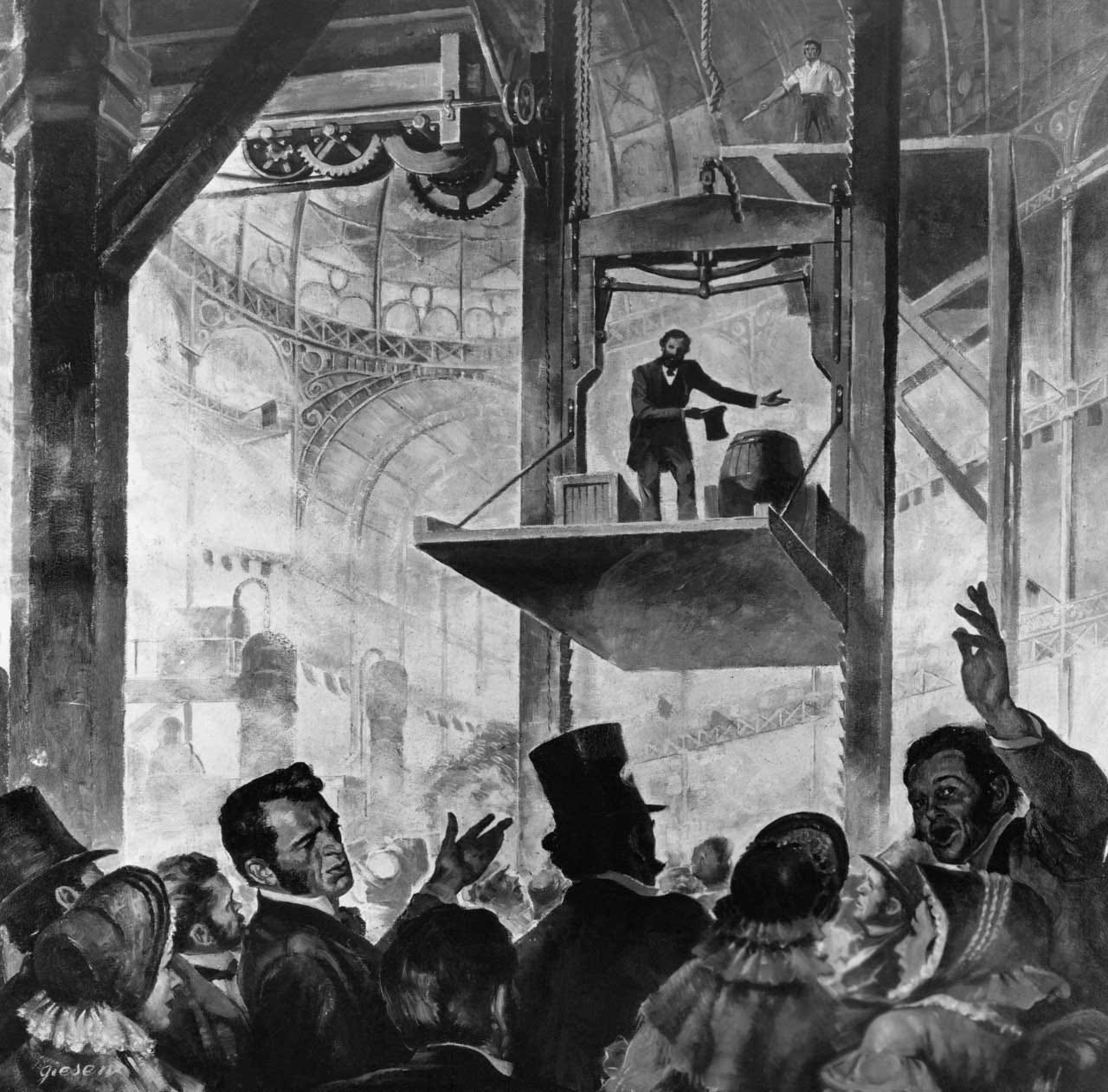
In the spring air of nineteenth century New York, progress often arrived with noise, smoke, and spectacle. Yet one of the most important leaps forward began with a pause. A man stood high above a crowd, balanced on a simple platform, and invited the unthinkable. The rope was cut. The fall began. Then, just as quickly, it stopped.
That single instant captured something deeper than mechanical ingenuity. It confronted a universal fear, the terror of falling, and replaced it with trust. The invention behind that moment would quietly transform how cities grew, how buildings were designed, and how people moved through space.
By the time the first passenger elevator was installed on March 23, 1857, the groundwork had already been laid, not only in engineering but in human confidence.
Engineering Meets Human Nerve
Lifting heavy loads was nothing new. Hoists and pulleys had been used for centuries in docks, mines, and workshops. The problem was never lifting, it was safety. Ropes snapped. Loads fell. Injuries and deaths were accepted as part of the risk.
What changed was not the idea of vertical movement, but the assurance that it could be controlled.
The breakthrough came in the form of a safety mechanism that worked automatically. Instead of relying on a worker’s reaction time, the system responded instantly to failure. If the rope gave way, a spring-loaded device locked the platform into guide rails and brought it to a halt within moments.
It was a simple idea, but its impact was profound. For the first time, vertical transport could be trusted.
Still, invention alone does not change the world. People must believe in it.
Showmanship That Shifted Perception
The true genius lay not only in the mechanism, but in how it was revealed. A dramatic public demonstration turned a technical solution into a story people could understand. It was bold, even reckless on the surface, yet it addressed the exact fear holding progress back.
The crowd expected disaster. Instead, they witnessed control.
That demonstration did more than attract attention. It reframed the elevator from a dangerous tool into a dependable system. Orders followed, though slowly at first, mostly from industrial settings where practicality outweighed hesitation.
Yet the larger leap remained. Goods could be lifted, but people still hesitated to step onto such platforms. Trust, once shaken by years of accidents, does not return overnight.
March 23, 1857: Elevating Everyday Life
The installation of the first passenger elevator marked a quiet turning point. It was placed not in a factory or warehouse, but in a department store. This choice was telling.
Commerce thrives on convenience. Customers were offered something new, the ability to move between floors without effort. What had once been a physical strain became an experience, even a curiosity.
At first, riding an elevator was novel. People approached it with caution, some with excitement. But as each journey ended safely, confidence grew. The machine that once symbolised risk began to represent ease.
This shift changed more than shopping habits. It altered architecture itself. Buildings were no longer limited by the number of stairs people were willing to climb. Height became practical.
Rise of the Vertical City
Before the passenger elevator, cities spread outward. Streets extended, land was consumed, and buildings remained modest in height. After its introduction, the logic of space changed.
Why build wide when one could build tall?
The elevator made upper floors desirable rather than inconvenient. In time, the higher one went, the more valuable the space became. Light, air, and distance from the noise of the street turned elevation into luxury.
This reversal reshaped urban life. Offices climbed skyward. Apartments followed. The skyline, once low and uneven, began its ascent.
It is easy to admire skyscrapers today and forget that they depend on an invisible promise. Every ascent relies on the same principle demonstrated in that early moment, that the system will hold, that the fall will be stopped.
Legacy Beyond the Machine
The story of the elevator is often told as one of invention, but it is equally a story of persuasion. Technology alone does not change behaviour. People must feel safe enough to adopt it.
That is what makes March 23, 1857 significant. It represents the point at which an idea crossed from possibility into daily life.
The man behind the mechanism did not live to see the full scale of its impact. His work was carried forward, refined, and expanded across continents. Elevators became faster, smoother, and more sophisticated. Yet the essential principle remained unchanged.
Safety first. Trust always.
Today, stepping into an elevator requires no thought. It is routine, almost invisible in its familiarity. Yet each journey echoes that original act of faith.
Why This Moment Still Matters
Modern cities are defined by their height. Glass towers, steel frames, and dense skylines all trace back to a single innovation that made vertical living viable.
Without it, the shape of our world would be entirely different.
The importance of this moment lies not only in what was built, but in how people learned to accept it. Fear was not eliminated, it was managed, addressed, and ultimately replaced with confidence.
That is the quiet power of progress. It does not always arrive with fanfare. Sometimes it appears in a single, suspended moment, where doubt hangs in the air and then, suddenly, gives way.
On this day in 1857, the journey upward became part of everyday life.