

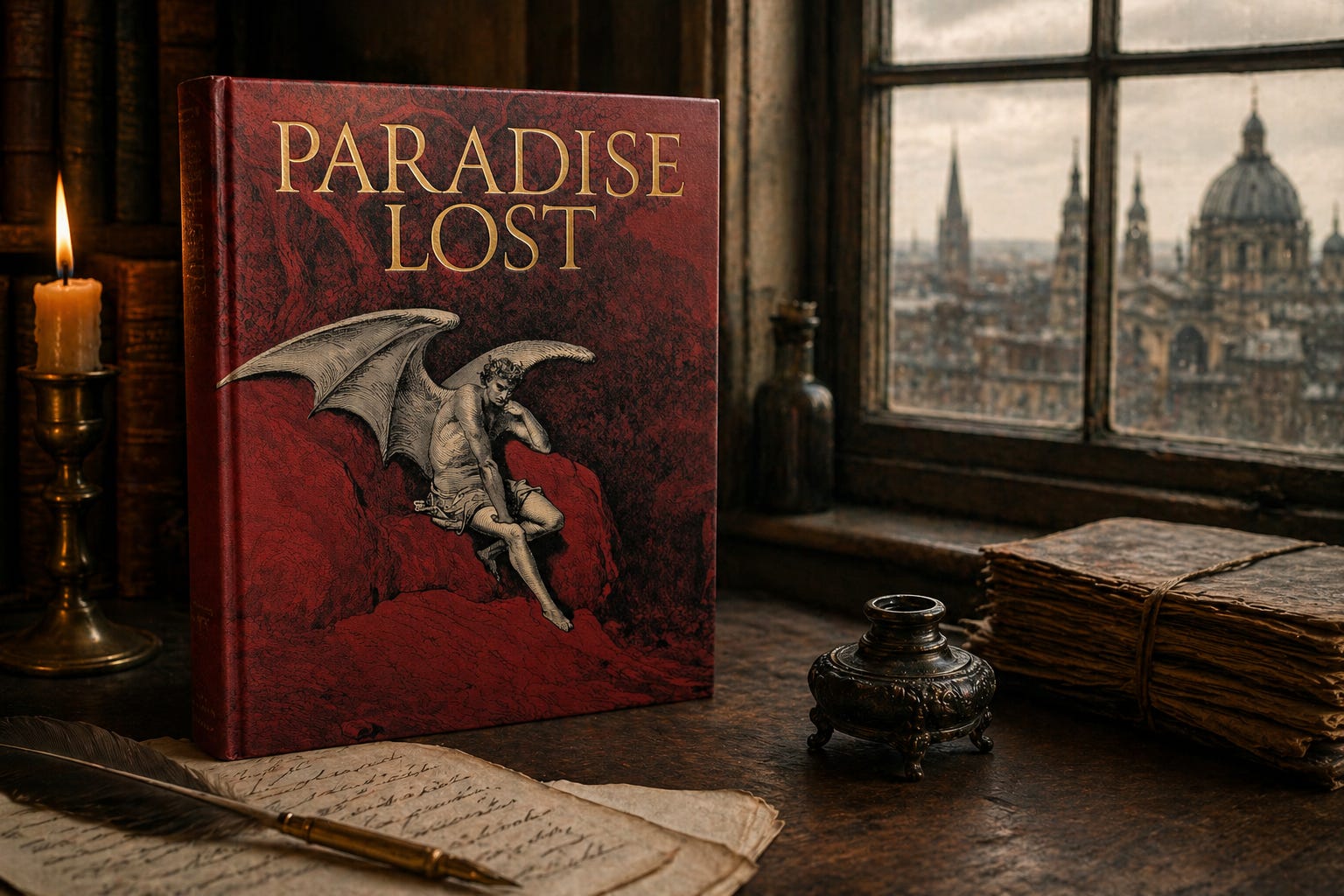
On this day in 1667, a modest entry in a London register set in motion a literary legacy that would echo for centuries. The agreement between John Milton and the publisher Samuel Simmons did not carry the thunder of revolution or the spectacle of court intrigue. It was a simple business arrangement, £5 paid upfront, with the promise of more to follow. Yet from that quiet transaction emerged Paradise Lost, a work that would come to define the ambition and reach of English poetry.
There is something fitting in the modesty of that beginning. Greatness rarely announces itself with certainty. It often slips into the world quietly, leaving others to catch up.
Milton’s Long Road to Creation
Milton’s journey to this moment was anything but straightforward. As a young man travelling through Italy, he sought out minds that challenged authority and stretched understanding. His meeting with Galileo Galilei left a lasting impression. Here was a man punished for truth, confined yet unbroken, still committed to ideas that unsettled power.
That encounter planted something deeper than admiration. It sharpened Milton’s belief that words could resist control, that thought itself could be an act of defiance.
Back in England, the country moved towards turmoil. Under Charles I, tensions between crown and Parliament reached breaking point. Milton did not stand aside. He wrote fiercely on matters of religion, liberty, and governance, his prose carrying the conviction of a man unwilling to bend to authority. When civil war came, he supported Parliament, though never without question.
His defence of free speech, expressed in his writings, remains one of the clearest statements of intellectual independence in the language. Yet it brought him no protection. Power shifts quickly, and when Charles II returned to the throne, Milton found himself on dangerous ground.
Imprisonment, Blindness, and Resolve
Milton’s imprisonment in the Tower of London might have silenced a lesser figure. Blind, politically exposed, and facing an uncertain fate, he stood at the edge of ruin. His earlier works were burned, his name associated with a failed republic.
Yet it was in this darkness that his greatest work took shape.
Unable to write, Milton composed in his mind. Line by line, he built an epic that drew on scripture, classical literature, and his own political experience. He dictated it to his daughters and trusted friends, shaping a narrative that went far beyond a simple retelling of biblical events.
In Paradise Lost, the fall of man becomes a stage for exploring authority, rebellion, and free will. Even Satan, the antagonist, is drawn with unsettling depth, persuasive, driven, and recognisably human in ambition. This complexity is no accident. Milton understood power, its allure, and its cost.
Publishing Against the Odds
When Milton presented his manuscript to Simmons in 1667, the risks were clear. England was still adjusting to the restored monarchy. Publishing the work of a known republican sympathiser carried real danger. Simmons had to weigh principle against survival, reputation against risk.
His decision to proceed speaks to a different kind of courage. It was not the boldness of public defiance, but the quieter resolve to recognise value where others might hesitate.
The initial print run was modest. Sales were steady rather than spectacular. There was no immediate recognition of genius, no rush to crown the work as a masterpiece. For years, Paradise Lost lived in the margins, appreciated by a few, overlooked by many.
Legacy Beyond Its Time
Milton did not live to see the full weight of his achievement. At his death, his reputation was far from secure. It was left to admirers like Andrew Marvell to speak of his brilliance, to insist that the work mattered.
History proved them right.
Over time, Paradise Lost rose from relative obscurity to stand among the greatest works in English literature. Its influence spread across poetry, politics, and philosophy. Writers drew from its language, thinkers engaged with its ideas, and readers returned to its themes of freedom and authority.
What makes the story compelling is not just the scale of the achievement, but the conditions under which it was created. Blindness did not limit Milton’s vision. Imprisonment did not silence his voice. Political defeat did not diminish his belief in the power of ideas.
Why April 27 Still Matters
The entry made on April 27, 1667 represents more than a publishing contract. It marks the point at which private thought became public legacy. Without that agreement, Milton’s work might have remained confined to memory, lost to time.
It is easy to focus on the finished masterpiece, to admire the poetry without considering the fragile path that brought it into being. Yet this moment reminds us that literature depends not only on writers, but on those willing to take a chance on them.
Simmons could not have known the full significance of what he was publishing. Few ever do. But his decision ensured that Milton’s voice would travel beyond the confines of his own troubled life.
Enduring Power of Milton’s Vision
Nearly four centuries later, Paradise Lost still speaks with force. Its questions remain unsettled. What does it mean to choose freely, and what is the cost of that freedom. Where does authority begin, and where should it end. These are not relics of the seventeenth century. They are concerns that shape every age.
Milton’s achievement lies not only in his command of language, but in his refusal to simplify. He presents a world where virtue and ambition collide, where certainty is elusive, and where the struggle for meaning continues.
That is why the events of April 27, 1667 still deserve attention. They remind us that even in uncertain times, when voices are suppressed and futures unclear, the act of creation can outlast circumstance.
And sometimes, the quietest agreements carry the loudest echoes.