

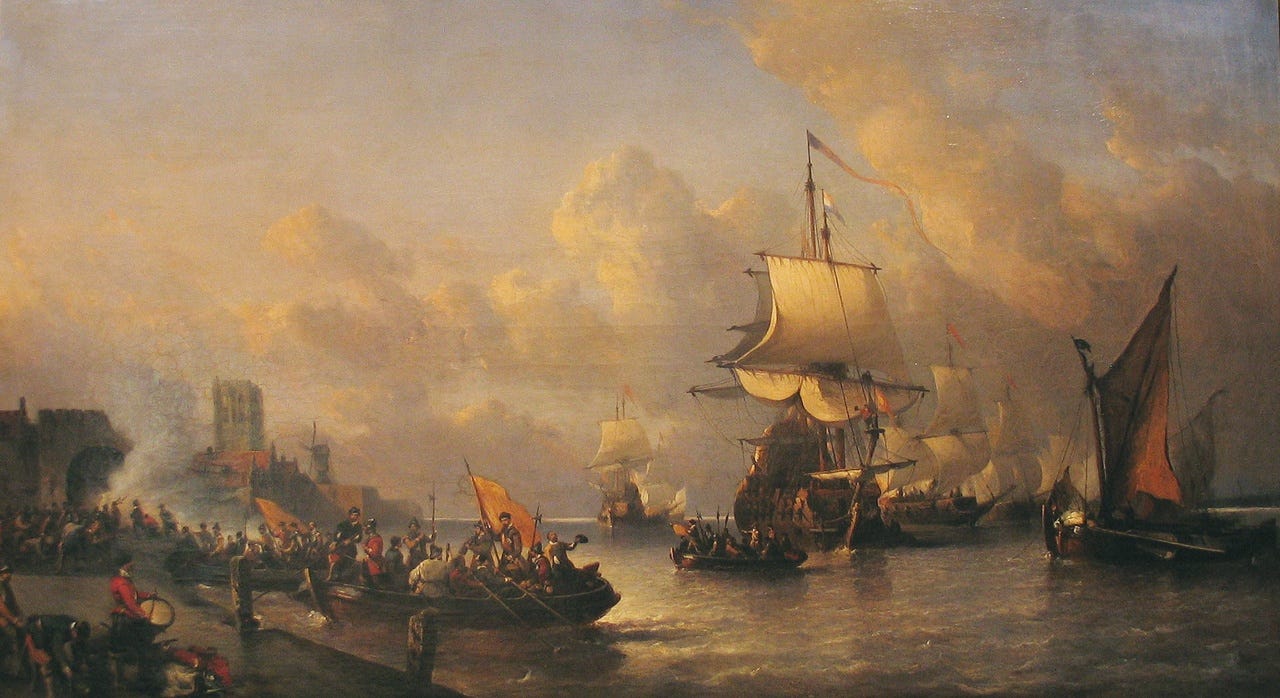
Late March 1572 offered no promise of triumph. It offered wind, cold, and the kind of chaos that strips a plan down to its bones. A battered fleet of Dutch privateers, driven off course by a violent North Sea storm, found itself clinging to survival rather than chasing glory. These men, hardened though they were, had not set out to seize a city. They were searching for refuge.
Yet history rarely waits for tidy intentions.
At the centre of this moment stood a figure often rendered in varying spellings, most commonly Willem van der Marck, sometimes referred to as Lumey. If this spelling requires checking, it is worth doing so, as the man himself deserves accuracy. He led the Sea Beggars, a loose but determined naval force aligned with the wider Dutch resistance. Their campaign until then had been one of harassment and survival, striking Spanish interests at sea rather than claiming territory.
The storm changed that calculation. Ships damaged, supplies strained, and options limited, the fleet drifted towards the Dutch coast near Brielle. What followed was not part of a grand design. It was something sharper, more instinctive. It was seizing a moment others had not yet recognised.
Spanish Rule and Rising Resistance
To understand the weight of that moment, one must step back.
The Netherlands in the mid 16th century sat under the authority of the Habsburg crown. When Charles V abdicated, control passed to his son, Philip II. Where the father had governed with a degree of flexibility, the son ruled with iron certainty. Religious uniformity was not a preference, it was policy.
This was an age shaped by the aftershocks of the Reformation. Protestant ideas had taken root across the Low Countries, but under Philip, tolerance gave way to persecution. Enforcement fell to men such as Fernando Álvarez de Toledo, whose campaigns against dissent were ruthless and systematic.
Opposition began to gather around figures like William of Orange, a nobleman who understood both the political machinery of empire and the mood of his people. Yet early resistance faltered. Armies were defeated, leaders scattered, and the Spanish grip appeared secure.
The rebellion needed more than courage. It needed a turning point.
Brielle Falls Almost by Accident
That turning point came not with a grand siege or a decisive battlefield victory, but with something far more precarious.
On April 1st, 1572, the Sea Beggars approached Brielle, a small but strategically valuable port. The Spanish garrison, crucially, had been drawn away to deal with unrest elsewhere. What remained was thin, uncertain, and unprepared.
When word reached van der Marck that the town was lightly defended, the decision was immediate. There would be no prolonged negotiation, no waiting for reinforcements. Delay would only invite danger.
The initial request for entry was ignored. That silence proved decisive.
The attack that followed was improvised but effective. One force moved towards an open gate where panicked civilians had begun to flee. Another forced entry by weakening and breaking through the town’s defences. Within hours, Brielle was in rebel hands.
The Spanish flag came down. The banner of William of Orange was raised.
There is a temptation to dress such events in inevitability. In truth, this was anything but certain. A delayed decision, a returning garrison, or a more resolute defence could have altered everything. Instead, fortune favoured boldness.
Floodwaters Secure a Fragile Victory
Capturing a town is one thing. Holding it is another.
Spanish forces, once aware of Brielle’s fall, moved quickly to retake it. Their response was predictable and, under normal circumstances, likely overwhelming. The Sea Beggars were not equipped for a prolonged defence against a professional army.
What followed again demonstrated the peculiar blend of local knowledge and opportunism that defined this episode.
A local figure, recorded as Rochus Meeuwis or similar, though the spelling should be checked, intervened in a manner both simple and devastating. He opened the dykes surrounding the low lying land near Brielle.
Water, long held at bay by careful Dutch engineering, surged outward. Fields became marsh. Ground turned to mire. Spanish artillery and movement were crippled before a shot could decide the matter.
By morning, the attackers found themselves stranded in mud and water, their advantage neutralised. The siege dissolved before it had truly begun.
This was not merely defence. It was adaptation. It was the land itself, shaped by human hands, becoming a weapon.
Why Brielle Changed Everything
The capture of Brielle did not end the conflict. The Dutch struggle for independence would stretch on for decades. Spain would not formally recognise Dutch independence until the mid 17th century.
Yet Brielle mattered in a way numbers alone cannot capture.
It was the first significant town secured by the rebels. More importantly, it proved that Spanish authority could be broken, not just challenged. News of the victory spread quickly, and with it came momentum.
Other towns followed. Uprisings gained confidence. What had been a resistance began to resemble a movement with tangible success.
Symbolism carries weight in conflict. Brielle offered proof.
Legacy of April 1st, 1572
There is something fitting in the date. April 1st often carries associations of misdirection and surprise. In 1572, it delivered both, though with consequences far beyond jest.
The fall of Brielle reminds us that history does not always pivot on grand strategy. Sometimes it turns on weather, on timing, on decisions made in uncertainty. It turns on individuals willing to act when the moment presents itself, even if that moment arrives uninvited.
For the Dutch Revolt, Brielle was not the end, nor even the beginning in a strict sense. It was the spark that proved the fire could take hold.
And it all began with a storm that refused to follow anyone’s plan.