

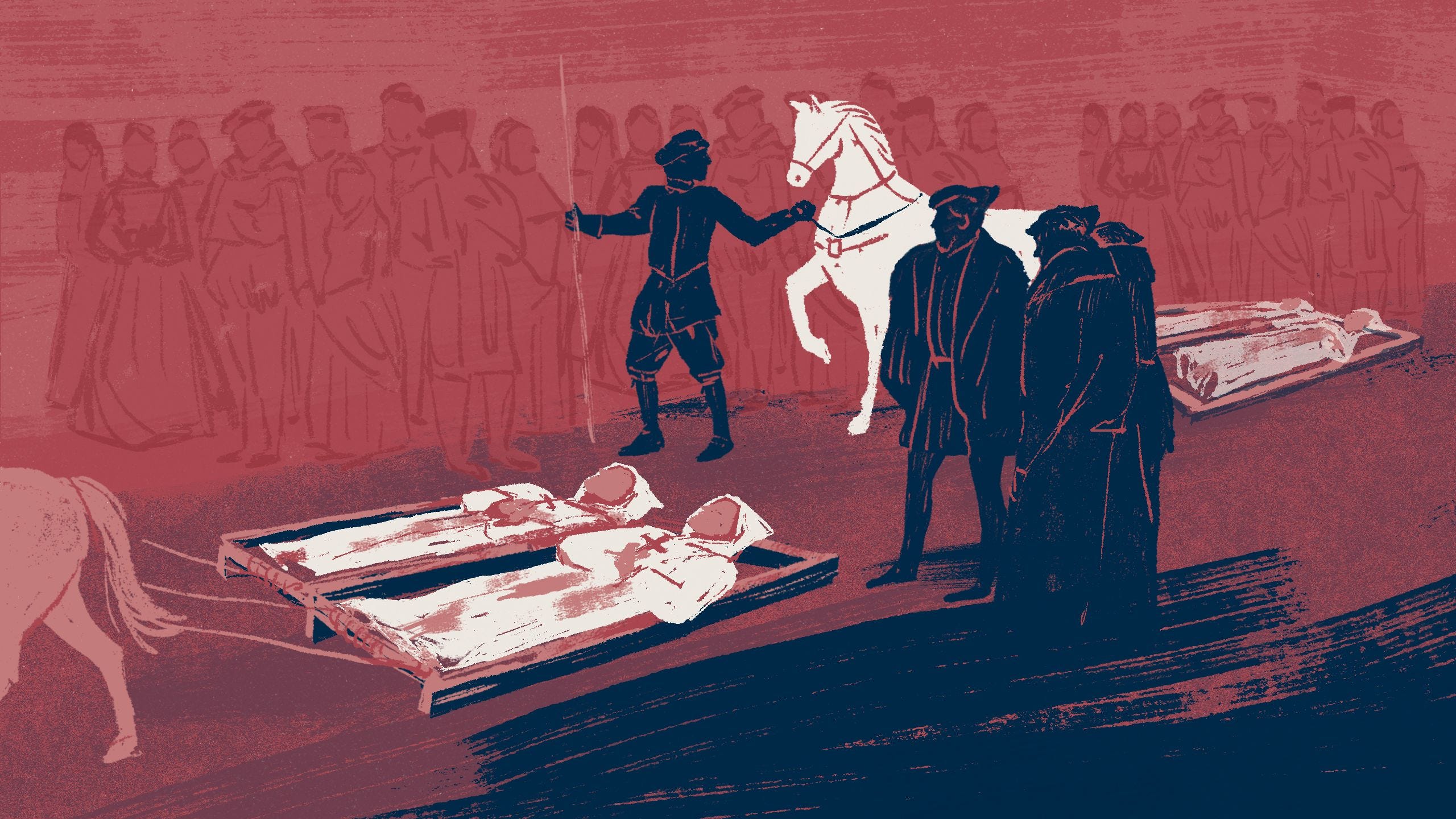
On This Day, 4 May 1535, five men were dragged through London towards Tyburn, where the machinery of Tudor power waited with rope, blade and block. Three were Carthusian priors, John Houghton of the London Charterhouse, Robert Lawrence of Beauvale and Augustine Webster of Axholme. With them went Richard Reynolds of Syon Abbey and the secular priest John Haile. Their crime was treason in the language of the court. In plainer English, they had refused to say that Henry VIII was supreme head of the Church in England.
That refusal has the ring of something small on paper. An oath. A formula. A few words spoken in the right room, before the right men, with the right amount of fear in the voice. Yet words mattered in Henry’s England because they drew the line between obedience and ruin. Houghton and his companions would not cross it.
Their deaths were not an accident of Tudor anger. They were a public message, delivered with theatrical savagery. The state did not merely kill them. It displayed them. Bodies were broken so that consciences might follow. The warning was meant for every monastery, every parish, every household where loyalty to Rome still breathed behind closed doors.
John Houghton and courage without spectacle
John Houghton is the figure who holds the eye. Prior of the London Charterhouse, he belonged to an order whose strength lay in quietness. The Carthusians were not noisy political operators. They were men of enclosure, discipline and prayer, heirs to a severe spiritual tradition that prized withdrawal from worldly appetite.
That is what makes their clash with Henry so stark. They did not seek the stage. The stage found them.
Houghton’s courage was not the bright, swaggering kind that history sometimes rewards too easily. It was slower, sterner and more costly. He had time to understand what refusal meant. He had watched the King’s will harden into law. He had seen Thomas Cromwell’s machinery gather speed. He knew that a Tudor command, once dressed as national necessity, could turn mercy into weakness and disagreement into treason.
Still he held his ground.
There is a temptation, from the safety of centuries, to make martyrs seem almost destined for their deaths, as if they moved towards Tyburn untouched by fear. That does them no service. The greater honour is to imagine the fear and then see the refusal standing beside it. Houghton was not made of marble. He was a man with a body that could be hurt, a mind that could picture the blade, and a voice that could have saved him with one oath.
He did not give it.
Henry VIII and power dressed as principle
Henry VIII’s break with Rome did not begin as a clean national awakening. It was tangled in dynastic anxiety, desire and pride. His marriage to Catherine of Aragon had failed to produce a surviving male heir. Anne Boleyn represented hope, urgency and appetite. The Pope would not grant the annulment Henry demanded, so the King remade the rules around himself.
By 1534, the Act of Supremacy declared Henry supreme head on earth of the Church of England. The oath that followed required subjects to accept the new order, including the legitimacy of Henry’s marriage to Anne. For many, compliance was prudence. For Houghton and the Carthusians, it was impossible.
My view is that this is where the Tudor story loses its romance. Henry is too often treated as a grand, storming force of history, all appetite, intelligence and royal theatre. There is truth in that, yet Tyburn shows the colder reality. His greatness, such as it was, depended on making smaller men suffer for refusing to flatter it.
A king secure in conscience does not need monks disembowelled in public. A government confident in truth does not require terror to prove it.
The Carthusians exposed the weakness beneath the crown. They had no army, no treasury, no faction capable of toppling Henry. Their threat lay in moral stubbornness. They reminded England that authority and truth were not the same thing. That was intolerable to a ruler who wanted the nation’s soul as well as its taxes.
Tyburn’s warning still speaks
The executions of 4 May 1535 opened a darker passage in English religious life. More Carthusians would suffer. Monasteries would be dissolved. Lands and wealth would pass into royal hands. The old religious landscape of England would be hacked apart, stone by stone and oath by oath.
The fate of Houghton, Lawrence, Webster, Reynolds and Haile also foreshadowed the deaths of others who could not accommodate themselves to Henry’s supremacy. They became part of a longer roll of Catholic men and women remembered among the Forty Martyrs of England and Wales, canonised in 1970 by Pope Paul VI.
Still, this story should not be flattened into a simple denominational grievance. Its meaning is larger than one confession. At its heart is a question every age must answer, what happens when the state demands not merely obedience, but inward surrender?
Henry wanted more than order. He wanted assent. He wanted the private chamber of conscience unlocked and inspected. That is why the Carthusians matter. They stood at the point where law overreaches and becomes an invasion of the soul.
Their resistance was not loud. It did not shake the walls of Westminster. It did something more enduring. It survived the men who tried to erase it.
On This Day in 1535, Tyburn was meant to prove that Henry VIII owned the final word. It proved almost the opposite. The King had the horses, the gallows, the executioner and the law. John Houghton had only his conscience. Nearly five centuries later, that is the part of the story still alive.