

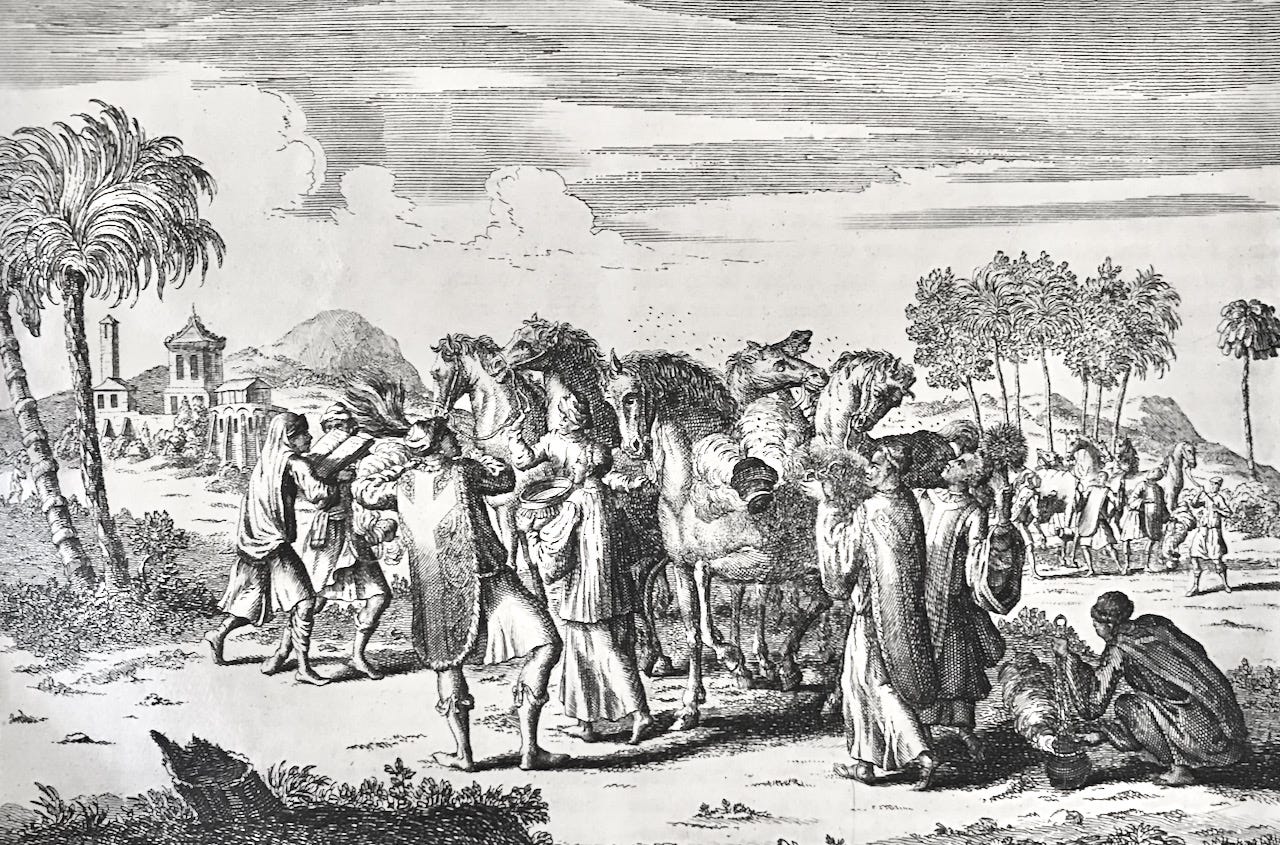
On 7 May 1253, William of Rubruck began a journey east that deserves to stand among the great acts of medieval courage. He was a Franciscan friar, probably Flemish by birth, travelling with the support of Louis IX of France towards the court of Möngke Khan, ruler of the Mongol Empire. His luggage was small. His certainty was immense. His road would carry him further than almost any European of his age could imagine.
That outline can make the enterprise sound orderly. It was anything of the sort. William went out from Constantinople into a world Europeans feared, misunderstood and decorated with every rumour panic could produce. He carried letters, prayer books, conviction and little else. His mission was to convert the Mongols to Christianity. His achievement was greater than his intention.
Mission beyond Constantinople
There is something magnificently stubborn about William of Rubruck. He left the glitter and quarrel of the Mediterranean world and moved towards the steppe, where distance itself became an adversary. After reaching Crimea, he continued with oxen and carts, then horses, through lands where hunger, cold and uncertainty were daily companions.
Europe in the mid thirteenth century had good reason to fear the Mongols. Their armies had broken kingdoms with a speed that made old certainties look ridiculous. The name of Genghis Khan still carried the force of thunder. His descendants had made empire on a scale that shrank the ambitions of western kings.
William approached that empire with a dangerous confidence. He believed Christian truth should need no ornament, and he spoke to power as though eternity mattered more than diplomacy. That gave him moral grandeur and political peril in the same breath. When he met Batu Khan, the formidable ruler of the western Mongol territories, his preaching was direct enough to offend. Batu did not convert. He sent him onwards.
That decision changed the value of the whole journey.
Mongol court seen without myth
William eventually reached the court of Möngke Khan, the Great Khan, late in 1253. Here the story becomes richer than a simple tale of missionary failure. He had travelled expecting a feared enemy waiting to be corrected. What he found was a political and cultural world of startling range.
The Mongol court was mobile, disciplined, alert and cosmopolitan. At Karakorum, William saw markets, temples, craftsmen, foreign residents and the machinery of imperial rule. He found Europeans there too, including skilled workers whose lives had carried them far beyond the map imagined at home.
Most striking of all was the religious atmosphere. Buddhists, Muslims, Christians, Daoists and followers of traditional Mongol beliefs could be found near the centre of power. Möngke listened, questioned and permitted debate. He appears to have understood something many rulers, then and since, have failed to grasp, that belief can be managed politically without being crushed into uniformity.
William did not admire that tolerance in the way a modern observer might. To him, neutrality in matters of salvation looked like blindness. He wanted decision, conversion, surrender to the truth as he understood it. Yet his frustration makes the scene more revealing. He was a man of fierce conviction watching an empire refuse to fit the categories he had brought with him.
Courage found in careful observation
This is why I find William of Rubruck so compelling. His mission failed on its own terms. He did not convert Sartaq, Batu or Möngke. He did not turn the Mongol Empire into a Christian ally for crusading Europe. He did not return with the great triumph his age might have understood most easily.
Still, he came back with something rarer. He observed.
That sounds modest until one remembers how uncommon it was. Medieval travellers were often tempted to season distant lands with monsters, marvels and moral convenience. William looked harder. He asked questions. He recorded customs, food, movement, housing, worship, geography and court procedure. He noticed similarities between languages. He described the Caspian Sea as an inland sea, helping to correct an old geographical mistake.
There is bravery in crossing a continent. There is another kind of bravery in allowing reality to disturb expectation. William had limits, deep ones. His religious certainty could make him severe. His view of other faiths was often combative. Yet he was too intelligent, and perhaps too honest, to come home with a simple fable.
His Itinerarium, written for Louis IX after William failed to meet him in person on his return, became one of the important European accounts of the Mongol world. Marco Polo would later become the household name, and fairly so, but William got there earlier and wrote with a plainness that still carries weight.
Legacy of a failed mission
The lesson of 7 May 1253 sits in the gap between intention and consequence. William of Rubruck was wrong about many things. He was also brave enough to look carefully at what stood in front of him.
William set out to convert. Instead, he documented. He hoped to prove the superiority of his faith to the most powerful ruler on earth. Instead, he revealed the scale and sophistication of a civilisation Europe had too often reduced to terror and rumour.
That matters because ignorance is rarely passive. It arms itself. It makes enemies easier to hate, peoples easier to dismiss and wars easier to bless. William, for all his certainty, punctured some of that ignorance. He showed that the Mongol Empire was violent and formidable, yet also organised, curious and intellectually alive. He did not soften its brutality. He complicated it. That is the historian’s first duty.
On This Day in 1253, a friar stepped eastward from the familiar world with a small party and a vast purpose. He failed to win the souls of the Khans. In failing, he gave Europe a clearer account of Asia than it was ready to expect.
That, to my mind, is the old story worth bringing into the modern era. William of Rubruck reminds us that conviction may begin a journey, but attention gives it lasting value.