

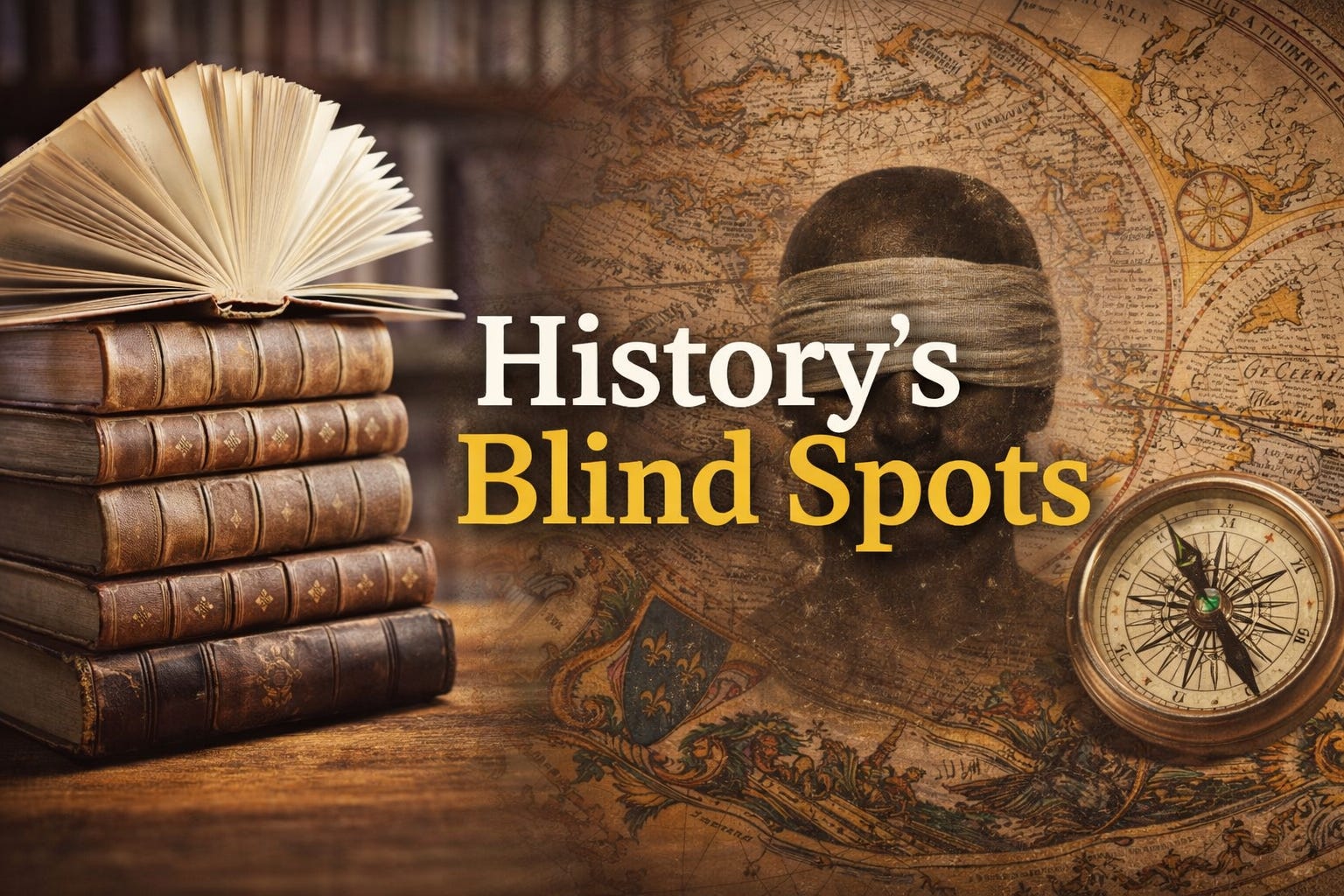
Introducing my new Blind Spots series
I have written more than a hundred history pieces so far, mostly unnoticed, quietly filed away on this Substack. I have never seen that as a problem. I write about history because I enjoy it, because it steadies me, and because in a world that feels increasingly anxious and confrontational, understanding the past matters more than ever.
We live in an age drunk on certainty. Politics has hardened into tribes, disagreement into hostility, and nuance into something faintly suspicious. Every position must be absolute, every argument framed as a battle to be won. The past, inevitably, has been dragged into this noise, simplified, weaponised and bent into shape to suit modern anxieties.
This new series, History’s Blind Spots, is born from a simple belief. History’s greatest danger is not ignorance, but confidence.
History’s blind spots are not just forgotten stories or neglected figures. They are the assumptions we repeat without question. They are the narratives that feel so familiar we stop examining them. They thrive wherever repetition replaces curiosity and explanation masquerades as understanding.
The people of the past did not live in neat story arcs. They acted without knowing outcomes. They argued fiercely, doubted constantly and improvised solutions to problems they barely understood. They were shaped by fear, belief, ambition and hope, not by the tidy logic we impose on them centuries later.
Yet we prefer our history orderly. We like eras reduced to slogans and individuals flattened into types. We turn rulers into personalities, centuries into moods and societies into morality tales. It makes the past easier to consume, but harder to understand.
One of the most persistent blind spots in popular history is the assumption that imagination belongs to myth, while truth belongs solely to fact. In reality, imagination has always been central to how humans make sense of their world. Long before systems and explanations existed, people told stories, tested ideas and explored uncertainty through belief. Curiosity, not certainty, has always driven discovery.

Not Knowing Was Not Failure
When we strip imagination from the past, we strip away its humanity. We forget that not knowing was not a failure, but a condition of living.
Another blind spot lies in scale. History loves kings, wars and turning points, but most lives unfolded far from palaces and battlefields. Communities were built on cooperation, routine and care. People lived, worked, loved and mourned in ways that rarely fit grand narratives. These quieter histories matter because they show how societies actually functioned, not how they are remembered.
Above all, history isn’t finished. It’s constantly rewritten, reinterpreted and reshaped by the present. What we choose to remember, celebrate or ignore tells us as much about ourselves as it does about the past. When left unexamined, nostalgia and myth become powerful tools, capable of narrowing rather than widening our understanding.
This new series will return to those blind spots. It will question familiar stories, revisit comfortable assumptions and linger where certainty feels least secure. Not to provide easy answers, but to encourage better questions.
In a world increasingly defined by absolutes, history remains one of the few places where uncertainty still has value.