


Ancient Rome is still sold as civilisation perfected. Roads straight as rulers. Laws etched in stone. Armies disciplined into immortality. Marble forums, aqueducts arcing across valleys, emperors carved into permanence. Rome appears solid, confident, engineered to last.
Yet this version of Rome is misleadingly clean. It privileges what survives over what sustained it. It celebrates command while forgetting compliance. It frames domination as destiny rather than process.
Strip away the stone and spectacle, and Rome looks less like a miracle of order and more like a fragile system held together by coerced labour, cultural intermediaries, and constant negotiation across language and power. Roman greatness rested not only on legions and law but on millions of people whose work and voices were absorbed, erased, or deliberately ignored.
This is not a footnote to Roman history. It is the foundation.
Empire held together by translation
Rome did not conquer a blank map. It absorbed peoples who spoke hundreds of languages and dialects, who worshipped different gods, lived under different customs, and understood authority in radically different ways. Governing such an empire required more than force. It required interpretation.
Interpreters were everywhere. In courts, tax offices, army camps, marketplaces, and provincial capitals. Orders had to be explained. Laws translated. Loyalty negotiated. Rome’s authority travelled through mouths and minds before it travelled through swords.
This dependence created an uncomfortable truth. Power relied on people who were not fully trusted. Interpreters occupied a dangerous space between ruler and ruled. They could soften commands or sharpen them. They could misunderstand deliberately. They could choose which words carried weight.
Rome knew this risk, yet had no alternative. Administration at scale is impossible without mediation. Even the most confident empire requires explanation.
Translation also shaped Roman identity. Local elites learned Latin to access power. Roman officials learned enough local language to function. Meaning shifted in the process. Roman law was not received as Rome intended but as provinces understood it.
The empire did not speak with one voice. It echoed through many.
Slavery as infrastructure
If translation allowed Rome to function, slavery allowed it to endure. Roman society did not merely include slavery, it was organised around it.
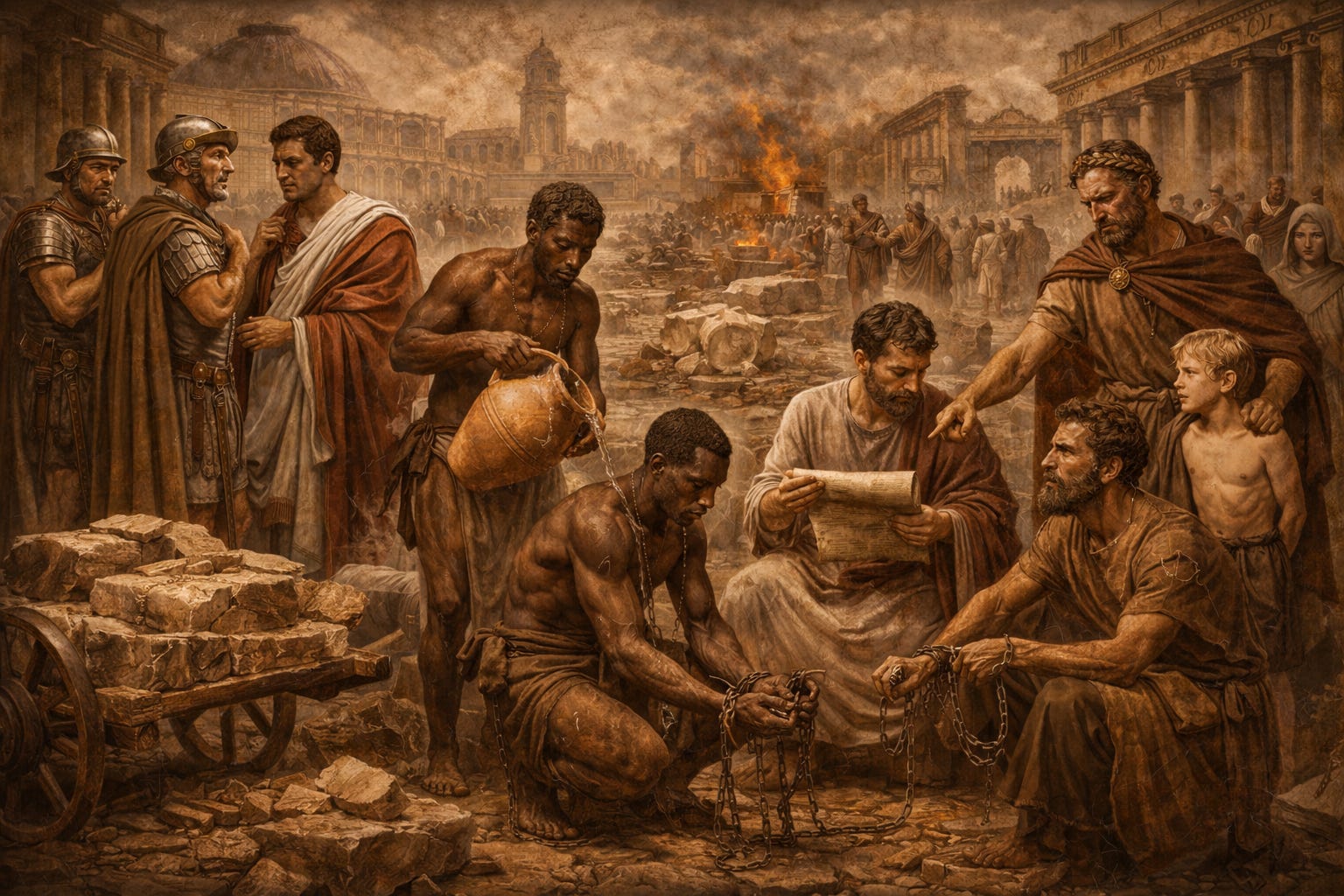
Slaves built roads, quarried stone, farmed estates, staffed households, taught children, kept accounts, copied texts, and maintained cities. They worked mines where death was routine. They served armies without recognition. They filled roles that required intelligence as well as endurance.
This was not marginal labour. It was structural. Rome’s economy assumed the presence of enslaved people in vast numbers. Without them, the empire would have slowed, fractured, or collapsed.
Roman writers understood this dependence, even as they justified it. Slaves were described as tools that could speak. That phrase reveals everything. Intelligence acknowledged, humanity denied.
Freedom in Rome was defined not as universal right but as privilege. Citizenship mattered precisely because most people lacked it. Liberty shone because bondage surrounded it.
Modern admiration for Roman efficiency often forgets the cost. Marble did not rise by itself. Grain did not move by miracle. Comfort for some required exhaustion for many.
Coercion beneath order
Roman law is often praised as a civilising achievement. It codified contracts, property, and procedure. It influenced legal systems centuries later. Yet law in Rome functioned less as protection and more as reinforcement of hierarchy.
Rights followed status. Citizens were shielded. Non citizens were exposed. Slaves existed outside legal personhood entirely. Punishment was exemplary rather than proportional. Violence was public by design.
Crucifixion was not simply execution. It was warning. Bodies were displayed to remind communities where power lay. Order was maintained not through consensus but through fear carefully deployed.
Rebellion was met with annihilation. Negotiation followed submission. Mercy, when granted, reinforced authority rather than undermined it.
Even within Rome, inequality was visible and accepted. The poor crowded insulae that burned easily and collapsed often. The elite retreated to villas that insulated them from consequence. Stability depended on distraction as much as discipline.
Bread and circuses were not indulgence. They were strategy.
Roman identity as performance
Rome presented itself as universal. Anyone could become Roman, in theory. Adopt the language. Accept the gods. Serve the state. Yet this openness concealed profound imbalance.
Roman identity was learned, not inherited, but learning required access. Access required proximity to power. Provincial elites were absorbed because they were useful. The majority were managed because they were necessary.
Cultural inclusion often meant cultural loss. Local traditions survived when harmless and vanished when inconvenient. Rome tolerated difference until difference threatened order.
This process required intermediaries. Local leaders who could speak Roman and local. Administrators who understood custom well enough to manipulate it. Collaboration became survival.
Rome’s flexibility is often praised. It should also be interrogated. Adaptation was a tool of dominance, not benevolence.
Emperors and erasure
The popular image of Rome centres on emperors and generals. Roman Empire becomes a parade of rulers, from Augustus to tyrants and reformers alike. Their personalities dominate narrative.
But empire does not run on character alone. It runs on systems. Emperors issued decrees that others implemented. Governors enforced policies that others explained. Soldiers marched because supply chains fed them.
By focusing on leaders, we erase labour. By celebrating architecture, we forget hands. By admiring endurance, we ignore exhaustion.
This distortion matters because it teaches the wrong lesson. It suggests that civilisation flows from vision rather than from work. That greatness is designed rather than extracted.
Rome lasted because millions were compelled to sustain it.
Why this blind spot persists
Rome flatters modern power. It offers precedent. Infrastructure. Authority. A story of order emerging from chaos. Western culture has long claimed Rome as ancestor, selectively inheriting its achievements while disowning its violence.
Education reinforces this selectivity. Latin texts survive because they were copied by elites. Slave voices rarely do. Translation favoured the powerful. Silence is mistaken for absence.
Popular culture continues the pattern. Rome appears as spectacle, not system. Gladiators distract from governance. Palaces distract from plantations.
This is not accidental. It is comfortable to admire civilisation without confronting coercion. It allows continuity without accountability.
Seeing Rome clearly
None of this diminishes Rome’s significance. It sharpens it. Rome was remarkable not because it was benevolent, but because it was effective. Effectiveness came at a price.
Understanding Rome as a civilisation built on invisible labour does not make it weaker. It makes it human. It reveals how power actually works, through dependence, mediation, and control.
Rome reminds us that empires are not sustained by marble ideals but by ordinary people doing extraordinary amounts of work under unequal conditions. It reminds us that communication is power, that translation shapes authority, and that silence is often imposed.
If history is to teach anything useful, it must look beyond monuments. It must ask who carried the stones, who spoke the words, and who paid the cost.
Rome still stands in imagination. Its blind spots deserve equal attention.